 2017, Vol. 49


金属氧化物半导体由于具有形貌容易控制、易合成和成本低等优点,已被广泛应用于制备各种气体传感器,如ZnO、TiO2、SnO2、In2O3、α-Fe2O3、WO3等.ZnO因其物理化学性质优异,基于纳米线、纳米棒、纳米管、纳米片等结构的气体传感器已被大量研究.ZnO纳米结构传感器具有高的灵敏度,但由于工作温度较高(在350 ℃左右),并不利于实际应用.目前,降低ZnO纳米结构传感器工作温度的研究已有报道,例如,采用Pt、Pd、Au、Ag等贵金属修饰或功能化[1-5].文献[1]报道了Pd敏化的ZnO纳米球气体传感器的最佳工作温度可从400 ℃下降到275 ℃,并且Pd的敏化也提高了器件的灵敏度.文献[2]报道了Au修饰ZnO纳米球和ZnO纳米球传感器的最佳工作温度分别为320 ℃和360 ℃,对体积分数为100 ×10-6的乙醇的灵敏度分别为252和75,明显降低了工作温度,提高了灵敏度.文献[3]报道了Au功能化的WO3纳米纤维传感器的工作温度由300 ℃降低至250 ℃,对n-丁醇的灵敏度也得到了提高.文献[4]报道了Ag纳米颗粒掺杂的ZnO粉末传感器,调节Ag纳米颗粒的掺入可使传感器工作温度从385 ℃降至308 ℃.文献[5]认为空气中Ag被氧化为Ag2O,在还原性气体中Ag2O被还原,释放电子,提高了传感器的传感响应.因此,利用贵金属修饰可有效改善金属氧化物半导体传感器的性能.本文通过光还原法在合成的ZnO多孔网络结构表面负载Ag纳米颗粒.Ag/ZnO多孔网络结构传感器气敏性质测试结果显示,Ag纳米颗粒的负载有效降低了ZnO多孔网络结构传感器的最佳工作温度,并提高了对乙醇的灵敏度.
1 实验部分将1 mmol Zn(CH3COOH)2 ·2H2O溶于100 mL去离子水中,搅拌10 min;添加0.1 mmol Na3C6H5O7 ·2H2O,继续搅拌5 min;最后添加1 mmol六次甲基四胺(HMT, C6H12N4),继续搅拌10 min,所得溶液作为生长液.将清洗过的带有Ag电极的Al2O3陶瓷片倾斜放入生长液中,85 ℃下生长2 h.用去离子水冲洗样品表面,60 ℃干燥3 h,在空气中400 ℃退火30 min.
将所得样品浸渍在0.01 mol/L的AgNO3溶液中30 min,取出样品,用去离子水冲洗,60 ℃下干燥,紫外光(300 W汞灯)照射15 min.
用X射线衍射分析仪(XRD,Philips X)分析样品晶体结构,用场发射扫描电子显微镜(FE-SEM,JEOL 6700F)和透射电子显微镜(TEM, JEM 2100)对样品形貌进行表征,用CGS-1TP智能气体分析系统(北京艾立特科技有限公司)测试其气敏特性.传感器的响应被定义为:S=Ra/Rg,其中Ra和Rg分别为样品在空气中和目标气体中的电阻.响应时间和恢复时间定义为在吸附和脱附过程中传感器电阻分别达到总电阻变化的90%所用的时间.
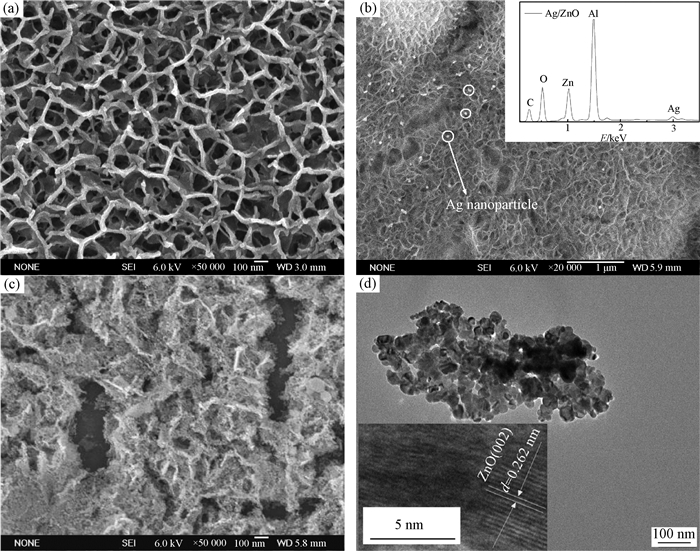
2 结果与讨论 2.1 形态和结构表征图 1(a) 为未退火ZnO纳米片网络结构的SEM,纳米片厚度为10~30 nm.图 1(b)为未退火Ag/ZnO纳米片网络结构的SEM,表面纳米颗粒的平均直径约为30 nm.图 1(b)中的插图为未退火样品电极之间区域的EDS,Al元素来源于衬底Al2O3,C元素来源于合成ZnO反应过程的中间产物,Ag元素来源于负载的Ag,证明了纳米颗粒为Ag纳米颗粒.图 1(c)为退火后负载Ag样品的SEM,退火后样品为纳米颗粒构成的多孔网络结构,无法分辨出Ag纳米颗粒.图 1(d)为退火后Ag/ZnO多孔网络结构的TEM,图 1(d)中的插图为退火后Ag/ZnO多孔网络结构的HRTEM,片状结构退火后已变为由颗粒构成的多孔结构.在HRTEM图像上可以清晰地观察到晶格条纹,晶格条纹间距为0.262 nm,对应六方纤锌矿结构ZnO的(002)面.
|
图 1 退火前ZnO (a)和Ag/ZnO (b)纳米片网络结构的SEM以及退火后Ag/ZnO多孔网络结构的SEM (c)和TEM (d) Figure 1 SEM of ZnO (a) and Ag/ZnO (b) nanosheets network structure before annealing, and SEM (c) and TEM (d) of Ag/ZnO porous network structure after annealing |
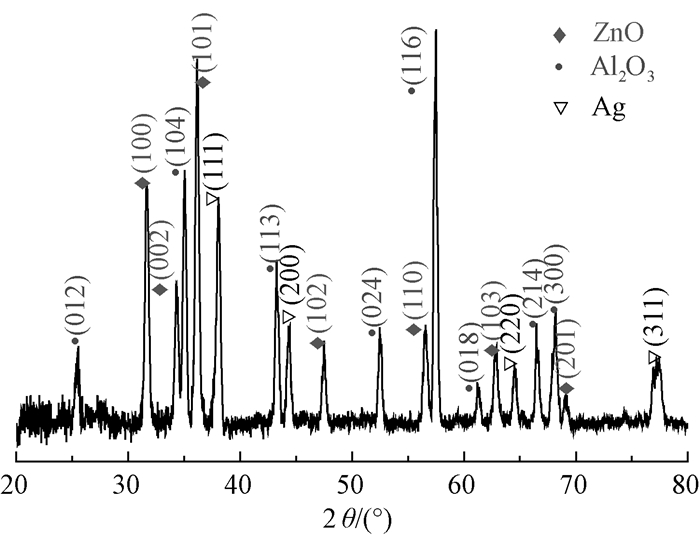
图 2为退火后Al2O3陶瓷片上合成的Ag/ZnO多孔网络结构的XRD谱.ZnO的衍射峰与标准卡(JCPDS card 36-1451)相匹配,显示ZnO为典型的六方纤锌矿结构.此外,有来自于陶瓷衬底的Al2O3衍射峰(JCPDS card 75-0785)以及来源于陶瓷片上的Ag电极和负载Ag纳米颗粒的Ag的衍射峰(JCPDS card 89-3722),无其他杂质峰被观察到.
|
图 2 Al2O3陶瓷片上合成的Ag/ZnO多孔网络结构的XRD谱 Figure 2 XRD pattern of as-synthesized Ag/ZnO porous network structure grown on Al2O3 substrate |
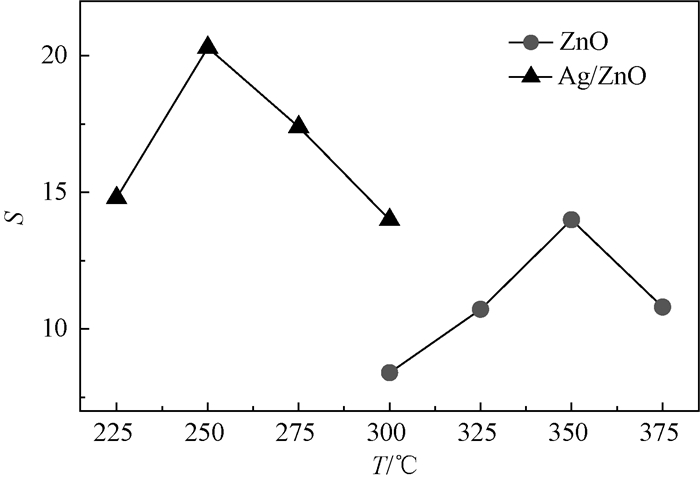
图 3显示不同温度下ZnO和Ag/ZnO多孔网络结构传感器对体积分数为50×10-6的乙醇的传感响应.ZnO和Ag/ZnO多孔网络结构传感器的灵敏度分别在350 ℃和250 ℃达到最大值,表明两个传感器的最佳工作温度分别为350 ℃和250 ℃,其机制与气体的吸附-脱附动力学和热动力学有关[6].实验结果显示,Ag负载降低了ZnO多孔网络结构传感器的工作温度.
|
图 3 不同温度下ZnO和Ag/ZnO多孔网络结构传感器对体积分数为50 ×10-6的乙醇的响应 Figure 3 The response of the ZnO and Ag/ZnO porous network structure sensors exposure to 50×10-6 ethanol at different operating temperatures |
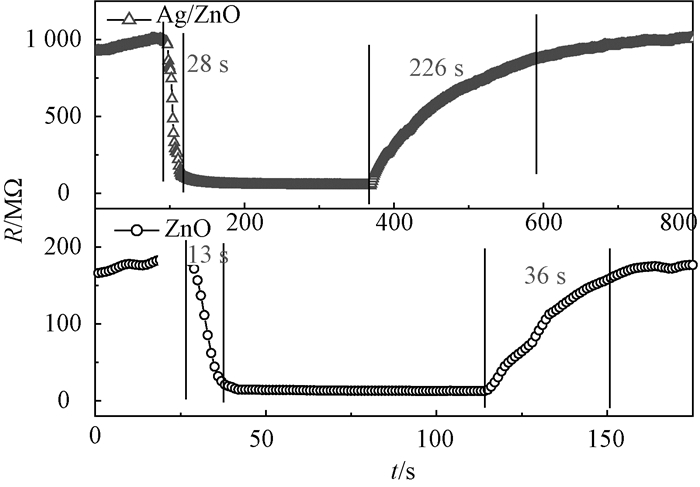
图 4显示在最佳工作温度下两个传感器对体积分数为50×10-6的乙醇的响应-恢复过程,可知ZnO传感器的响应-恢复时间为13 s和36 s,Ag/ZnO传感器的响应-恢复时间为28 s和226 s.由于工作温度与脱附速率成正比,Ag负载使ZnO多孔网络结构传感器最佳工作温度降低,导致气体脱附能力下降,从而使Ag/ZnO多孔网络结构传感器的恢复时间延长[2].
|
图 4 在最佳工作温度下ZnO和Ag/ZnO多孔网络结构传感器对体积分数为50×10-6的乙醇的响应-恢复过程 Figure 4 Response and recovery process of the bare ZnO and Ag/ZnO porous network structure sensors to 50×10-6 ethanol at optimal operating temperature |
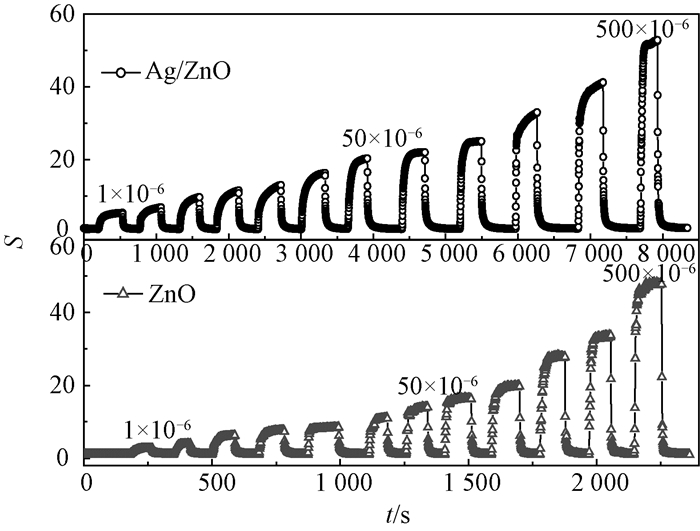
图 5显示ZnO和Ag/ZnO多孔网络结构传感器分别在350 ℃和250 ℃对不同体积分数乙醇的动态响应曲线,可知传感器响应随着乙醇体积分数的增加而增大.Ag/ZnO多孔网络结构传感器的响应值明显高于ZnO多孔网络结构传感器,例如,体积分数为50×10-6的乙醇,ZnO多孔网络结构传感器在350 ℃下的响应值为14.0,而Ag/ZnO多孔网络结构传感器在250 ℃下的响应值为20.3,表明Ag负载不仅降低了传感器的工作温度,而且提高了传感器的灵敏度.
|
图 5 ZnO和Ag/ZnO多孔网络结构传感器对不同体积分数乙醇的动态响应曲线 Figure 5 The instant response curves of the bare ZnO and Ag/ZnO porous network structure sensors to various ethanol volume fractions |
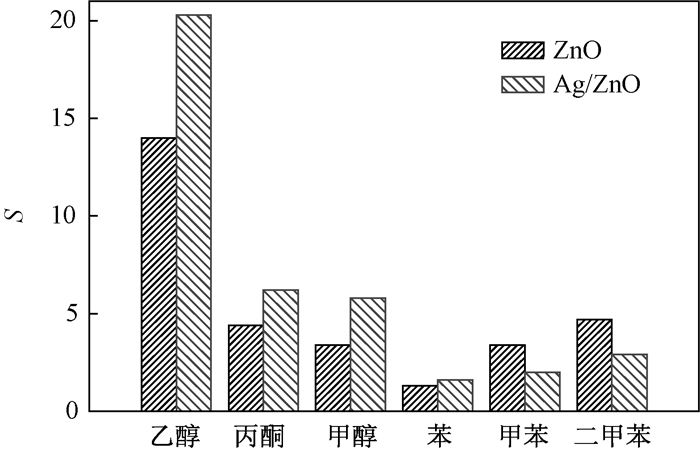
图 6显示在最佳工作温度下ZnO和Ag/ZnO多孔网络结构传感器对体积分数为50×10-6的乙醇、丙酮、甲醇、苯、甲苯、二甲苯的响应,显然对乙醇的响应最高,表明ZnO和Ag/ZnO多孔网络结构传感器对乙醇具有较好的选择性.
|
图 6 ZnO和Ag/ZnO多孔网络结构传感器对不同种类气体的传感响应 Figure 6 Responses of the bare ZnO and Ag/ZnO porous network structure sensor structures to various testing gases |
通常化学电阻式半导体传感器是建立在吸附气体与敏感材料之间化学和电子相互作用导致敏感材料电阻发生变化的基础上.当ZnO暴露在空气中时,O2分子将吸附在ZnO表面.温度不同,O2分子将通过从ZnO导带俘获电子转变成不同的氧负离子(如O2-、O-或O2-)[7],在ZnO的表面形成耗尽层,导致载流子浓度降低,在空气中ZnO电阻增加.当温度小于150 ℃时,O2-占主导地位;当温度在150 ~300 ℃时,O-占主导地位;当温度大于300 ℃时,O2-占主导地位.ZnO多孔网络结构传感器最佳工作温度为350 ℃,该温度下ZnO表面O2-占据主导地位.当ZnO暴露在乙醇气体中时将发生如下反应[8] (ads表示ZnO表面吸附):
| $ {{\rm{C}}_{\rm{2}}}{{\rm{H}}_{\rm{5}}}\rm{OH}\left( \rm{ads} \right)\to \rm{C}{{\rm{H}}_{\rm{3}}}\rm{CHO+}{{\rm{H}}_{\rm{2}}}, $ | (1) |
| $ \rm{C}{{\rm{H}}_{\rm{3}}}\rm{CHO}\left( \rm{ads} \right)\rm{+5}{{\rm{O}}^{\rm{2}-}}\to \rm{2C}{{\rm{O}}_{\rm{2}}}\rm{+2}{{\rm{H}}_{\rm{2}}}\rm{O+10}{{\rm{e}}^{-}}. $ | (2) |
乙醇在ZnO表面与O2-反应,释放的e-将回到ZnO导带,因此使传感器电阻降低,耗尽层宽度也将缩小,如图 7(a)所示.与其他气体相比较[9-10],有以下反应式:
| $ \rm{C}{{\rm{H}}_{\rm{3}}}\rm{COC}{{\rm{H}}_{\rm{3}}}\left( \rm{ads} \right)\rm{+2}{{\rm{O}}^{\rm{2}-}}\to \rm{C}{{\rm{H}}^{\rm{+}}}_{\rm{3}}\rm{+C}{{\rm{H}}_{\rm{3}}}{{\rm{O}}^{-}}\rm{+C}{{\rm{O}}_{\rm{2}}}\rm{+4}{{\rm{e}}^{-}}, $ | (3) |
| $ \rm{C}{{\rm{H}}_{\rm{3}}}\rm{OH}\left( \rm{ads} \right)\rm{+3}{{\rm{O}}^{\rm{2}-}}\to \rm{C}{{\rm{O}}_{\rm{2}}}\rm{+2}{{\rm{H}}_{\rm{2}}}\rm{O+6}{{\rm{e}}^{-}}, $ | (4) |
| $ {{\rm{C}}_{\rm{6}}}{{\rm{H}}_{\rm{6}}}\left( \rm{ads} \right)\rm{+2}{{\rm{O}}^{\rm{2}-}}\to {{\rm{C}}_{\rm{6}}}{{\rm{H}}_{\rm{5}}}{{\rm{O}}^{-}}\rm{+O}{{\rm{H}}^{-}}\rm{+2}{{\rm{e}}^{-}}, $ | (5) |
| $ {{\rm{C}}_{\rm{6}}}{{\rm{H}}_{\rm{5}}}\rm{C}{{\rm{H}}_{\rm{3}}}\left( \rm{ads} \right)\rm{+2}{{\rm{O}}^{\rm{2}-}}\to {{\rm{C}}_{\rm{6}}}{{\rm{H}}_{\rm{5}}}\rm{CHO+}{{\rm{H}}_{\rm{2}}}\rm{O+4}{{\rm{e}}^{-}}, $ | (6) |
| $ {{\rm{C}}_{\rm{6}}}{{\rm{H}}_{\rm{4}}}\rm{C}{{\rm{H}}_{\rm{3}}}\rm{C}{{\rm{H}}_{\rm{3}}}\left( \rm{ads} \right)\rm{+4}{{\rm{O}}^{\rm{2}-}}\to {{\rm{C}}_{\rm{6}}}{{\rm{H}}_{\rm{5}}}\rm{CHOCHO+2}{{\rm{H}}_{\rm{2}}}\rm{O+8}{{\rm{e}}^{-}}\rm{.} $ | (7) |

|
图 7 ZnO多孔网络结构传感器(a)和Ag/ZnO多孔网络结构传感器(b)的气体敏感机制示意图 Figure 7 Schematic illustrations for the gas-sensing mechanism of pure ZnO porous network sensor(a) and Ag/ZnO porous network sensor(b) |
由反应式(1)~(7)可知,一个乙醇分子与O2-反应将释放10e-回到ZnO导带,与其他气体相比,释放电子最多,因此传感器电阻变化最大,对乙醇具有高的选择性.
当Ag/ZnO暴露在空气中时,Ag纳米颗粒能提供更多的有效吸附位点,吸附更多的O2,使氧负离子增多,耗尽层宽度增加.同时Ag纳米颗粒与ZnO之间形成异质结构,使电子向Ag纳米颗粒转移,提高ZnO表面的耗尽层宽度,增加ZnO在空气中的电阻[11].当暴露在还原性气体中时,还原性气体与氧负离子反应释放电子,返回ZnO导带,耗尽层宽度减小,降低了ZnO电阻,如图 7(b)所示.有报道显示,Ag在空气中容易被氧化形成Ag2O,在还原性气体中Ag2O被还原成Ag释放电子,释放的电子返回至ZnO导带,进一步降低了ZnO电阻[5].而且Ag纳米颗粒具有催化作用,能够降低还原性气体与氧负离子之间反应的活性,使ZnO在较低的工作温度下具有较高的响应[12].
3 结论采用水溶液法合成了ZnO纳米片网络结构,400 ℃退火30 min,形成ZnO多孔网络结构.随后通过光还原法将Ag纳米颗粒负载在ZnO多孔网络结构中.气敏性能测试显示,Ag/ZnO多孔网络结构传感器显示出较好的乙醇选择性,工作温度和响应度都优于纯ZnO多孔网络结构,表明Ag负载不仅提高了ZnO多孔网络结构传感器的灵敏度,而且降低了传感器的工作温度.结果表明,Ag纳米颗粒的修饰能有效改善ZnO基传感器的性能.
| [1] |
SHINDE V R, GUJAR T P, LOKHANDE C D. Enhanced response of porous ZnO nanobeads towards LPG: effect of Pd sensitization[J]. Sensors and actuators B: chemical, 2007, 123(2): 701-706. DOI:10.1016/j.snb.2006.10.003 (  0) 0) |
| [2] |
ZHANG H, WU S, LIU J, et al. Laser irradiation-induced Au-ZnO nanospheres with enhanced sensitivity and stability for ethanol sensing[J]. Phys Chem Chem Phys, 2016, 18(32): 22503-22508. DOI:10.1039/C6CP03487J ( 0) |
| [3] |
YANG X, SALLES V, KANETI Y V, et al. Fabrication of highly sensitive gas sensor based on Au functionalized WO3 composite nanofibers by electrospinning[J]. Sensors and actuators B: chemical, 2015, 220(1): 1112-1119. ( 0) |
| [4] |
MOHAMMADREZAEI A, AFZALZADEH R, HOSSEINI-GOLGOO S M. Assessing three different ranges of amounts of silver nanoparticle dopants on the ethanol sensing properties of zinc oxide[J]. Measurement science and technology, 2012, 23(3): 035106. DOI:10.1088/0957-0233/23/3/035106 ( 0) |
| [5] |
DONG C, LIU X, HAN B, et al. Nonaqueous synthesis of Ag-functionalized In2O3/ZnO nanocomposites for highly sensitive formaldehyde sensor[J]. Sensors and actuators B: chemical, 2016, 224(1): 193-200. ( 0) |
| [6] |
WANG Z, XUE J, HAN D, et al. Controllable defect redistribution of ZnO nanopyramids with exposed {1011} facets for enhanced gas sensing performance[J]. ACS Appl Mater Interfaces, 2015, 7(1): 308-317. DOI:10.1021/am506206c ( 0) |
| [7] |
ALENEZI M R, ALSHAMMARI A S, JAYAWARDENA K D, et al. Role of the exposed polar facets in the performance of thermally and UV activated ZnO nanostructured gas sensors[J]. J Phys Chem C Nanomater Interfaces, 2013, 117(34): 17850-17858. DOI:10.1021/jp4061895 ( 0) |
| [8] |
QIN N, WANG X, XIANG Q, et al. A biomimetic nest-like ZnO: controllable synthesis and enhanced ethanol response[J]. Sensors and actuators B: chemical, 2014, 191(2): 770-778. ( 0) |
| [9] |
PENG C, GUO J, YANG W, et al. Synthesis of three-dimensional flower-like hierarchical ZnO nanostructure and its enhanced acetone gas sensing properties[J]. Journal of alloys and compounds, 2016, 654: 371-378. DOI:10.1016/j.jallcom.2015.09.120 ( 0) |
| [10] |
VAISHNAV V S, PATEL S G, PANCHAL J N. Development of indium tin oxide thin film toluene sensor[J]. Sensors and actuators B: chemical, 2015, 210(1): 165-172. ( 0) |
| [11] |
HWANG I S, CHOI J K, WOO H S, et al. Facile control of C2H5OH sensing characteristics by decorating discrete Ag nanoclusters on SnO2 nanowire networks[J]. ACS Appl Mater Interfaces, 2011, 3(8): 3140-3145. DOI:10.1021/am200647f ( 0) |
| [12] |
SUO C, GAO C, WU X, et al. Ag-decorated ZnO nanorods prepared by photochemical deposition and their high selectivity to ethanol using conducting oxide electrodes[J]. RSC Adv, 2015, 112(5): 92107-92113. ( 0) |