 2022, Vol. 52


2. 中国海洋大学海洋化学理论与工程技术教育部重点实验室,山东 青岛 266100
营养盐是浮游植物生命活动的物质基础,浮游植物按一定比例(Redfield比)摄取营养物质维持自身物质循环和能量代谢,营养盐水平会影响海域的浮游植物生物量及初级生产力水平;而营养盐结构会影响浮游植物的组成[1-3]。适宜的营养盐水平及结构能促进浮游植物的生长和繁殖,反之则会影响海洋生态系统结构,甚至引发富营养化、赤潮及水体缺氧等诸多生态环境问题,并影响食物网及渔业资源[4-6]。
莱州湾是渤海的三大海湾之一,其生态环境质量对环莱州湾社会经济可持续发展具有重要的支撑作用。莱州湾受人类活动影响显著,通过小清河、潍河、白浪河及黄河等十余条河流承接了山东省境内的济南、淄博、潍坊等14个地级市排放的氮、磷营养物质及其他污染物。自20世纪70年代末以来,随着环莱州地区社会经济的高速发展,莱州湾环境质量持续恶化,突出表现在水质污染严重[2],富营养化加剧,营养盐结构失衡,浮游生态系统物种多样性降低等方面[7],对环莱州湾地区的社会经济高质量发展形成刚性制约。自2000年代以来,围绕莱州湾环境质量改善,相关部门相继开始实施入海河流整治、海岸线控制等综合整治措施[8-12],特别是于2011年开始实行陆源氨氮(NH4-N)入海排放总量控制措施,按照国家行政区等比例减排考核指标,年均减排率约3%[13]。然而,据《2018年中国海洋生态环境质量状况公报》显示,近年来莱州湾水质呈现出恶化势头趋缓,固稳向好趋势却并不明显,溶解无机氮(DIN)超标严重,富营养化水平居高不下;这说明莱州湾生态环境问题依然严重且难以破解,其中重要原因是陆源营养物质的排放与海域响应关系不明[14]。
已有众多学者就莱州湾营养盐入海通量、时空分布及对海域生态环境的影响进行了较为深入研究[15-17]。调查监测数据显示,近40年来莱州湾陆源营养物质的入海排放通量发生显著变化,突出表现在总溶解态氮(TDN)入海排放通量逐年增加而总溶解态磷(TDP)入海排放通量则呈现由1980—1995年间增大然后自1995年后逐步减小的迹象[2];与此同时,莱州湾海域营养盐浓度和结构也发生显著变化,突出表现在DIN浓度持续增大而活性磷酸盐(PO4-P)浓度有所降低[2, 18-19],DIN/PO4-P比例由1980年代的23∶1左右持续增大到2010年代中期的110∶1左右[2],远超Redfield比值,结果可能对莱州湾浮游植物生物量和优势种产生显著影响。由于陆源入海通量和近海输运-迁移-转化过程都处在动态变化,只有采用陆海同步调查的精细化数据,才有可能全面系统剖析陆源营养物质输运与近海营养物质浓度的关系。然而,由于陆海调查监测时间不同步和调查监测站位布设不衔接等原因,结果导致陆源营养物质入海通量监测数据与近海营养盐时空分布的海上调查数据之间缺乏匹配性,难以进行量化分析。
本文通过2018—2021年度不同季节在莱州湾开展的陆海时间同步空间对接的调查,查明莱州湾陆源主要入海河流及直排海口的营养盐入海通量和海域营养盐的分布和组成的季节变化特征,解析莱州湾浮游植物生长的营养盐限制性因素,为莱州湾富营养化的陆海统筹调控管理提供直接调查监测依据。
1 材料和方法 1.1 莱州湾海域及其高联陆域简况莱州湾是典型的半封闭海湾,面积约7 000 km2,约占渤海海域总面积的10%,水深较浅,大部分海域水深小于15 m。莱州湾湾内水动力较弱,湾内常年存在一个逆时针环流,水交换时间长,湾底平均交换时间为40 d以上[20]。入湾河流包括黄河、小清河、潍河等20余条,在山东境内集水面积约为46 056 km2,涵盖山东境内的菏泽、聊城、济宁、德州、泰安、济南、淄博、潍坊、滨州、东营、烟台、青岛、日照13个地级市。
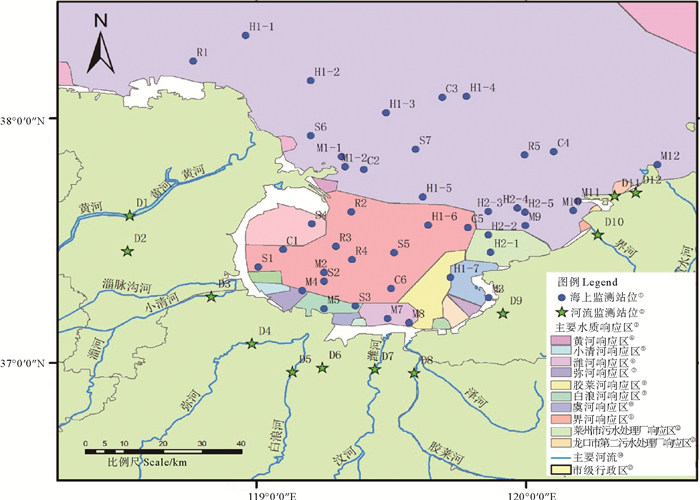
1.2 调查站位和时间通过陆海时间同步、空间对接调查,获得环莱州湾河流营养盐入海通量和海域营养盐分布的高质量数据。在调查站位布设方面,入海河口及直排海口与海上水质响应区在空间上有机对接[21]。其中,陆上监测站位布设于黄河、广利河、小清河、弥河、白浪河、虞河、潍河、胶莱河、界河、泳汶河这10条河流入海口及两个直排海口(莱州湾污水处理厂和龙口市第二污水处理厂排放口),这些河流和直排海口的径流量和污染物入海通量之和达到了莱州湾陆源排放总量的95%以上。在莱州湾海域共布设48个站位,不仅覆盖整个莱州湾海域,而且考虑到海上水质响应区生态环境要素变化梯度大,从而进行加密设置。其中R站位位于水质响应区边界点,M站位位于混合区边界点,H站位位于污染热点区域边界,S为加密站位(见图 1)。另外,在调查时间方面,陆源河流及直排海口的调查与海上调查的时间准同步。在调查要素方面,河流及直排海口营养盐浓度与流量同步,海上水文、化学和生物生态要素同步。
|
( ①Offshore monitoring stations; ②River monitoring stations; ③Main hydrologic response units; ④Yellow River hydrologic response unit; ⑤Xiaoqing River hydrologic response unit; ⑥Wei River hydrologic response unit; ⑦Mi River hydrologic response unit; ⑧Jiaolai River hydrologic response unit; ⑨Bailang River hydrologic response unit; ⑩Yu River hydrologic response unit; ⑪ Jie River hydrologic response unit; ⑫ Laizhou waste water treatment facility hydrologic response unit; ⑬ Longkou waste water treatment facility hydrologic response unit; ⑭ Main river; ⑮ Municipal administrative.R站位位于水质响应区边界点,M站位位于混合区边界点,H站位位于污染热点区域边界,S为加密站位。Station R were located at the boundary point of the water quality response areas, station M were located at the boundary point of the mixing areas, station H were located at the boundary of the pollution hot spot areas, and station S were encrypted stations. ) 图 1 2018—2021年度莱州湾陆海同步调查站位分布图 Fig. 1 Survey and distribution map of Laizhou Bay in 2018—2021 |
陆海同步调查分别于2018年10月24—25日、2019年5月10—12日、2019年8月18—21日和2021年3月22—27日开展。其中2019年8月份采样时间为强降雨后7天,受台风“利奇马”影响,自2019年8月11日开始,环莱州湾地区普降大到暴雨,平均降雨量达158 mm,济南、潍坊、滨州等莱州湾的集水区出现极端强降雨天气,最大降雨量达到346 mm,破山东过程降雨量历史记录[22]。
1.3 样品采集与前处理方法按照《海洋调查规范》(GB/T 12763.3—2007)采集水样,水样经过孔径为0.45 μm醋酸纤维滤膜过滤后,装入经酸洗的聚乙烯瓶中,-20 ℃下保存,用于营养盐测定。玻璃滤器在使用前先经过盐酸浸泡24 h,然后用超纯水清洗3~6次。按照《地表水和污水监测技术规范标准(HJ-T92002)》采集环莱州湾河流和直排海口的样品,并同步监测流量,水样盛于2 L高密度聚乙烯塑料桶中4 ℃下冷藏保存,6 h内运回实验室中进行过滤和分析。
1.4 样品测定和分析河流和排污口流量采用直读转子流速仪(ZSX-5,中国)测量。海水温度和盐度用多参数仪(Manta 3.0, Eureka,美国)测定。营养盐通过营养盐自动分析仪(QuAAtro Applications,德国)测定;NO2-N、NO3-N、NH4-N、PO4-P、SiO3-Si检测限分别为0.01、0.02、0.03、0.01、0.14 μmol·L-1;DIN为NO3-N、NO2-N和NH4-N之和。叶绿素a(Chl a)通过丙酮萃取后应用荧光法(F-4500型荧光分光光度计,日立)测定[23],检测限为0.01 μg·L-1。
1.5 数据处理应用公式(1)计算各项营养盐的入海通量:
| $ F_{\mathrm{j}}=C_{\mathrm{j}} \cdot Q_{\mathrm{j}} \cdot M \cdot 10^{-9} \cdot 24 \cdot 31 \cdot 3600。$ | (1) |
其中:Fj是在本文中指调查营养盐的入海月通量,单位为t·month-1(吨·月-1);Cj是营养盐的浓度, 单位μmol·L-1;Qj是河流月径流量或直排海口污水月流量,单位为m3·s-1;M为元素的相对原子质量。
应用SPSS 25.0进行数据相关性分析、主成分分析;相关性分析采用Pearson相关系数(two-tailed, α=0.05)判别,P < 0.05时说明变量之间显著相关;统计变量之间的差异性检验使用Mann-Whitney U-test(two-tailed, α=0.05),P < 0.05说明变量之间存在显著性差异。
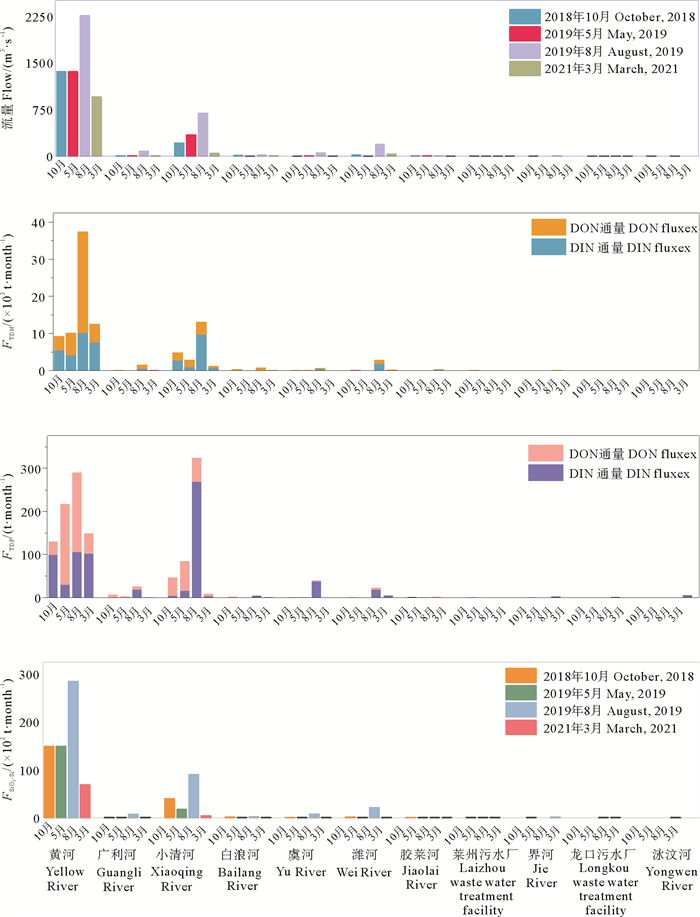
2 结果与分析 2.1 2018—2021年莱州湾营养盐入海通量及比值莱州湾各入海河流和直排海口流量如图 2所示,夏季流量高于其它三个季节,其中,黄河和小清河三个季节径流量远高于莱州湾其他入海河流,春季、夏季、秋季和冬季两者径流量合计占比达环莱州湾河流径流量的99%、90%、97%和96%。
|
图 2 2018—2021年度莱州湾入海河流及直排海口流量、TDN、TDP和SiO3-Si通量 Fig. 2 River flow TDN, TDP and SiO3-Si fluxes of rivers and outlets in Laizhou Bay from 2018 to 2021 |
2018—2021年春季、夏季、秋季和冬季莱州湾入海河流及直排海口TDN的入海通量分别为1.3×10⁴、5.7×10⁴、1.5×10⁴和1.4×10⁴ t·month-1,其中DIN的平均占比分别为46%、23%、37%和56%;TDP的入海通量分别3.1×10²、7.2×10²、1.9×10²和1.6×10² t·month-1,其中PO4-P的平均占比分别为81%、21%、30%和44%;SiO3-Si的入海通量则分别为1.7×10⁴、4.1×10⁴、1.9×10⁴和0.7×10⁴ t·month-1;春、夏、秋和冬季TDN/TDP通量比分别为111、212、199和197,均值为180,TDN/SiO3-Si通量比则分别3、12、5和28,均值为12。季节分布上,TDP和SiO3-Si入海通量受径流量影响在夏季最高,冬季最低,TDN通量在夏季最高,但在冬季与春季相差不大。这表明,莱州湾营养盐入海通量受径流量的控制更为明显。各河流及排污口其分担率有显著差异,基本按黄河、小清河、潍河、虞河、广利河、白浪河、胶莱河、泳汶河、界河的次序降低。
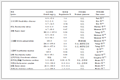
2.2 莱州湾水文分布特征受陆源淡水输入影响,莱州湾盐度分布基本与海岸平行,呈现由湾顶向湾口增大的特征,其中夏季由于河流径流量增大使得莱州湾内盐度最低,为28.14;春季最高,为29.68。莱州湾水温以8月份最高,为25.64 ℃;3月最低,为5.93 ℃。秋季、春季、夏季和冬季水体表层盐度均值较底层分别低2.56、1.29、3.48和1.56,温度分别相差-0.68、2.44、0.69、1.32 ℃,春季和夏季会存在一定程度的层化现象(见表 1)。
|
表 1 2018—2021年度莱州湾四个季节水文和营养盐各项要素 Table 1 Elements of hydrology and nutrients for the four seasons in Laizhou Bay during 2018—2021 |
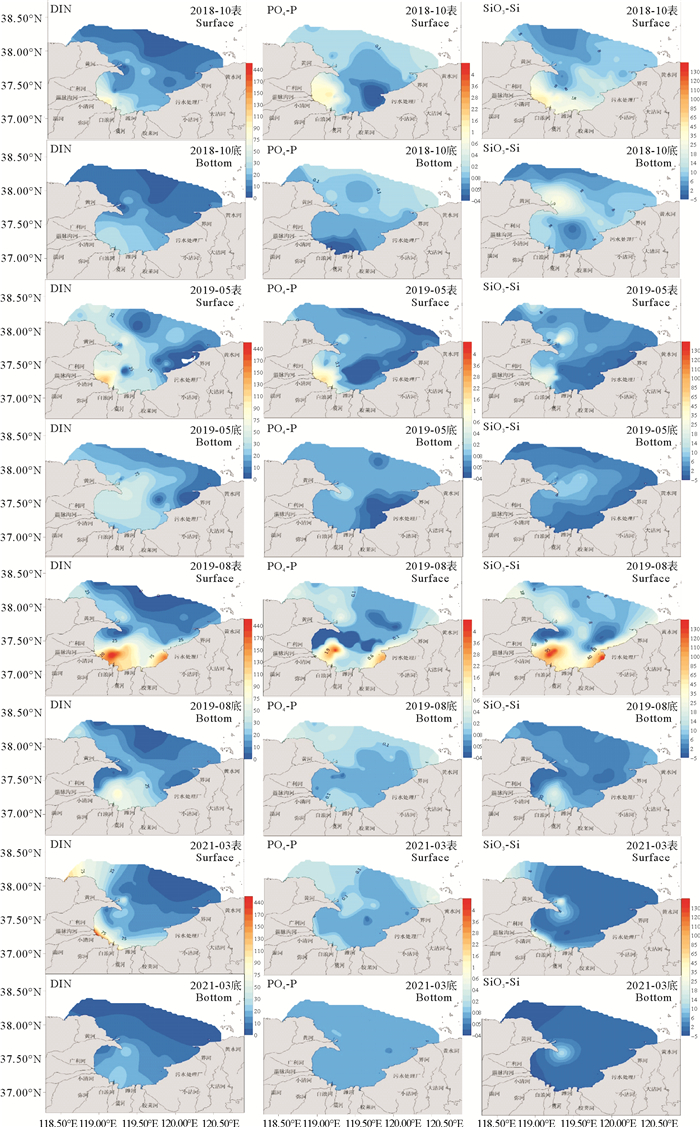
2018—2021年春、夏、秋和冬季莱州湾水体DIN分布基本上呈现由湾顶向湾中央和湾口逐步降低的变化趋势,在小清河和黄河等河口区出现明显高值区(见图 3)。其中,春季和夏季DIN浓度均值相近,分别为(33.73±20.07)和(34.00±42.39) μmol·L-1,均高于国家Ⅲ类但满足Ⅳ类海水水质标准,秋季和冬季较低,为(20.76±53.28)和(16.65±14.70) μmol·L-1,均高于国家Ⅰ类但满足Ⅱ类海水水质标准。NO3-N为DIN主要的赋存形态,春季、夏季、秋季和冬季平均占比分别为(69±17)%、(86±7)%、(59±16)%和(67±12)%(见表2)。
|
图 3 2018—2021年不同季节莱州湾营养盐浓度分布图 Fig. 3 Distribution of nutrient concentration in the Laizhou Bay during 2018—2021 |
莱州湾海域不同季节PO4-P浓度变幅较大,春、夏、秋和冬季分别为0.02~1.81、0.02~4.95、0.01~1.66和0.01~0.51 μmol·L-1,均值分别为(0.13±0.31)、(0.28±0.75)、(0.15±0.28)和(0.07±0.08) μmol·L-1;季节上,夏季最高,秋季和春季次之,冬季最低,均满足国家Ⅰ类海水水质标准(见表2);春、夏、秋和冬季PO4-P浓度低于浮游植物生长的绝对阈值(0.1 μmol·L-1)的海域面积占比分别为85.1%、49.5%、40.7%和58.7%,均值为58.5%。
莱州湾水体SiO3-Si浓度基本呈现湾顶河口区高、湾口低的分布特征。受黄河及湾顶部入海河流的影响[24],河口区出现高值。莱州湾SiO3-Si的浓度均值具有明显的季节差异,呈现出夏季(20.21±30.29) μmol·L-1最高,秋季(12.14±10) μmol·L-1其次,春季(6.75±7.29) μmol·L-1再次,冬季(3.46±12.30) μmol·L-1最低的变化特征。
2.4 莱州湾营养盐结构DIN/PO4-P比值具有较大空间差异,基本呈现近岸河口海域逐渐向湾口降低的趋势(见图 4)。莱州湾整个海域DIN/PO4-P比值均值呈现春季(744.74)最高,夏季(404.64)其次,冬季(330.06)再次,秋季(235.11)最低的变化趋势,均远高于Redfield比。不同季节莱州湾DIN/SiO3-Si均值差异明显,其中,冬季最高,达到13.08,春季其次,为7.41;夏季再次,为4.39;秋季最小,为1.60。

|
图 4 2018—2021年不同季节莱州湾DIN/PO4-P、DIN/SiO3-Si分布图 Fig. 4 Distribution of DIN/PO4-P and DIN/SiO3-Si in Laizhou Bay in different seasons during 2018—2021 |
莱州湾表层和底层Chl a整体呈现由湾顶向湾口逐步降低的变化趋势,表层Chl a浓度高于底层(见图 5)。Chl a的浓度均值具有明显的季节差异,呈现出夏季(5.70±5.37) μg·L-1最高,冬季(5.56±5.19) μg·L-1其次,秋季(4.08±3.54) μg·L-1再次,春季(1.35±0.87) μg·L-1最低的变化特征(见表2)。其中,夏季湾南部和东南部及湾中央部分海域Chl a含量高于10 μg·L-1,高于赤潮发生标准,其面积约占海域总面积的60%。

|
图 5 2018—2021年不同季节莱州湾海域Chl a分布图 Fig. 5 The seasonal distribution of Chl a in Laizhou Bay during 2018—2021 |
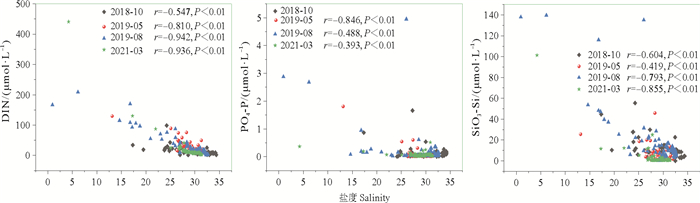
莱州湾河流各季节的TDN、TDP和SiO3-Si通量呈现出一致的规律,即黄河及莱州湾西南岸的小清河的TDN、TDP和SiO3-Si营养盐通量占比均高达85%以上,这直接影响了莱州湾海域DIN、PO4-P和SiO3-Si分布规律,使得浓度高值区集中在黄河口及小清河河口附近海域(见图 3),与之前的研究一致[25-28]。值得注意的是夏季小清河TDP通量高于黄河的TDP通量(见图 2),这是由于2019年8月11日“利奇马”台风登陆后,济南潍坊等地出现极端强降雨天气,导致河流径流量显著升高,吸附于泥沙颗粒表面的颗粒磷, 经过雨水冲刷作用使得河流中总磷含量增加,并能够向溶解态磷的形式转变[29],后经河流输运进入莱州湾内,导致莱州湾西南岸小清河口附近PO4-P出现高值区(见图 3)。夏季莱州湾海域内营养盐的高值区与盐度低值区基本吻合,这是由于监测时间在台风“利奇马”所带来的强降雨后1周,河流径流短时期内显著增大,不仅使得莱州湾表层水体盐度降低,而且径流携带大量陆源营养物质输送到莱州湾内,导致海域营养盐浓度升高[30]。此外,小清河流域除农业耕地外,城市和工业建设用地占比也较高(11.4%)[31],河流中TDN和TDP含量较高,同样也使得莱州湾西南部近岸海域DIN和PO4-P浓度较高。黄河SiO3-Si通量在各个季节中占比均为最高,黄河上游岩石类型以硅酸盐为主,下游岩石类型主要为黏土类硅酸盐[32],所以在黄河口附近海域存在一个SiO3-Si含量的高值区。莱州湾DIN、PO4-P和SiO3-Si浓度与盐度大都呈显著负相关关系(见图 6),表明陆源输入是该海域营养盐分布的决定性因素之一[33-34]。各入海河流输入的营养盐比例不同是导致湾内DIN/PO4-P、DIN/SiO3-Si时空异质性明显的直接原因。莱州湾入海河流TDN/TDP和TDN/SiO3-Si通量的比例均值分别180和12,大大偏离Redfield比值,其中白浪河TDN/TDP通量比均值最高,为307.94;其次为莱州污水处理厂,为277.28,这与对应的莱州湾海域的DIN/PO4-P高值分布区基本一致(见图 4),胶莱河TDN/SiO3-Si通量比均值最高,为35.08;其次为广利河,为35.11,也与莱州湾海域的DIN/SiO3-Si的高值分布区基本对应(见图 4),陆源输入营养盐的不均衡导致了莱州湾营养盐结构呈现“氮高、硅少、磷寡”的特征。
|
图 6 不同季节莱州湾DIN、PO4-P和SiO3-Si与盐度相关性分析图 Fig. 6 Correlation analysis of DIN, PO4-P and SiO3-Si with salinity in Laizhou Bay in different seasons |
水动力条件也是影响莱州湾营养盐空间分布格局的重要因素之一。莱州湾东部海域刁龙嘴以西存在一个逆时针环流区[35];秋季Chl a、DIN,夏季DIN、PO4-P和SiO3-Si,春季DIN浓度较高,与逆时针环流区域相吻合,营养盐在此区域停留时间较长,净迁移距离短,难以扩散[35];此外该区域围填海活动加剧使得底部水体交换不畅,进一步降低了莱州湾的流速及水体交换速率,导致营养盐在此积累[36-38]。夏季黄河入海径流增大,科氏力加强,在莱州湾湾底形成窄的浮力沿岸流,部分余流进入莱州湾内,从黄河口开始沿着海岸顺时针向东岸运移后再出海湾,加之其他河流和排污口输入量的增大,河口余流导致河口海域底部营养盐浓度显著高于其他海域[39]。
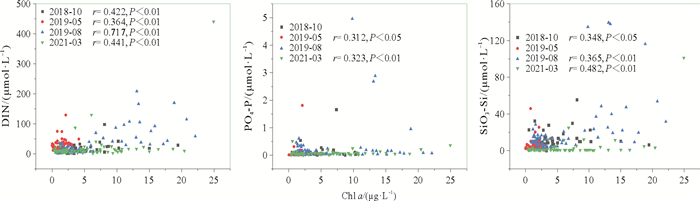
莱州湾各季节DIN与Chl a呈显著正相关,PO4-P浓度在春季和冬季也与Chl a呈正相关关系,SiO3-Si除春季外其他三个季节也与Chl a呈现正相关关系(见图 7),夏季表层DIN和SiO3-Si在湾西南部和南部近岸海域的高值区与夏季表层Chl a高值区吻合(见图 3,5),表明除陆源输入这一主要因素外,当外界达到适宜的条件(温度、光照等),浮游植物初级生产也会对海域营养盐时空分布具有调控作用[40]。
|
图 7 不同季节莱州湾DIN、PO4-P和SiO3-Si及Chl a相关性分析图 Fig. 7 Correlation analysis of DIN, PO4-P and SiO3-Si with Chl a in Laizhou Bay in different seasons |
对于浮游植物受营养盐限制评价方法,一是根据Justic'等[41]提出的评估营养盐结构的化学计量标准:若SiO3-Si/PO4-P>22同时DIN/PO4-P>22则P为限制因素;若DIN/PO4-P < 10同时SiO3-Si/DIN>1则DIN为限制因素;若SiO3-Si/PO4-P < 10和SiO3-Si/DIN < 1则硅为限制。二是通过浮游植物生长的营养盐浓度阈值来评估[42],SiO3-Si、PO4-P和DIN的阈值分别为2、0.1和1 μmol·L-1[43-46],当某种营养盐低于此阈值则为限制因子。
莱州湾PO4-P浓度低于其阈值的海域分布于湾中央和湾东南部,四个季节其面积占比均高达40%以上,并且DIN/PO4-P和SiO3-Si/PO4-P比值则远高于22(见表2),这表明磷为莱州湾浮游植物生长的限制因子,这与姜会超等[36]研究结果一致。与胶州湾[47]、大亚湾[48]、钦州湾和廉州湾[49]等海域相比,莱州湾磷限制更为严重。春季莱州湾内磷限制最显著,这是由于该季节陆源磷的入海通量显著低于夏季和秋季,且浮游植物生长旺盛,即按照16∶1的比例吸收DIN和PO4-P,也会加剧磷受限的程度[33, 50];秋季垂直混合加强,营养盐通过海底沉积物(间隙水)向上覆水释放,表层营养盐得到补充[51],缓解了莱州湾磷限制的状况;夏季强降雨期间,莱州湾营养物质入海通量显著增大,浮游植物生长的磷限制状况有所改善,适宜的光照、温度及营养条件使得该季节浮游植物快速繁殖增长甚至暴发赤潮。
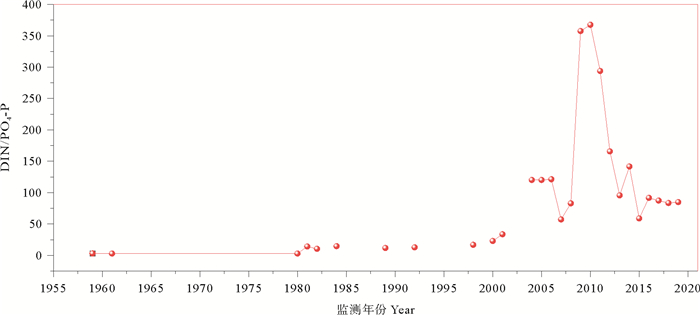
自改革开放以来随着沿海经济高速发展和人口快速增加,人们生产生活所产生的氮、磷等营养物质数量显著增大,这些营养物质最终入海结果导致近海富营养化程度加剧。1990—2000年代中期,由于氮肥使用量居高不下且削减总量有限,而生产生活中禁止含磷物资的使用大大减少了磷的排放,特别由于黄河经常性断流,导致泥沙携带的磷大大减少,结果导致2000年后莱州湾入海河流的氮磷通量比值不断增大[2, 54],莱州湾的营养状况从20世纪90年代前的氮限制变为21世纪初的磷限制,2010年达到最高值367.57(见图 8);随着2011年国家开始实施以NH4-N为约束性指标的陆源污染物总量减排计划,环莱州湾地区氮减排效果显著,莱州湾入海河流的氮磷通量比值开始明显下降[19](见图 8)。黄河筑坝工程对各项营养盐的截留作用有显著差异,滞留效率硅>磷>氮[55-56]。研究表明,近40年来,黄河氮输送通量除1990年代后期黄河断流外,呈现不断升高的趋势,而总磷入海通量先下降然后进入2000年代中期后缓慢增长,这加剧了莱州湾氮多磷寡的营养盐失衡状况。
|
图 8 莱州湾1959—2019年DIN/PO4-P变化图[52-53] Fig. 8 Variation of DIN/PO4-P in Laizhou Bay from 1959 to 2019[52-53] |
营养盐结构的不对称变化会导致浮游植物群落发生演替,低水平的PO4-P有利于非硅藻的生长[57-58],渤海近50年间氮磷比不断升高,导致浮游植物群落结构由硅藻为主逐渐演变为硅藻和甲藻共同控制[59]。Xin等[2]指出渤海1990年代以前浮游植物主要以硅藻为主,Chl a含量相对较低,浮游动物种群丰富,底栖动物生物量较高,赤潮罕见;而1990s后硅藻优势度降低;进入21世纪后,Chl a含量增加且浮游植物中非硅藻比例增加,浮游动物数量减少,大型底栖动物小型化加剧,赤潮灾害频发,赤潮致灾种呈多样化和微型化变化趋势;这些变化进而改变了鱼类群落的结构和多样性,导致渔业资源下降。
4 结论(1) 2018—2021年各季节莱州湾入海河流及直排海口的营养盐入海通量和营养盐浓度时空分布具有良好的响应关系。入莱州湾TDN、TDP、SiO3-Si排放通量,整体呈现夏季>秋季>春季>冬季的变化特征,海域DIN、PO4-P、SiO3-Si浓度均值也基本呈现夏季>秋季>春季>冬季的变化特征。从空间分布看,不仅DIN、PO4-P、SiO3-Si浓度高值区与盐度低值区基本吻合,而且营养盐分布呈现湾西南部近岸海域高于东部海域的特征,这与湾西部和西南部的黄河、小清河入海的营养物质排放通量显著高于湾东部和东南部入海通量直接关联。除陆源输入外,海域水动力和浮游物植物生长对营养盐分布的调控作用也不容忽视。
(2) 莱州湾陆源氮磷营养盐入海通量比例对海域营养盐结构具有决定性影响。莱州湾各季节陆源TDN/TDP入海通量比值均值高达180;相应的,莱州湾海域各季节DIN/PO4-P比值均值高达428,都远高于Redfield比值,表明莱州湾营养盐结构严重失衡;各季节PO4-P浓度低于浮游植物生长阈值的海域面积占比均值高达58.5%,海域浮游植物生长磷限制严重,可能导致莱州湾浮游植物优势种由硅藻为主逐渐演变为硅甲藻共同占优的趋势, 对莱州湾生态环境的影响不容忽视。
| [1] |
Tang Q, Jin X, Wang J, et al. Decadal-scale variations of ecosystem productivity and control mechanisms in the Bohai Sea[J]. Fisheries Oceanography, 2010(12): 4-5. (  0) 0) |
| [2] |
Xin M, Wang B D, Xie L P, et al. Long-term changes in nutrient regimes and their ecological effects in the Bohai Sea, China[J]. Marine Pollution Bulletin, 2019, 146: 562-573. DOI:10.1016/j.marpolbul.2019.07.011 ( 0) |
| [3] |
Ning X, Lin C, Su J, et al. Long-term environmental changes and the responses of the ecosystems in the Bohai Sea during 1960—1996[J]. Deep-Sea Research Part Ⅱ, 2010, 57(11-12): 1079-1091. DOI:10.1016/j.dsr2.2010.02.010 ( 0) |
| [4] |
Zhu W, Wan L, Zhao L F. Effect of nutrient level on phytoplankton community structure in different water bodies[J]. Journal of Environmental Sciences, 2010(1): 32-39. ( 0) |
| [5] |
Tilman D, Kilham S S, Kilham P, et al. Phytoplankton community ecology: The role of limiting nutrients[J]. Annual Review of Ecology and Systematics, 1982(1): 49-72. ( 0) |
| [6] |
Pan H Z, Li A F, Cui Z G, et al. A comparative study of phytoplankton community structure and biomass determined by HPLC-CHEMTAX and microscopic methods during summer and autumn in the central Bohai Sea, China[J]. Marine Pollution Bulletin, 2020, 155: 111172. DOI:10.1016/j.marpolbul.2020.111172 ( 0) |
| [7] |
李延峰, 宋秀贤, 吴在兴, 等. 人类活动对海洋生态系统影响的空间量化评价——以莱州湾海域为例[J]. 海洋与湖沼, 2015, 46(1): 133-139. Li Y F, Song X X, Wu Z X, et al. Spatial quantitative evaluation of the impact of human activities on marine ecosystem: A case study of Laizhou Bay[J]. Oceanologia et Limnologia Sinica, 2015, 46(1): 133-139. ( 0) |
| [8] |
苏莹. 山东省入海污染物分配容量计算——精准化近海三维水质数值模拟数学规划法[D]. 青岛: 中国海洋大学, 2014. Su Y. Calculation of Pollutant Allocation Capacity into the Sea in Shandong Province--Mathematical Programming Method for Accurate Three-Dimensional Numerical Simulation of Offshore Water Quality[D]. Qingdao: Ocean University of China, 2014. ( 0) |
| [9] |
陈力群. 莱州湾海洋环境评价与污染总量控制方法研究[D]. 青岛: 中国海洋大学, 2004. Chen L Q. Marine Environmental Assessment and Total Pollution Control in Laizhou Bay[D]. Qingdao: Ocean University of China, 2004. ( 0) |
| [10] |
李岩, 李克强, 王修林, 等. 近海污染物总量控制水质监测体系构建方法——以莱州湾为例[J]. 中国海洋大学学报(自然科学版), 2015, 45(11): 69-74. Li Y, Li K Q, Wang X L, et al. Construction method of water quality monitoring system for total amount control of coastal pollutants: A case study of Laizhou Bay[J]. Periodical of Ocean University of China, 2015, 45(11): 69-74. ( 0) |
| [11] |
麻德明, 石洪华, 丰爱平. 基于流域单元的海湾农业非点源污染负荷估算——以莱州湾为例[J]. 生态学报, 2014, 34(1): 173-181. Ma D M, Shi H H, Feng A P. Estimation of agricultural non-point source pollution load in Bay based on watershed unit: A case study of Laizhou Bay[J]. Acta Ecologica Sinica, 2014, 34(1): 173-181. ( 0) |
| [12] |
张雪. 近三十年莱州湾主要污染物时空变化及小清河口水质评价指标体系建立[D]. 青岛: 中国海洋大学, 2014. Zhang X. Spatiotemporal Variation of Main Pollutants in Laizhou Bay and Establishment of Water Quality Evaluation Index System of Xiaoqing Estuary in Recent 30 Years[D]. Qingdao: Ocean University of China, 2014. ( 0) |
| [13] |
Su Y, Wang X L, Li K Q, et al. Estimation methods and monitoring network issues in the quantitative estimation of land-based COD and TN loads entering the sea: A case study in Qingdao City, China[J]. Environmental Science and Pollution Research, 2014, 21(17): 10067-10082. DOI:10.1007/s11356-014-3047-9 ( 0) |
| [14] |
Huang J, Li Q, Huang L, et al. Watershed-scale evaluation for land-based nonpoint source nutrients management in the Bohai Sea Bay, China[J]. Ocean & Coastal Management, 2013, 71(1): 314-325. ( 0) |
| [15] |
陈淑珠, 顾郁翘, 刘敏光, 等. 黄河口及其邻近海域营养盐分布特征[J]. 中国海洋大学学报(自然科学版), 1991(1): 34-42. Chen S Z, Gu Y Q, Liu M G, et al. Distribution characteristics of nutrients in the Yellow River Estuary and its adjacent waters[J]. Periodical of Ocean University of China, 1991(1): 34-42. ( 0) |
| [16] |
谢琳萍, 孙霞, 王保栋, 等. 渤黄海营养盐结构及其潜在限制作用的时空分布[J]. 海洋科学, 2012(9): 45-53. Xie L P, Sun X, Wang B D, et al. Temporal and spatial distribution of nutrient structure and its potential limiting effect in the Bohai Sea and Yellow Sea[J]. Marine Sciences, 2012(9): 45-53. ( 0) |
| [17] |
Jiang T, Skyllberg U, Bjorn E, et al. Characteristics of dissolved organic matter (DOM) and relationship with dissolved mercury in Xiaoqing River-Laizhou Bay estuary, Bohai Sea, China[J]. Environmental Pollution, 2017, 223: 19-30. DOI:10.1016/j.envpol.2016.12.006 ( 0) |
| [18] |
张锦峰, 高学鲁, 李培苗, 等. 莱州湾西南部海域及其毗邻河流水体营养盐的分布特征及长期变化趋势[J]. 海洋通报, 2015, 34(2): 222-222. Zhang J F, Gao X L, Li P M, et al. Distribution characteristics and long-term variation trend of nutrients in the southwest of Laizhou Bay and its adjacent rivers[J]. Marine Science Bulletin, 2015, 34(2): 222-222. ( 0) |
| [19] |
刘义豪, 杨秀兰, 靳洋, 等. 莱州湾海域营养盐现状及年际变化规律[J]. 渔业科学进展, 2011(4): 1-5. Liu Y H, Yang X L, Jin Y, et al. Status and interannual variation of nutrients in Laizhou Bay[J]. Progress in Fishery Sciences, 2011(4): 1-5. DOI:10.3969/j.issn.1000-7075.2011.04.001 ( 0) |
| [20] |
虞兰兰, 陈艳丽, 张海宁, 等. 基于非线性规划的莱州湾营养盐环境容量计算[J]. 海洋科学进展, 2016, 34(2): 304-312. Yu L L, Chen Y L, Zhang H N, et al. Calculation of nutrient environmental capacity in Laizhou Bay based on nonlinear programming[J]. Progress in Fishery Sciences, 2016, 34(2): 304-312. DOI:10.3969/j.issn.1671-6647.2016.02.015 ( 0) |
| [21] |
Duan K, Li K Q, Liang S K, et al. Optimizing a coastal monitoring network using a water-quality response grid(WRG)--based sampling design for improved reliability and efficiency[J]. Marine Pollution Bulletin, 2019, 145: 480-489. DOI:10.1016/j.marpolbul.2019.06.046 ( 0) |
| [22] |
耿晔, 杜天君, 谢建辉, 等. 基于自动监测的台风"利奇马"降雨对城市地表水水质影响分析[J]. 环境科技, 2021, 34(1): 65-70. Geng Y, Du T J, Xie J H, et al. Analysis of the impact of Typhoon "lichima" rainfall on urban surface water quality based on automatic monitoring[J]. Environmental Science and Technology, 2021, 34(1): 65-70. ( 0) |
| [23] |
Yentsch C S, Menzel D W. A method for the determination of phytoplankton chlorophyll and phaeophytin by fluorescence[J]. Deep Sea Research and Oceanographic Abstracts, 1963, 10(3): 221-231. DOI:10.1016/0011-7471(63)90358-9 ( 0) |
| [24] |
祝雅轩, 裴绍峰, 张海波, 等. 莱州湾营养盐和富营养化特征与研究进展[J]. 海洋地质前沿, 2019, 35(4): 1-9. Zhu Y X, Pei S F, Zhang H B, et al. Characteristics and research progress of nutrients and eutrophication in Laizhou Bay[J]. Marine Geology Frontiers, 2019, 35(4): 1-9. ( 0) |
| [25] |
万修全, 吴德星, 鲍献文, 等. 2000年夏季莱州湾主要观测要素的分布特征[J]. 中国海洋大学学报(自然科学版), 2004, 34(1): 7-12. Wan X Q, Wu D X, Bao X W, et al. Distribution characteristics of main observational elements in Laizhou Bay in summer of 2000[J]. Periodical of Ocean University of China, 2004, 34(1): 7-12. ( 0) |
| [26] |
李广楼, 崔毅, 陈碧鹃, 等. 秋季莱州湾及附近水域营养现状与评价[J]. 海洋环境科学, 2007, 26(1): 45-48, 57. Li G L, Cui Y, Chen B L, et al. Nutritional status and evaluation of Laizhou Bay and its adjacent waters in autumn[J]. Marine Environmental Science, 2007, 26(1): 45-48, 57. DOI:10.3969/j.issn.1007-6336.2007.01.011 ( 0) |
| [27] |
夏斌, 张晓理, 崔毅, 等. 夏季莱州湾及附近水域理化环境及营养现状评价[J]. 渔业科学进展, 2009, 30(3): 103-111. Xia B, Zhang X L, Cui Y, et al. Evaluation of physicochemical environment and nutrition status of Laizhou Bay and its adjacent waters in summer[J]. Progress in Fishery Sciences, 2009, 30(3): 103-111. DOI:10.3969/j.issn.1000-7075.2009.03.018 ( 0) |
| [28] |
郭富, 王保栋, 辛明, 等. 2015年春、夏季莱州湾营养盐分布特征[J]. 海洋科学进展, 2017, 35(2): 258-266. Guo F, Wang B D, Xin M, et al. Distribution characteristics of nutrients in Laizhou Bay in spring and summer of 2015[J]. Progress in Fishery Sciences, 2017, 35(2): 258-266. DOI:10.3969/j.issn.1671-6647.2017.02.010 ( 0) |
| [29] |
方芳, 李哲, 田光, 等. 三峡小江回水区磷素赋存形态季节变化特征及其来源分析[J]. 环境科学, 2009, 30(12): 3488-3493. Fang F, Li Z, Tian G, et al. Seasonal variation characteristics of phosphorus enrichment morphology and its source analysis in the backwater area of the Three Gorges Xiaojiang River[J]. Environmental Science, 2009, 30(12): 3488-3493. DOI:10.3321/j.issn:0250-3301.2009.12.008 ( 0) |
| [30] |
张艳军, 赵润德, 胡跃诚, 等. 强降雨对胶州湾生源要素补充和分布的影响[J]. 中国海洋大学学报(自然科学版), 2016, 46(4): 79-88. Zhang Y J, Zhao R D, Hu Y C, et al. The effect of heavy rainfall on the supplement and distribution of source factors in Jiaozhou Bay[J]. Periodical of Ocean University of China, 2016, 46(4): 79-88. ( 0) |
| [31] |
王琼, 姜德娟, 于靖, 等. 小清河流域氮磷时空特征及影响因素的空间与多元统计分析[J]. 生态与农村环境学报, 2015, 31(2): 137-145. Wang Q, Jiang D J, Yu J, et al. Spatial and multivariate statistical analysis of spatio-temporal characteristics and influencing factors of nitrogen and phosphorus in Xiaoqing River Basin[J]. Journal of Ecology and Rural Environment, 2015, 31(2): 137-145. ( 0) |
| [32] |
张龙军, 王宝森, 薛明, 等. 黄河流域硅酸盐风化的讨论(2)——流域耗水量对化学风化消耗大气CO2的贡献[J]. 中国海洋大学学报(自然科学版), 2011, 41(4): 109-115. Zhang L J, Wang B S, Xue M, et al. Discussion of silicate weathering in the Yellow River basin (2)--the contribution of watershed water consumption to atmospheric CO2 consumption by chemical weathering[J]. Periodical of Ocean University of China, 2011, 41(4): 109-115. ( 0) |
| [33] |
Turner R E, Rabalais N N, Justic' D, et al. Global patterns of dissolved N, P and Si in large rivers[J]. Biogeochemistry, 2003, 64(3): 297-317. DOI:10.1023/A:1024960007569 ( 0) |
| [34] |
童钧安, 陈懋. 莱州湾环境质量现状与发展趋势研究[J]. 海洋科学进展, 1995(3): 26-33. Tong J A, Chen M. Current situation and development trend of environmental quality in Laizhou Bay[J]. Progress in Fishery Sciences, 1995(3): 26-33. ( 0) |
| [35] |
Chi W, Zhang X, Zhang W, et al. Impact of tidally induced residual circulations on chemical oxygen demand (COD) distribution in Laizhou Bay, China[J]. Marine Pollution Bulletin, 2020, 151: 1-3. ( 0) |
| [36] |
姜会超, 王玉珏, 李佳蕙, 等. 莱州湾营养盐空间分布特征及年际变化趋势[J]. 海洋通报, 2018(4): 53-65. Jiang H C, Wang Y J, Li J H, et al. Spatial distribution characteristics and interannual variation trend of nutrients in Laizhou Bay[J]. Marine Science Bulletin, 2018(4): 53-65. ( 0) |
| [37] |
姜胜辉, 朱龙海, 胡日军, 等. 围填海工程对莱州湾水动力条件的影响[J]. 中国海洋大学学报(自然科学版), 2015, 45(10): 74-80. Jiang S H, Zhu L H, Hu R J, et al. Effect of reclamation on hydrodynamic conditions of Laizhou Bay[J]. Periodical of Ocean University of China, 2015, 45(10): 74-80. ( 0) |
| [38] |
李聪明. 莱州市海湾扇贝养殖产业结构与特征初步研究[D]. 青岛: 中国海洋大学, 2014. Li C M. Preliminary study on the industrial structure and characteristics of bay scallop culture in Laizhou[D]. Qingdao: Ocean University of China, 2014. ( 0) |
| [39] |
门光, 万修全, 马伟伟, 等. 基于CART方法计算的黄河淡水水龄在渤海的分布变化特征[J]. 海洋与湖沼, 2017, 48(3): 423-435. Men G, Wan X Q, Ma W W, et al. Distribution and variation characteristics of fresh water age of Yellow River in Bohai Sea Based on cart method[J]. Oceanologia et Limnologia Sinica, 2017, 48(3): 423-435. ( 0) |
| [40] |
窦勇, 唐学玺, 杨震, 等. 山东近海黄海段营养盐结构对初级生产力的影响研究[J]. 海洋环境科学, 2011, 30(2): 177-181. Dou Y, Tang X X, Yang Z, et al. Effects of nutrient structure on primary productivity in the Yellow Sea of Shandong offshore[J]. Marine Environmental Science, 2011, 30(2): 177-181. DOI:10.3969/j.issn.1007-6336.2011.02.006 ( 0) |
| [41] |
Justic' D, Rabalais N N, Turner R E, et al. Changes in nutrient structure of river-dominated coastal waters: Stoichiometric nutrient balance and its consequences[J]. Estuarine, Coastal and Shelf Science, 1995, 40(3): 339-356. DOI:10.1016/S0272-7714(05)80014-9 ( 0) |
| [42] |
Dortch Q, Whitledge T E. Does nitrogen or silicon limit phytoplankton production in the Mississippi River plume and nearby regions?[J]. Continental Shelf Research, 1992, 12(11): 1293-1309. DOI:10.1016/0278-4343(92)90065-R ( 0) |
| [43] |
Rhee G Y. A continuous culture study of phosphate uptake, growth rate and polyphosphate in Scenedesmus sp[J]. Journal of Phycology, 2010, 9(4): 495-506. ( 0) |
| [44] |
Conway H L, Harrison P J. Marine diatoms grown in chemostats under silicate or ammonium limitation. Ⅳ. Transient response of Chaetoceros debilis, Skeletonema costatum, and Thalassiosira gravida to a single addition of the limiting nutrient[J]. Marine Biology, 1977, 43(1): 33-43. ( 0) |
| [45] |
Brown, Edward, J, et al. Phosphate-limited growth kinetics of Selenastrum capricornutum (Chlorophyceae)[J]. Journal of Phycology, 1979, 15(s1): 305-311. ( 0) |
| [46] |
Perry M. J and Eppley R. W. Phosphate uptake by phytoplankton in the central North Pacific Ocean[J]. Deep Sea Research Part A. Oceanographic Research Papers, 1981, 28(1): 39-49. ( 0) |
| [47] |
高磊, 张蒙蒙, 姚海燕, 等. 近年来胶州湾营养盐结构与限制变化的探讨[J]. 海洋湖沼通报, 2018(6): 61-68. Gao L, Zhang M M, Yao H Y, et al. Discussion on changes of nutrient structure and limitation in Jiaozhou Bay in recent years[J]. Transactions of Oceanology and Limnology, 2018(6): 61-68. ( 0) |
| [48] |
彭云辉, 孙丽华, 陈浩如, 等. 大亚湾海区营养盐的变化及富营养化研究[J]. 海洋通报, 2002(3): 44-49. Peng Y H, Sun L H, Chen H R, et al. Wang zhaoding. Changes of nutrients and eutrophication in Daya Bay[J]. Marine Science Bulletin, 2002(3): 44-49. ( 0) |
| [49] |
杨静, 张仁铎, 赵庄明, 等. 近25年广西北部湾海域营养盐时空分布特征[J]. 生态环境学报, 2015, 24(9): 1493-1498. Yang J, Zhang R D, Zhao Z M, et al. Spatial and temporal distribution characteristics of nutrients in Guangxi Beibu Gulf in recent 25 years[J]. Ecology and Environmental Sciences, 2015, 24(9): 1493-1498. ( 0) |
| [50] |
余恒, 王红磊. 黄河河口磷酸盐的缓冲作用探讨[J]. 四川环境, 1999(3): 40-43. Yu H, Wang H L. Buffering effect of phosphate in the Yellow River Estuary[J]. Sichuan Environment, 1999(3): 40-43. ( 0) |
| [51] |
刘浩, 许文珊. 长江口水域营养盐的限制性研究[J]. 上海海洋大学学报, 2013(5): 720-725. Liu H, Xu W S. Study on the limitation of nutrients in the Yangtze River Estuary[J]. Journal of Shanghai Ocean University, 2013(5): 720-725. ( 0) |
| [52] |
生态环境部. 环境状况公报, 1989—2019[R]. http://www.mee.gov.cn/hjzl/zghjzkgb/lnzghjzkgb/. Ministry of Ecological Environment. State of the Environment Bulletin, 1989—2019[R]. http://www.mee.gov.cn/hjzl/zghjzkgb/lnzghjzkgb/. ( 0) |
| [53] |
王修林, 李克强. 渤海主要化学污染物海洋环境容量[M]. 北京: 科学出版社, 2006: 318-318. Wang X L, Li K Q. Marine Environmental Capacity of Major Chemical Pollutants in the Bohai Sea[M]. Beijing: Science Press, 2006: 318-318. ( 0) |
| [54] |
MU D, Li Q X, Tao H J, et al. Nutrient enrichment experiment on the nutrient limitation of the south-western Bohai Bay[J]. Marine Science Bulletin, 2012, 31(6): 680-688. ( 0) |
| [55] |
Gang P, Krom M, Zhang M, et al. Impact of Suspended Inorganic Particles on Phosphorus Cycling in the Yellow River (China)[J]. Environmental Science & Technology, 2013, 9685-9692. ( 0) |
| [56] |
冉祥滨, 于志刚, 姚庆祯, 等. 水库对河流营养盐滞留效应研究进展[J]. 湖泊科学, 2009, 21(5): 614-622. Ran X B, Yu Z G, Yao Q Z, et al. Research progress on retention effect of reservoir on river nutrients[J]. Journal of Lake Sciences, 2009, 21(5): 614-622. ( 0) |
| [57] |
Riegman R, Boer M, Domis L. Growth of harmful marine algae in multispecies cultures[J]. Journal of Plankton Research, 1996, 18(10): 1851-1866. ( 0) |
| [58] |
Egge J K. Are diatoms poor competitors at low phosphate concentrations?[J]. Journal of Marine Systems, 1998, 16(3-4): 191-198. ( 0) |
| [59] |
栾青杉, 吴强. 2011年春, 夏, 秋三季莱州湾浮游植物群落演替及其与主要中上层鱼类资源密度的关系[J]. 中国水产科学, 2020, 27(5): 547-558. Luan Q S, Wu Q. Succession of phytoplankton community and its relationship with density of main pelagic fish resources in Laizhou Bay in spring, summer and autumn of 2011[J]. Journal of Fishery Sciences of China, 2020, 27(5): 547-558. ( 0) |
2. The Key Laboratory of Marine Chemistry Theory and Technology, Ministry of Education, Ocean University of China, Qingdao 266100, China