 2022, Vol. 52


红树林是指热带、亚热带海岸潮间带的木本植物群落,作为一种处于陆地生态系统与海洋生态系统过渡带的湿地生态系统,是热带、亚热带海岸带的生态关键区,因其具有高生产率、高归还率、高分解率的特性,在维持海湾河口生态系统的稳定和生态平衡中起着重要的作用[1]。红树林生态系统具有开放性、脆弱性和复杂性等特点,90%以上的红树林会受到不同程度的人为干扰[2]。
海南省的红树林几乎包括了中国红树植物的全部种类,其群落类型主要有:海莲群落、白骨壤群落、桐花树群落、红海榄群落、角果木群落、木榄群落和海桑群落等[3]。很多学者对海南省红树林湿地小型底栖动物进行了研究[4-6],黄冕[7]在海南省砂质潮间带和潮下带沉积物中发现海洋线虫146种,隶属于58属、25科。这些研究主要集中在海南省东部的东寨港地区,暂无新英港红树林小型底栖动物的报道。
小型底栖动物(Meiofauna)是指分选时能通过孔径为0.5 mm而被0.042 mm的套筛所截留的底栖生物,具有数量多、分布广、生活周期短等特点,在底栖生态系统的物质循环和能量流动中起着重要的作用[8-9]。海洋线虫种类繁多,且通常占小型底栖生物密度的90%以上,代表了分布最广泛、数量最丰富的、多样性最高的后生动物类群,对它们的研究在生物多样性、底栖生物的能量流转及环境监测等方面有着重要的意义[10-11]。
海南省儋州市的红树林湿地占地面积大约为608.18 hm2[12],1986年成立新英红树林自然保护区,面积大约为133 hm2,该区的红树林主要集中在新英港西海岸靠近洋浦一侧和盐丁岸段[13]。本文初步探究新英港红树林湿地小型底栖动物类群组成及海洋线虫的群落结构,不仅补充了海南省红树林湿地海洋线虫群落结构的研究资料,而且为深入了解海洋线虫在该红树林生态系统中的功能提供了数据支持,也为构建健康的红树林生态系统体系提供参考。
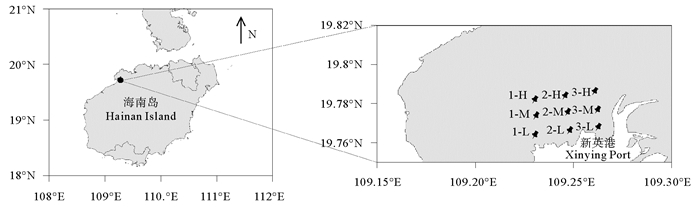
1 材料与方法 1.1 采样地概况和站位设置新英港红树林植物物种丰富度高, 红树植物主要有红海榄、木榄、榄李、海漆、桐花树、秋茄和白骨壤等树种[14]。在海莲纯林中设置2个断面(断面1、断面2)、桐花树和白骨壤混合林中设置1个断面(断面3),各断面间距约1 km,在每个断面上取高、中、低3个潮位,各潮位间距约200 m,在相对无人为扰动的红树林生长区域(沉积物底质为泥质),用内径为2.9 cm的注射器改制而成的采样管,在每个站位取深度为5 cm的样芯,设3个重复,共27个样品,最后用5%的福尔马林溶液对样品进行现场固定,具体参照《海洋沉积物间隙生物调查规范》[15]。采样站位见图 1。
|
(图中黑色标记代表采样地点。1、2、3表示断面; H、M、L分别表示高、中、低潮位。The black mark in the figure represents the sampling location. 1, 2 and 3 represent sections; H, M and L represent high, middle and low tide levels. ) 图 1 新英港红树林湿地采样站位图 Fig. 1 Map of the sampling stations of Xinying Port mangrove wetland |
将泥样放入上层为500 μm与下层为42 μm孔径的套筛内,用已过滤的自来水不断冲洗,去除甲醛、泥、黏土和杂质等,直至流出的水澄清。再将截留下的样品用密度为1.15 g·mL-1的Ludox-TM硅胶溶液转移至离心管,以4 000 r·min-1转速,离心10 min,重复离心2次,提取出小型底栖动物。取上清液并转入划线的培养皿中,利用解剖镜(Nikon-SMZ800)对小型底栖动物进行鉴定和计数。将海洋线虫挑出放入装有混合溶液(V甘油: V酒精: V水=1:1:18)的玻璃容器中进行虫体透明化,在干燥箱中静置1周左右后制片。
1.3 数据处理与分析利用Excel 2007、Primer 6.0和SPSS 22进行数据处理和分析。小型底栖动物的分类主要参照《Introduction to the Study of Meiofauna》[16],海洋线虫的分类鉴定主要参照《Free-living Marine Nematodes》[17]。
生物量的估算采用各类群的平均个体干质量换算法[18],各类群采用的经验系数为:海洋线虫0.826 μg [19]、桡足类1.86 μg [20]、多毛类14 μg、寡毛类13.98 μg、动吻类2 μg和其他未鉴定类群3.5 μg [21]。海洋线虫的摄食类型根据Wieser[22]的方法进行划分。
多样性指数公式:
新英港红树林湿地共鉴定出5个以上的小型底栖动物类群,分别为海洋线虫(Nematoda)、多毛类(Polychaeta)、寡毛类(Oligochaeta)、桡足类(Copepoda)、动吻类(Kinorhyncha)和其他未鉴定类群(Unidentified groups)。其中海洋线虫是绝对优势类群,占小型底栖动物丰度的98.92%,其次是寡毛类(0.84%)、桡足类(0.11%)、多毛类(0.06%)、动吻类(0.04%)和其他未鉴定类群(0.03%)。
小型底栖动物总平均丰度为(1 067.3±844.6)ind·10 cm-2,各断面小型底栖动物丰度变化趋势依次是:断面1>断面3>断面2。单因素方差分析表明,各断面小型底栖动物丰度差异显著(P < 0.05)。
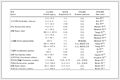
小型底栖动物总平均生物量为(982.98±822.78)μg·10 cm-2,各断面海洋线虫生物量变化趋势与小型底栖动物生物量变化趋势一致。小型底栖动物类群、丰度和生物量见表 1。
|
表 1 新英港红树林湿地小型底栖动物类群丰度及生物量 Table 1 The abundance and biomass of meiofauna in the mangrove wetland of Xinying Port |
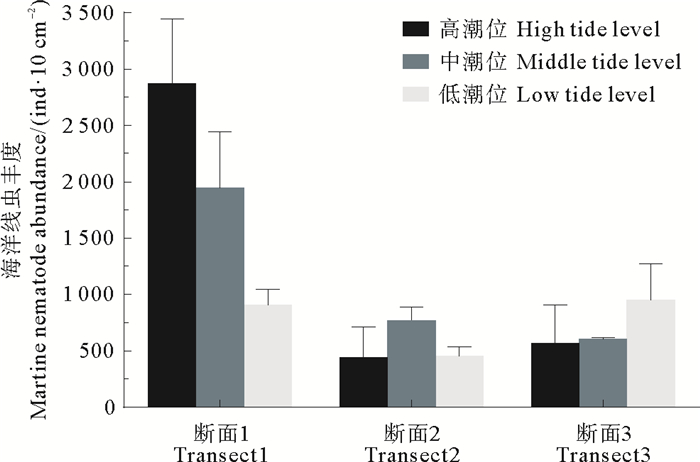
各潮位海洋线虫的丰度见图 2。海洋线虫平均丰度(1 055.9±832.1)ind·10 cm-2; 最大值为(2 870.8±1 134.2)ind·10 cm-2,出现在断面1的高潮位; 最小值为(440.6±531.8)ind·10 cm-2,出现在断面2的高潮位。单因素方差分析表明,断面1潮位间海洋线虫丰度差异显著(P < 0.05),变化趋势为高潮位>中潮位>低潮位,断面2、断面3潮位间海洋线虫丰度无显著性差异(P>0.05)。
|
图 2 新英港红树林湿地海洋线虫的丰度 Fig. 2 Marine nematode abundance at Xinying Port mangrove wetland |
共鉴定出海洋线虫36种,隶属于29属15科。优势科为烙线虫科(Ironidae, 占22.78%),其次为希阿利线虫科(Xyalidae, 占13.07%)、链线虫科(Desmodoridae,占11.74%)、色矛线虫科(Chromadoridae,占10.40%)。优势属(优势度≥5%)由高到低依次为:三齿线虫属(Trissonchulus)、吞咽线虫属(Daptonema)、折咽线虫属(Ptycholaimellus)、拟囊咽线虫属(Parasphaerolaimus)、近瘤线虫属(Adoncholaimus)、裸口线虫属(Anoplostoma)、扎洛线虫属(Zalonema)和微口线虫属(Terschellingia),优势度依次为:22.78%、11.09%、10.40%、8.23%、6.66%、6.16%、5.47%和5.18%。海洋线虫优势属占总数的75.97%。
Wieser[22]根据口腔结构的不同将海洋线虫的摄食类型,分为4类:选择性沉积食性者(1A型),不具口腔或口腔极小,依靠食道的吸力,以细菌大小的有机颗粒为食。非选择性沉积食性者(1B型),具有不具齿的杯型口腔,依靠食道吸力和唇部、口腔前部运动获得食物。刮食者或硅藻捕食者(2A型),具带小齿的口腔,将食物刮起,刺破其细胞壁,吸取其中的细胞液。捕食者或杂食者(2B型),具有带大鄂的发达口腔,将被捕食者整体吞食,或刺破其细胞壁,吸取其中的胞液。
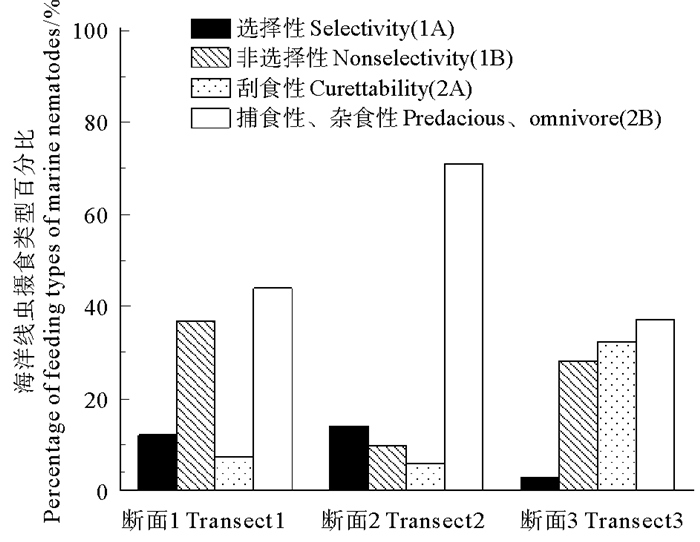
从个体数量分析,捕食性、杂食性沉积食性者所占个体数最多,占个体总数的44.76%,非选择性次之,占31.29%,刮食性和选择性较少,分别为14.94%和9.01%。海洋线虫摄食类型占丰度的百分比变化依次为:2B>1B>2A>1A,海洋线虫摄食类型百分比见图 3。
|
图 3 新英港红树林湿地海洋线虫摄食类型百分比 Fig. 3 Percentage of feeding types of marine nematodes in the mangrove wetland of Xinying Port |
优势种(优势度≥5%)为宽交接器三齿线虫(Trissonchulus latispiculum,占19.76%)、短毛裸口线虫(Anoplostoma tumidum,占6.74%)、Ptycholaimellus sp.(占10.58%)、短毛吞咽线虫(Daptonema brevisetosum,占8.98%)和Adoncholamus sp.(占6.84%),它们共占海洋线虫总数的52.9%,宽交接器三齿线虫在三个断面的优势度都较高,分别为12.59%、36.49%和8.20%,说明该种是研究区域的广布种。优势种的优势度及摄食类型见表 2。
|
|
表 2 新英港优势种的优势度及摄食类型 Table 2 Dominance and feeding type of species in each dominant genera |
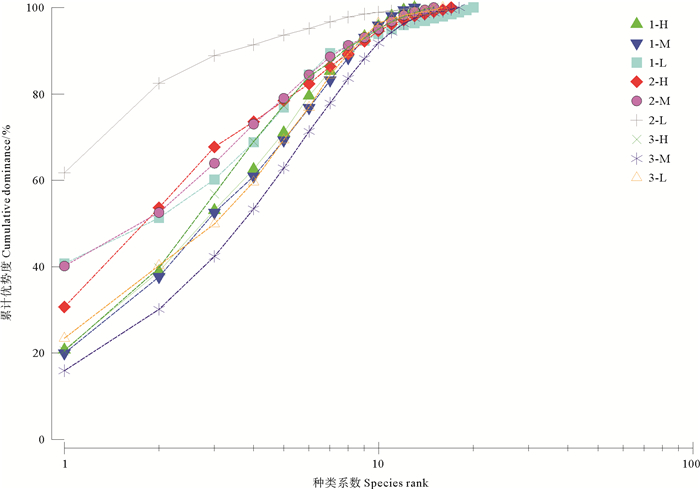
各站位海洋线虫群落的生物多样性指数见表 3,站位3-M种类数最多为19,其香农-维纳指数(H′)和优势度指数(1-λ)最高,其优势度曲线在图 4的最下方,表明其海洋线虫群落优势度较低,但物种多样性较高。站位1-M的种类数最少为15,其物种丰富度指数最低。其他站位的多样性分析结果和K-优势度分析结果介于站位3-M和1-M的结果之间。各站位海洋线虫群落的K-优势度曲线见图 4。各站位多样性分析的结果与K-优势度曲线的分析结果一致。
|
|
表 3 新英港红树林湿地海洋线虫群落的生物多样性指数 Table 3 Biodiversity index of marine nematode communities in the mangrove wetland of Xinying Port |
|
(1、2、3表示断面; H、M、L分别表示高、中、低潮位。1, 2 and 3 represent sections; H, M and L represent high, middle and low tide levels. ) 图 4 新英港红树林湿地各站位海洋线虫群落的K-优势度曲线 Fig. 4 K-dominance curve of marine nematode communities in each transect of the mangrove wetland in Xinying Port |
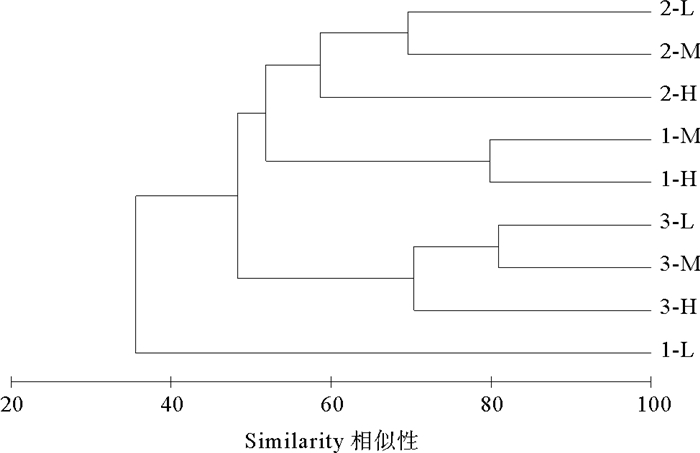
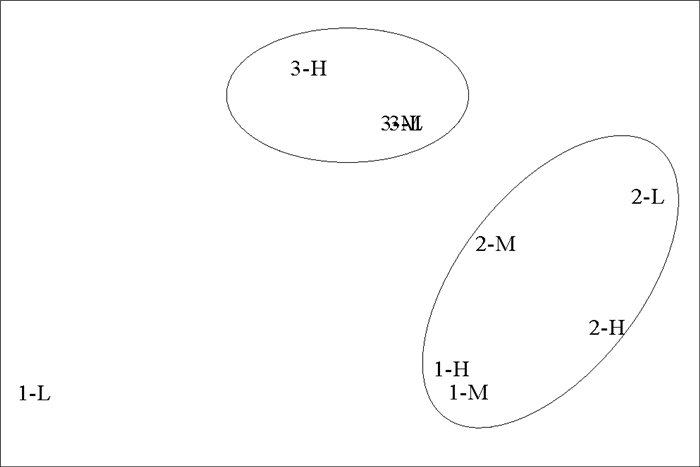
对新英港红树林湿地海洋线虫群落的聚类分析结果表明:不同站位海洋线虫种类相似性在48.29~80.96之间,站位1-L与其他站位线虫群落差异较大,相似度为35.59,站位3-M与3-L的线虫群落结构相似度最高,为80.96,鉴定结果表示,站位3-M(8个优势种)与站位3-L(7个优势种)共有6个共同优势种。站位3-M和3-L的物种多样性指数也相差不大,两个站位群落结构较为相似。海洋线虫群落聚类分析见图 5。将这些站位划分表示在多维度尺度分析(Multi-Dimensional Scaling,MDS)标序图上,进一步体现它们的相互关系,聚类分析结果与MDS分析结果基本相同(见图 6)。不同潮位相同植被生境下的海洋线虫群落相似度较高。
|
(1、2、3表示断面; H、M、L分别表示高、中、低潮位。1, 2 and 3 represent sections; H, M and L represent high, middle and low tide levels. ) 图 5 新英港红树林湿地海洋线虫群落聚类分析图 Fig. 5 Cluster analysis map of marine nematode communities in the mangrove wetland in Xinying Port |
|
(1、2、3表示断面; H、M、L分别表示高、中、低潮位。1, 2 and 3 represent sections; H, M and L represent high, middle and low tide levels. ) 图 6 新英港红树林湿地海洋线虫群落结构标序(MDS)分析 Fig. 6 Analysis of marine nematode community structure (MDS) in the mangrove wetland of Xinying Port |
本研究中小型底栖动物的类群组成与东寨港相似但丰度和生物量有差别。刘均玲等[23]在东寨港红树林湿地中共发现6种小型底栖动物类群,袁超[24]在东寨港发现7种。本研究中小型底栖动物丰度为(1 067.3±844.6)ind·10 cm-2,高于刘均玲等[25]、何永姑等[4]在东寨港四个季节的研究结果,也高于朱慧兰等[26]在浙江西门岛红树林湿地的研究结果((643.71±162.43)ind·cm-2),这与Armenteros等[27]得出的热带红树林湿地的小型底栖动物丰度一般低于亚热带或温带的结论有出入。Semprucci等[28]指出沉积物粒径是决定小型底栖动物(尤其是海洋线虫)丰度和种类组成的主要因素。史本泽[6]在东寨港研究中表明小型底栖生物的丰度与沉积物有机质含量呈极显著的正相关。造成红树林小型底栖动物群落的差异的原因是多方面的,小型底栖动物的丰度会受到有机质含量、温度和溶解氧等的影响[29]。本研究小型底栖动物的总平均生物量为(982.98±822.78)μg·10 cm-2,高于东寨港的(764.06±511.63)μg·10 cm-2[23],有可能是东寨港红树林沉积物存在潜在的有机质污染[24],也可能是由于在生物量的计算过程中本研究采用的海洋线虫平均个体干质量是0.8 μg,而东寨港红树林湿地研究采用的是0.6 μg。本课题组对福建九龙江口和洛阳江口的红树林湿地4个季度海洋线虫优势属的全部个体进行测量表明,成体个体干质量在0.14~4.88 μg,幼体的变化范围为0.17~1.46 μg,平均个体干质量为0.826 μg[19],所以本研究中海洋线虫个体平均干质量采用从红树林湿地获得的经验系数0.8 μg,而在东寨港红树林湿地的研究中采用的是0.6 μg[23],这是在冬季对海洋线虫测量得到的结果。研究表明,小型底栖动物的丰度和生物量都与底质类型有关,各研究区域所存在的差异不能归结为某一种原因,具体还需要更深入的研究。
3.2 不同纬度红树林湿地海洋线虫优势属Wu等[30]指出线虫的多样性和功能组成存在明显的纬度变化。从目前的研究报道来看,在不同纬度的红树林沉积物中,海洋线虫群落优势科具有相似性,在越南芽庄湾红树林湿地鉴定出海洋线虫48属28科[31],色矛线虫科、希阿利线虫科、条线虫科(Linhomoeidae)和链线虫科4个科占主导地位,与本研究有3个相同优势科; 在红海沙特阿拉伯海岸红树林研究区域记录了25属15科[32],微线虫科(Microlaimidae)、希阿利线虫科、链线虫科和色矛线虫科为优势科,与本研究有3个相同优势科,研究表明链线虫科和色矛线虫科是红树林湿地中最丰富和多样化的科[33-34]。
国内不同纬度部分红树林海洋线虫的优势属比较见表 4。赵爽[5]在东寨港红树林湿地四个季节分别发现海洋线虫42种40属、46种43属、34种34属、38种38属,与本研究相同的属有Terschellingia、Trissonchulus、Daptonema、Sabatieria、Metalinhomoeus、Subsphaerolaimus等。表 4表示在福建红树林湿地中,通常以Sabatieria、Ptycholaimellus、Parasphaerolaimus、Terschellingia、Daptonema等为优势属。本研究中海洋线虫的种类,与海南省现有的研究结果有很大的相似性,但本研究海洋线虫多样性略高,与福建省红树林相比其中4个属同样为本研究的优势属。说明不同纬度红树林湿地海洋线虫群落中优势属存在差异性和相似性,但造成这种差异的原因不仅是纬度这一个因素,还可能与沉积物类型、红树植物的不同等有关。
|
|
表 4 不同纬度红树林海洋线虫优势属比较 Table 4 Comparison of dominant genera of marine nematodes in mangroves of different latitudes |
本研究的第一优势属三齿线虫属同样也是海南东寨港红树林[5]、越南延安河口红树林[38]的优势属,在表 4中其他纬度地区未发现该属或不为优势属,但是当在种的层面上进一步研究发现在越南红树林湿地中种类为红树林三齿线虫(Trissonchulus mangrovi),与本研究发现的种类宽交接器三齿线虫和Trissonchulus sp.有所不同。
Sahoo等[39]认为红树林中的小型底栖动物与非红树林区有明显的差别,主要是由于红树林中具有丰富的单宁酸和有机质。海洋线虫不同的摄食类型表示沉积物中的食物来源不同, 也反应了沉积物中有机物存在的形式不同,不同的红树植物正是通过形成不同的沉积物为海洋线虫提供不同的有机质来影响其群落结构[40]。Gee等[41]研究表明,海洋线虫的群落结构与不同红树植物形成的沉积物有关,相似的沉积物生境对海洋线虫群落几乎没有影响。本次采样地包含的红树植物有海莲群落和桐花树、白骨壤混合群落两种不同群落的生境,两个海莲生境下的海洋线虫群落相似度更高,与桐花树、白骨壤混合群落生境下的海洋线虫群落有差别,初步判断红树林湿地海洋线虫的群落结构与不同的红树植物形成的沉积物有关,也可能因为本研究采样时间仅为秋季,不同季节对海洋线虫群落的影响还有待进一步研究。
3.3 海洋线虫的摄食类型海洋线虫口腔结构的差异代表了摄食类型的不同,摄食类型的变化反映了食物来源的不同,也反映了沉积环境中有机物存在形式的差异[40]。本研究中海洋线虫摄食类型以2B型为主导,且2B型在断面1、断面2中均高于断面3,这可能是由于断面1和断面2的红树植被为海莲。海洋线虫的主要摄食类型不同与红树植物形成的沉积物及季节有关,因为季节的不同以及红树植物的不同影响了沉积物中海洋线虫的食物源。曾佳丽等[42]对泉州湾洛阳河口红树林湿地研究发现四个季节秋茄生境的1B型均多于桐花树生境,而秋茄生境的2B型均少于或等于桐花树生境,朱慧兰等[26]研究发现在浙江西门岛冬季秋茄植被沉积物中以2A型为主。新英港红树林湿地的海洋线虫摄食类型丰度变化趋势为:2B>1B>2A>1A,这与在福建省洛阳江口红树林中的研究发现相同[35],说明本研究区域的生境与洛阳江口的生境较相似。
4 结语本研究在海南省新英港红树林湿地中共发现5个以上的小型底栖动物类群,分别为自由生活海洋线虫、多毛类、寡毛类、桡足类、动吻类及其他未鉴定类群。小型底栖动物的类群组成与国内其他红树林的研究结果基本相似。本研究共鉴定出海洋线虫36种,隶属于29属15科,优势种为宽交接器三齿线虫、短毛裸口线虫、Ptycholaimellus sp.、短毛吞咽线虫和Adoncholaimus sp.,优势属为三齿线虫属、吞咽线虫属、折咽线虫属、拟囊咽线虫属、近瘤线虫属、裸口线虫属、扎洛线虫属和微口线虫属,摄食类型以2B型为主,占丰度百分比依次为2B>1B>2A>1A。本研究表明,新英港红树林湿地海洋线虫的群落结构与不同的红树植物形成的沉积物有关。
| [1] |
林鹏. 中国红树林研究进展[J]. 厦门大学学报(自然科学版), 2001, 40(2): 592-603. Lin P. A review on the mangrove resarch in China[J]. Journal of Xiamen University(Natural Science), 2001, 40(2): 592-603. DOI:10.3321/j.issn:0438-0479.2001.02.050 (  0) 0) |
| [2] |
杨盛昌, 陆文勋, 邹祯, 等. 中国红树林湿地: 分布、种类组成及其保护[J]. 亚热带植物科学, 2017, 46(4): 301-310. Yang S C, Lu W X, Zou Z, et al. Mangrove wetlands: distribution, species composition and protection in China[J]. Subtropical Plant Science, 2017, 46(4): 301-310. DOI:10.3969/j.issn.1009-7791.2017.04.001 ( 0) |
| [3] |
涂志刚, 陈晓慧, 吴瑞. 海南省红树林自然保护区红树林资源现状[J]. 海洋开发与管理, 2015, 32(10): 90-92. Tu Z G, Chen X H, Wu R. Present situation of mangrove resources in Mangrove Nature Reserve of Hainan Province[J]. Ocean Development and Management, 2015, 32(10): 90-92. DOI:10.3969/j.issn.1005-9857.2015.10.019 ( 0) |
| [4] |
何永姑, 刘均玲, 袁超, 等. 不同季节东寨港红树林沉积物小型底栖动物的分布特征[J]. 海洋科学进展, 2019, 37(4): 681-688. He Y G, Liu J L, Yuan C, et al. Characteristics of meiofauna distribution in sediments of Dongzhai Bay mangrove in different seasons[J]. Aduances in Marine Science, 2019, 37(4): 681-688. ( 0) |
| [5] |
赵爽. 海南东寨港红树林海洋线虫多样性研究[D]. 海口: 海南大学, 2018. Zhao S. Diversity of Marine Nematodes in Mangroves in Dongzhai Port, Hainan[D]. Haikou: Hainan University, 2018. ( 0) |
| [6] |
史本泽. 不同生境中海洋线虫分类及小型底栖生物群落结构研究[D]. 青岛: 中国科学院研究生院(海洋研究所), 2016. Shi B Z. Classification of Marine Nematodes and Community Structure of Meiofauna in Different Habitats[D]. Qingdao: Graduate School of Chinese Academy of Sciences(Institute of Oceanology), 2016. ( 0) |
| [7] |
黄冕. 海南岛自由生活线虫的分类研究[D]. 聊城: 聊城大学, 2018. Huang M. Study on Classification of Free-Living Nematodes from the Hainan Island[D]. Liaocheng: Liaocheng University, 2018. ( 0) |
| [8] |
张志南, 周红. 国际小型底栖生物研究的某些进展[J]. 中国海洋大学学报(自然科学版), 2004(5): 799-806. Zhang Z N, Zhou H. Some advances in international research on meiofauna[J]. Periodical of Ocean University of China, 2004(5): 799-806. ( 0) |
| [9] |
杜永芬, 徐奎栋, 类彦立. 海洋微型和小型底栖生物相互作用研究综述[J]. 海洋科学集刊, 2009(1): 163-173. Du Y F, Xu K D, Lei Y L. Research progress in the interactions of marine micro-and meiobenthos[J]. Studia Marine Sinica, 2009(1): 163-173. ( 0) |
| [10] |
华尔, 崔春燕, 徐华林, 等. 深圳福田红树林保护区自由生活海洋线虫群落特征研究[J]. 中国海洋大学学报(自然科学版), 2020, 50(9): 46-63. Hua E, Cui C Y, Xu H L, et al. Study on the community characteristics of marine nematodes in Futian Mangrove Reserve, Shenzhen[J]. Periodical of Ocean University of China, 2020, 50(9): 46-63. ( 0) |
| [11] |
杜永芬, 高抒, Warwick R M, 等. 海岸带湿地自由生活海洋线虫的生态功能研究进展[J]. 科学通报, 2014, 59(31): 3043-3060. Du Y F, Gao S, Warwick R M, et al. Research progress on ecological function of free-living marine nematodes in coastal wetlands[J]. Chinese Scientific Bulletin, 2014, 59(31): 3043-3060. ( 0) |
| [12] |
国家林业局. 中国湿地资源-海南卷[M]. 北京: 中国林业出版社, 2015. State Forestry Administration. China Wetland Resources-Hainan Volume[M]. Beijing: China Forestry Press, 2015. ( 0) |
| [13] |
吴瑞, 陈晓慧, 陈丹丹, 等. 海南省新英湾红树林资源现状调查分析[J]. 热带农业科学, 2016, 36(8): 35-37. Wu R, Chen X, Chen D, et al. Investigation on current statutus of mangrove resources in Xinying Bay of Hainan Province[J]. Chinese Journal of Tropical Agriculture, 2016, 36(8): 35-37. ( 0) |
| [14] |
成家隆, 吴昊, 陈玉军, 等. 儋州滨海新区红树林防护体系建设可行性研究[J]. 防护林科技, 2015(10): 71-72. Cheng J, Wu H, Chen Y, et al. Feasibility study on the construction of mangrove protection system in Danzhou Binhai New Area[J]. Protection Forest Science and Technology, 2015(10): 71-72. ( 0) |
| [15] |
中国科学院海洋研究所, 同济大学, 中国地质调查局青岛海洋地质研究所, 等. 海洋沉积物间隙生物调查规范: GB/T 34656—2017[S]. 北京: 中国标准出版社, 2017. Institute of Oceanography, Chinese Academy of Sciences, Tongji University, Qingdao Institute of marine geology, China Geological Survey, et al. Specifications for Marine Sediment Interstitial Biota Survey: GB/T 34656—2017[S]. Beijing: Standards Press of China, 2017. ( 0) |
| [16] |
Higgins R P T H. Introduction to the Study of Meiofauna[M]. London: Smithsonian Institut Ion Press, 1988.
( 0) |
| [17] |
Warwick R, Platt H, Somerfield P. Freeliving Marine Nematodes: Part Ⅲ Monhysterida[M]. London: Cambridge University Press, 1998.
( 0) |
| [18] |
慕芳红, 张志南, 郭玉清. 渤海小型底栖生物的丰度和生物量[J]. 青岛海洋大学学报(自然科学版), 2001, 31(6): 897-905. Mu F, Zhang Z, Guo Y. Abundance and biomass of the benthic meiofauna in the Bohai Sea[J]. Journal of Ocean University of Qingdao, 2001, 31(6): 897-905. DOI:10.3969/j.issn.1672-5174.2001.06.012 ( 0) |
| [19] |
刘梦迪, 陈建春, 郭玉清, 等. 红树林湿地沉积物中海洋线虫个体干质量的研究[J]. 海洋学报, 2018, 40(8): 89-96. Liu M, Chen J, Guo Y, et al. Study on the individual dry weight of marine nematodes in mangrove sediments[J]. Acta Oceanologica Sinica, 2018, 40(8): 89-96. DOI:10.3969/j.issn.0253-4193.2018.08.009 ( 0) |
| [20] |
McIntyre A D. The meiofauna and macrofauna of some tropical beaches[J]. Journal of Zoology, 1968, 156(3): 377-392. DOI:10.1111/j.1469-7998.1968.tb04360.x ( 0) |
| [21] |
Widbom B. Determination of average individual dry weights and ash-free dry weights in different sieve fractions of marine meiofauna[J]. Marine Biology, 1984, 84(1): 101-108. DOI:10.1007/BF00394532 ( 0) |
| [22] |
Wieser W. Die Beziehung zwischen Munhöhdlengestalt, Ernährungs-weise und Vorkommen bei freilebenden marine nematode: Eine kologisch-morphologische studie[J]. Ark Zool, 1953, 4(26): 439-484. ( 0) |
| [23] |
刘均玲, 黄勃, 梁志伟. 东寨港红树林小型底栖动物的密度和生物量研究[J]. 海洋学报, 2013, 35(2): 187-192. Liu J L, Huang B, Liang Z W. Study on abundance and biomass of benthic meiofauna in mangrove in Dongzhai Bay[J]. Acta Oceanologica Sinica, 2013, 35(2): 187-192. DOI:10.3969/j.issn.0253-4193.2013.02.020 ( 0) |
| [24] |
袁超. 海南东寨港红树林小型底栖动物分布与主要环境因子的相关性研究[D]. 海口: 海南大学, 2017. Yuan C. Distribution of Meiofauna and Its Correlation with Main Environmental Factors in Dongzhai Port Mangrove Hainan Province[D]. Haikou: Hainan University, 2017. ( 0) |
| [25] |
刘均玲, 袁超, 何永姑, 等. 东寨港红树林小型底栖动物丰度与Chl a、有机质的相关性[J]. 生态学报, 2019, 39(1): 185-191. Liu J L, Yuan C, He Y G, et al. Correlation of meiofauna abundance with chlorophyll a and organic matter of Dongzhai Harbor Mangrove[J]. Acta Ecologica Sinica, 2019, 39(1): 185-191. ( 0) |
| [26] |
朱慧兰, 郭玉清, 吴成业, 等. 浙江西门岛红树林湿地小型底栖动物的研究[J]. 集美大学学报(自然科学版), 2020, 25(4): 241-247. Zhu H L, Guo Y Q, Wu C Y, et al. Study on meiofauna abundance in mangrove of Ximen Island, Zhejiang Province[J]. Journal of Jimei University(Natural Science), 2020, 25(4): 241-247. ( 0) |
| [27] |
Armenteros M, Maratin I, Williams J. Spatial and temporal variations of meiofunal communities from the western sector of the guif of Batabano[J]. Cuba: I Mangrove Systems, 2008, 56(2): 124-132. ( 0) |
| [28] |
Semprucci F, Colantoni P, Baldelli G, et al. The distribution of meiofauna on back-reef sandy platforms in the Maldives (Indian Ocean)[J]. Marine Ecology, 2010, 31(4): 592-607. DOI:10.1111/j.1439-0485.2010.00383.x ( 0) |
| [29] |
Coull B C. Role of meiofauna in estuarine soft-bottom habi-lats[J]. Australian Journal of Ecology, 1999, 24(4): 327-343. DOI:10.1046/j.1442-9993.1999.00979.x ( 0) |
| [30] |
Wu J, Chen H, Zhang Y. Latitudinal variation in nematode diversity and ecological roles along the Chinese coast[J]. Ecology and Evolution, 2016, 6(22): 8018-8027. DOI:10.1002/ece3.2538 ( 0) |
| [31] |
Mokievsky V O, Tchesunov A V, Udalov A A, et al. Quantitative distribution of meiobenthos and the structure of the free-living nematode community of the mangrove intertidal zone in Nha Trang bay (Vietnam) in the South China Sea[J]. Russian Journal of Marine Biology, 2011, 37(4): 272-283. DOI:10.1134/S1063074011040109 ( 0) |
| [32] |
Abdulmohsin A, Mohsen E. Meiobenthic assemblage of the grey mangrove (Avicennia marina) along the Saudi Arabian coast of the Red Sea with emphasis on free-living nematodes[J]. Oceanological and Hydrobiological Studies, 2018, 47(4): 359-375. DOI:10.1515/ohs-2018-0034 ( 0) |
| [33] |
Sabeel R. Variation in Distribution of Sudanese Mangroves and Their Ecological Significance for Benthic Fauna[D]. Ghent: Ghent University, 2015.
( 0) |
| [34] |
Ólafsson E. Meiobenthos in mangrove areas in eastern Africa with emphasis on assemblage structure of free-living marine nematodes[J]. Hydrobiologia, 1995, 312(1): 47-57. DOI:10.1007/BF00018886 ( 0) |
| [35] |
杨培培, 常瑜, 郭玉清, 等. 福建省红树林湿地海洋线虫的优势属及摄食类型[J]. 海洋学报, 2019, 41(12): 90-102. Yang P P, Chang Y, Guo Y Q, et al. Dominant genera of marine nematodes and their feeding types in several mangrove wetlands of Fujian Province[J]. Acta Oceanologica Sinica, 2019, 41(12): 90-102. DOI:10.3969/j.issn.0253-4193.2019.12.009 ( 0) |
| [36] |
王玥, 庞小鹏, 郭玉清. 广西北海金海湾红树林湿地海洋线虫群落研究初探[J]. 海洋与湖沼, 2020, 51(3): 583-590. Wang Y, Pang X P, Guo Y Q. Study on marine nematodes community in Jinhai Bay mangrove wetland, Beihai, Guangxi[J]. Oceanologia Et Limnologia Sinica, 2020, 51(3): 583-590. ( 0) |
| [37] |
潘超, 吴成业, 郭玉清, 等. 湛江特呈岛红树林湿地冬季小型底栖动物和海洋线虫群落的初步研究[J]. 渔业研究, 2020, 42(2): 97-104. Pan C, Wu C Y, Guo Y Q, et al. Preliminary study on meiofauna and marine nematode community in the mangrove wetland of Techeng Island, Zhanjiang in winter[J]. Journal of Fisheries Research, 2020, 42(2): 97-104. ( 0) |
| [38] |
Tu N D, Gagarin V G. Free-living nematodes from mangrove forest in the Yên River estuary (Vietnam)[J]. Inland Water Biology, 2017, 10(3): 266-274. DOI:10.1134/S1995082917030129 ( 0) |
| [39] |
Sahoo G, Suchiang S R, Ansari Z A. Meiofauna-mangrove interaction: A pilot study from a tropical mangrove habitat[J]. Cahiers De Biologie Marine, 2013, 54(3): 349-358. ( 0) |
| [40] |
Moens T, Vincx M. Observations on the Feeding Ecology of Estuarine Nematodes[J]. Journal of the Marine Biological Association of the United Kingdom, 1997, 77(1): 211-227. DOI:10.1017/S0025315400033889 ( 0) |
| [41] |
Gee J M, Somerfield P J. Do mangrove diversity and leaf litter decay promote meiofaunal diversity?[J]. Journal of Experimental Marine Biology and Ecology, 1997, 218(1): 13-33. DOI:10.1016/S0022-0981(97)00065-8 ( 0) |
| [42] |
曾佳丽, 卓异, 林家逸, 等. 泉州湾洛阳河口红树林湿地自由生活海洋线虫食性研究[J]. 厦门大学学报(自然科学版), 2016, 55(4): 515-521. Zeng J L, Zhuo Y, Lin J Y, et al. Feeding habits of free-living marine nematodes in mangrove wetlands in Luoyang Estuary, Quanzhou Bay[J]. Journal of Xiamen University(Natural Science), 2016, 55(4): 515-521. ( 0) |