 2020, Vol. 50


微藻种类繁多、光合作用效率高、生长周期短、富含油脂、蛋白、多糖、色素、维生素等多种活性物质[1-3],近年来在农业、生态环境保护、生物能源开发及食品药品等领域备受青睐[4-7]。随着微藻规模化养殖的不断扩大,提高养殖产量和质量的关键问题是如何获得具有高产、高活性物质含量、抗污染能力强、抗逆境胁迫等优良性状的微藻种质。因此,必须加强不同微藻藻种的育种技术研究,提高育种效率,从而获得性状优良的微藻种质,以实现微藻规模化、产业化发展。
微藻诱变育种是指采用各种物理以及化学诱变的方法引起藻种遗传性状产生变异,再通过定向筛选、培育以获得所需要的优良突变藻株的育种技术[8]。与传统的选择育种方法相比,诱变育种周期短、突变率高,在提高产量、增强抗性、改善微藻品质等方面潜力巨大[9-10]。诱变育种技术已广泛应用于富含生物活性成分的微藻、生物能源微藻等经济微藻中,成为提高育种效率、获得优良微藻种质的主要手段。国内外已有大量文献报道,运用诱变育种技术已成功获得高活性物质含量、高油脂产量及耐低温、高温等优良性状的藻种[11-14]。但目前可实现规模化养殖的微藻种类十分有限,且表型性状的不稳定性也会对微藻生产造成影响,因此,必须不断地对微藻诱变育种技术进行改进和创新。本文综述了物理诱变、化学诱变、复合诱变技术的诱变机理及其在微藻育种中的应用现状,并对微藻诱变育种中存在的问题进行了总结及展望,以期为微藻种质资源开发利用以及推动微藻诱变育种研究提供参考。
1 物理诱变育种物理诱变主要通过各种辐射诱变剂对微藻进行辐照处理,诱发染色体异位、缺失、重组或断裂等,从而引起后代性状产生变异[15-16]。目前使用较广泛的辐射源有:紫外线、射线、重离子束等。随着诱变技术的不断发展,许多有效的诱变源如激光、超声波、太空诱变等也被应用于微藻的育种中[17-19]。此外,常压室温等离子体(Atmospheric and room temperature plasma,ARTP)作为一种新型的诱变育种手段,也已成功应用于微藻诱变育种的研究中[20]。
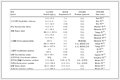
1.1 紫外线诱变紫外(Ultraviolet,UV)诱变育种是目前使用最久、应用最广的一种物理诱变方法[21]。紫外线可穿透藻细胞直接作用于DNA,当DNA分子吸收紫外光后,易导致单链相邻或双链相对应的两个胸腺嘧啶形成二聚体,DNA在进行解旋、复制、转录时,由于嘧啶二聚体不能进行分离,从而阻碍碱基的正常配对,使基因发生突变[22-24]。紫外诱变因操作简单、低成本、高突变率、高安全性等特点,在微藻诱变育种研究中得到广泛应用[25-26]。国内外已有大量研究报道,利用紫外线对不同微藻进行诱变并获得了大量性状优良的突变藻株。如三角褐指藻(Phaeodactylum tricornutum)、魏氏真眼点藻(Eustigmatos vischeri)、小球藻(Chlorella sp.)、栅藻(Scenedesmus sp.)、四爿藻(Tetraselmis suecica)、集胞藻PCC 6803(Synechocystis sp. PCC 6803)等,均已利用紫外诱变育种技术成功获得了具有高生物量、高油脂产量、高EPA及高精氨酸含量的优良突变株,具体研究成果见表 1。
|
表 1 紫外线诱变在微藻育种中的研究成果 Table 1 Research achievements of UV mutagenesis in microalgae breeding |
射线是一种能量高、穿透力强的电离辐射源,常见的有X射线、γ射线等[35-36]。利用射线辐射微藻细胞,可直接或间接引起遗传物质发生改变。一方面,电离辐射可直接破坏碱基、糖-磷酸、脱氧核糖等化学键,导致染色体发生断裂、重复、缺失等突变,此外,辐射可使藻细胞内的水、有机分子等组分发生电离产生具有极强还原或氧化特性的自由基,从而间接引起染色体畸变[37]。与紫外诱变相比,高能量、强穿透力的射线辐射更易造成DNA序列的改变,因此在微藻诱变育种中具有更高的突变效率。γ射线辐射因其重演性较好、辐照条件易于控制等优点成为微藻育种中最常用的诱变源之一,尤其是60Co-γ射线在寇氏隐甲藻(Crypthecodi-nium cohnii)、栅藻、微拟球藻(Nannochloropsis oculata)、雨生红球藻(Haematococcus pluvialis)等富含活性物质的微藻诱变育种研究中成效显著,已培育出许多高油脂、高DHA、高虾青素含量及高耐受CO2等性状优良的株系,具体见表 2。
|
|
表 2 60Co-γ射线诱变在微藻育种中的研究成果 Table 2 Research achievements of 60Co-γ ray mutagenesis in microalgae breeding |
重离子束是一种具有高传能线密度(Linear energy transfer,LET)的人工粒子辐射源,应用于育种研究的重离子主要通过加速器将原子的核外电子部分或全部剥离掉再加速而成,常见的有碳、氮、铁等重离子束[43]。重离子束的LET值远高于X、γ等传统射线,能够造成细胞核内DNA分子更致密的损伤,且多为DNA双链的平头末端断裂、大片段缺失、DNA-蛋白质交联等难以重组修复的团簇损伤[44-47]。因此,重离子束辐射诱变能够在具有较高存活率的情况下获得更高的突变效率。随着核物理学的不断发展,重离子束辐照在高等植物诱变育种方面取得了很大的进展[48-50]。近年来,在微藻育种研究中也逐渐开展了重离子辐射诱变技术,并已成功应用于微拟球藻、栅藻、羊角月牙藻(Selenastrum capricornutum)、三角褐指藻等的育种研究中,获得的突变株的生物量、油脂产量、岩藻黄质含量、光合效率等均显著提高,表 3概述了该技术在以上微藻育种中的具体研究成果。
|
|
表 3 重离子束辐射诱变在微藻育种中的研究成果 Table 3 Research achievements of heavy-ion irradiation mutagenesis in microalgae breeding |
常压室温等离子体诱变(Atmospheric and room temperature plasma,ARTP)是一种安全高效、环境友好的新型诱变育种手段。ARTP产生的放电均匀、稳定的高浓度活性粒子,可直接穿透细胞造成DNA分子损伤,引起突变,还可以通过破坏整个细胞以启动细胞内的DNA修复等多种修复机制,这些不精确的修复会触发细胞内复杂的调控系统,从而引起基因表达方式及代谢途径的改变[57-58]。因此,利用ARTP诱变技术较易获得具有良好遗传稳定性的突变株。此外,ARTP诱变育种突变率高,且对DNA造成最大损伤的情况下细胞仍能保持活性,从而为育种工作提供了更多的突变资源[59]。目前,ARTP诱变技术已成功应用于微藻的突变,在小球藻、雨生红球藻、螺旋藻(Spirulina sp.)、湛江等鞭金藻(Isochrysis zhanjiangensis)、寇氏隐甲藻等的育种研究中均取得了显著成效,获得了具有高生物量、高油脂产量及高多糖、高氨基酸、高虾青素含量等多种优良性状的突变藻种,应用前景十分广阔。该技术在以上微藻育种研究中取得的具体成果见表 4。
|
|
表 4 ARTP诱变在微藻育种中的研究成果 Table 4 Research achievements of ARTP mutagenesis in microalgae breeding |
激光具有单色性好、方向性好、高光亮性和高相干性等优点,将激光作为辐射源应用于微藻育种,其主要通过对藻细胞产生光、光压、热及电磁场等综合理化效应使DNA和RNA结构发生突变,从而导致性状改变以达到育种目的。一定频率的激光辐射微藻后,在上述各效应的叠加作用下,藻细胞DNA分子产生断裂、交联、聚合等一系列突变,RNA分子结构也随之产生变化,引起酶的抑制或激活,导致基因表达和藻细胞代谢途径改变,最终产生突变株。近年来,随着激光诱变育种设备的不断研制与广泛应用,使得激光诱变育种效率大大提高,且操作更加简便,如CO2、He-Ne、Nd: YAG等激光器在微拟球藻、雨生红球藻、小球藻、紫球藻(Porphyridium cruentum)等的育种中已取得了显著的成效,突变藻株的油脂、虾青素、胞外多糖含量等均显著提高,具体研究成果见表 5。
|
|
表 5 激光诱变在微藻育种中的研究成果 Table 5 Research achievements of laser mutagenesis in microalgae breeding |
超声波是一种频率高、功率大、穿透力强的机械波,在传播过程中可与介质发生作用产生热、机械和空化等理化效应。将超声波应用于微藻诱变育种,其主要通过空化效应作用于微藻细胞,即超声波在传播时由于声压发生剧烈变化从而产生空化气泡,这些空化气泡在瞬间爆破的过程中,释放出巨大能量,导致局部产生瞬时极端高温、高压、放电现象,并产生大量自由基[71]。这一系列继发效应可导致藻细胞遗传物质、酶活性及细胞膜结构改变,从而使基因表达过程、胞内外物质交换及信息传递、代谢途径等改变。已有研究表明,超声波对微藻生长、光合作用、油脂合成及转化均有显著影响[71-73],随着超声波特性和诱变机理研究的不断深入,超声波微藻诱变育种取得了一定成效。朱甲妮[74]在频率18 kHz、功率20 W和时间10 min的超声条件下诱变栅藻,诱变株的油脂产量与出发株相比提高了26%;肖若楠[75]用频率20 kHz、功率20 W的超声波处理栅藻30 min,诱变株的细胞干重和油脂含量分别比出发株提高了33.3%和37.2%。韩飞[18]将处于对数生长末期的四尾栅藻进行频率40 kHz、功率200 W和时间20 min的超声处理,突变株的油脂含量比原始株提高了57.5%。实践表明,超声频率、处理时间不同随之产生的效应程度也不同,且不同微藻种类的耐受性也各不相同,因此,选择合适的超声参数和剂量是育种成功的关键。
1.7 太空诱变微藻太空诱变育种是指通过返回式航天器如卫星、飞船等将藻种搭载到宇宙空间,利用强辐射、微重力等空间条件实现微藻的有益突变。宇宙射线种类多且穿透力强,当高能射线辐射微藻细胞后极易导致DNA分子损伤,而空间微重力在DNA损伤的情况下阻碍了DNA修复系统的启动与运转,最终使基因产生变异[76]。刘波等[19]通过太空搭载小球藻,获得了一株油脂和脂肪酸含量分别比出发株增加6.5%和3.76%的优良突变株。谭丽等[77]经过太空搭载钝顶螺旋藻成功选育出优良突变株H11,与原始株相比,H11的生物量、总多糖产率分别提高了15.39%和176.50%。太空诱变技术作为一种有效的育种手段,具有突变频率高、变异稳定性好、多数性状可稳定遗传等优点,但由于空间条件难得且难以模拟,从而限制了太空诱变在微藻育种中的应用。
2 化学诱变育种化学诱变是一种利用化学诱变剂处理微藻以获得突变藻株的育种方法,具有突变范围广、易操作、成本低等特点[20]。目前广泛应用于微藻育种的化学诱变剂主要是一些烷化剂,如甲基磺酸乙酯(Ethyl methane sulfonate,EMS)、亚硝基胍(N-methyl-N’-Nitro-nitrosoguanidine,NTG或MNNG)等。这些烷化剂通常具有一个或多个高活性的烷化基团,在诱变过程中通过取代DNA分子中的氢原子以造成碱基的错配、置换等,从而引起突变[78]。另外,烷化基团还可与DNA结构中的氧原子发生烷化反应,形成极易水解的磷酸酯从而造成DNA链的断裂[79]。与物理诱变相比,化学诱变多为基因的点突变,对微藻的基因组损伤较小,且突变位点具有特异性。近年来,栅藻、小球藻、微拟球藻、波氏真眼点藻(Eustigmatos polyphem)、三角褐指藻、小新月菱形藻(Nitzschia closterium f.minutissima)、节旋藻(Arthrospira sp.)、纤细裸藻(Euglena gracilis)等均已利用化学诱变技术成功获得了耐高温、低温及高产虾青素、油脂、EPA、类胡萝卜素、蛋白质等的优良突变株,详见表 6。
|
|
表 6 化学诱变在微藻育种中的研究成果 Table 6 Research achievements of chemical mutagenesis in microalgae breeding |
复合诱变是指采用两种或两种以上的诱变方法对微藻进行育种,可以是两种及以上物理诱变方法或化学诱变方法,也可以物理诱变与化学诱变等方法相结合。单一诱变育种产生的基因突变往往比较单一,运用复合诱变方法有利于打破突变局限性,获得更多的正突变藻株。目前应用在微藻育种中的复合诱变方法主要有两种,一种是使用多种方法依次诱变处理出发藻株,最后筛选优良藻株。另外一种复合诱变方法是每次诱变处理后都进行筛选,即第一种方法诱变处理后筛选出优良藻株,然后对筛选出的优良藻株进行第二种方法诱变处理,再次进行筛选。许多研究表明,与单一诱变相比,复合诱变可以增加基因突变类型,拓展突变谱,且诱变方法顺序不同获得的基因突变类型也往往不同,因此,复合诱变更有利于筛选获得性状优良的突变藻株[92-93]。目前,复合诱变主要应用于原壳小球藻(Chlorella protothecoides)、埃氏小球藻(Chlorella emersonii)等富含油脂藻种的育种研究中,获得的突变株其油脂含量显著提高,表 7概述了复合诱变育种在以上微藻中的具体成果。
|
|
表 7 复合诱变在微藻育种中的研究成果 Table 7 Research achievements of combined mutagenesis in microalgae breeding |
在微藻育种中应用物理诱变方法,具有简单易操作、且安全性高的优点,但ARTP、射线、太空诱变等物理诱变方法,存在设备昂贵、维护成本高、条件难得、难以推广的弊端;紫外诱变成本虽低,但存在突变单一且不稳定的缺点。化学诱变方法成本低,但有利突变少,且大多数诱变剂具有强烈致癌毒性,对环境及研究人员伤害较大。复合诱变方法可以增加基因突变类型,拓展突变谱,且变异稳定性好,但操作复杂,耗时费力。因此,微藻诱变育种技术还需不断改进和创新。表 8总结了不同诱变育种方法的优缺点。
|
|
表 8 不同诱变育种方法的优缺点 Table 8 Advantages and disadvantages of different mutation breeding methods |
近年来,微藻诱变育种研究已经取得了较大进展,不同的诱变育种方法在提高突变效率、创造微藻新种质方面均发挥了重要作用,但目前仍存在许多问题制约着微藻种质资源开发利用,阻碍了微藻诱变育种研究进程。①不确定性:突变方向不确定,具有随机性,无法定向获得所需要的目的性状,且有意义的突变较少。②不可重复性:不论是物理诱变还是化学诱变,不同剂量、不同批次、不同时间所产生的突变率和突变方向各有不同,难以重复。③矛盾性:突变株品质的提高往往伴随着产量的下降,即品质和产量相互矛盾。④盲目性:对大部分诱变方法作用机理的研究比较浅显,育种工作存在一定的盲目性。⑤筛选困难:利用传统方法在产生的大量突变藻株中筛选出目的藻株存在工作量大、耗资、耗力、耗时等缺点,急需建立高效、准确的高通量筛选方法。因此,如何进行高效、定向诱变育种,提高有利突变,准确快速筛选出目的藻株是今后研究的重点与难点。
解决微藻诱变育种过程中存在的问题,一方面需要研究人员在实际的育种工作中结合不同微藻的特性来选择适合的诱变方法,综合运用多种有效的诱变技术,取长补短,以实现选育效率的最优化。另一方面,应将微藻诱变育种与当前先进的生物技术相结合,如可以通过基因组重测序技术、转录组测序、蛋白质组分析等技术从DNA、蛋白水平上揭示表型与基因型之间的联系,掌握诱变作用机理,从而实现高效、定向诱变育种。此外,光学传感器检测技术,如红外光谱分析(Infrared spectra analysis)[96-97]、核磁共振(Nuclear magnetic resource,NMR)[98]、拉曼光谱[99-101]等在微藻表型检测方面已进行了较多的研究,以及近年来出现的分子标记技术,这些技术的发展为建立目的突变藻株的高效、定向筛选奠定了基础。相信在科学快速发展的推动下,微藻诱变育种研究将进入高速发展阶段。
| [1] |
Chung Y S, Lee J W, Chung C H. Molecular challenges in microalgae towards cost-effective production of quality biodiesel[J]. Renewable & Sustainable Energy Reviews, 2017, 74: 139-144.
(  0) 0) |
| [2] |
梁英, 麦康森. 微藻EPA和DHA的研究现状及前景[J]. 水产学报, 2000, 24(3): 289-296. Liang Y, Mai K S. Current status and prospect of studies on microalgal EPA and DHA[J]. Journal of Fisheries of China, 2000, 24(3): 289-296. ( 0) |
| [3] |
Chia S R, Ong H C, Chew K W, et al. Sustainable approaches for algae utilisation in bioenergy production[J]. Renewable Energy, 2018, 129: 838-852. DOI:10.1016/j.renene.2017.04.001
( 0) |
| [4] |
王慧岭, 张晋阳, 罗建涛, 等. 微藻在食品领域的应用[J]. 安徽农业科学, 2018, 46(17): 44-47. Wang H L, Zhang J Y, Luo J T, et al. Application of microalgae in food field[J]. Journal of Anhui Agricultural Sciences, 2018, 46(17): 44-47. DOI:10.3969/j.issn.0517-6611.2018.17.013 ( 0) |
| [5] |
梁英, 黄徐林, 田传远, 等. 海洋药源微藻研究进展[J]. 中国海洋大学学报(自然科学版), 2016, 46(11): 32-43. Liang Y, Huang X L, Tian C Y, et al. Advances in studies on marine medicinal microalgae[J]. Periodical of Ocean University of China, 2016, 46(11): 32-43. ( 0) |
| [6] |
李玉领, 唐东山, 李向阳, 等. 沙蒿胶-微藻联合固沙效果的试验研究[J]. 工业安全与环保, 2018, 44(3): 56-60. Li Y L, Tang D S, Li X Y, et al. The experiment research on the sand fixation effect of the joint of microalgae and artemisia sphaerocephala krasch[J]. Industrial Safety and Environmental Protection, 2018, 44(3): 56-60. DOI:10.3969/j.issn.1001-425X.2018.03.015 ( 0) |
| [7] |
梁英, 王玥, 石伟杰, 等. 不同浓度柠檬酸对2株绿藻生长及总脂含量影响[J]. 中国海洋大学学报(自然科学版), 2018, 48(10): 1-10. Liang Y, Wang Y, Shi W J, et al. Effect of citric acid at different concentrations on the growth and total lipid content of two green algae[J]. Periodical of Ocean University of China, 2018, 48(10): 1-10. ( 0) |
| [8] |
梁英, 陈书秀. 微藻育种的研究现状及前景[J]. 海洋通报, 2008(3): 88-94. Liang Y, Chen S X. Current status and prospect of studies on microalgal breeding[J]. Marine Science Bulletin, 2008(3): 88-94. DOI:10.3969/j.issn.1001-6392.2008.03.014 ( 0) |
| [9] |
杨震, 彭选明, 彭伟正. 作物诱变育种研究进展[J]. 激光生物学报, 2016, 25(4): 302-308. Yang Z, Peng X M, Peng W Z. Progress of study on crop mutation breeding[J]. Acta Laser Biology Sinica, 2016, 25(4): 302-308. DOI:10.3969/j.issn.1007-7146.2016.04.003 ( 0) |
| [10] |
范勇, 胡光荣, 王丽娟, 等. 微藻育种研究进展[J]. 生物学杂志, 2017, 34(2): 3-8, 35. Fan Y, Hu G R, Wang L J, et al. Research progress on microalgae breeding[J]. Journal of Biology, 2017, 34(2): 3-8, 35. DOI:10.3969/j.issn.2095-1736.2017.02.003 ( 0) |
| [11] |
Choi J I, Yoon M, Joe M, et al. Development of microalga Scenedesmus dimorphus mutant with higher lipid content by radiation breeding[J]. Bioprocess and Biosystems Engineering, 2014, 37(12): 2437-2444. DOI:10.1007/s00449-014-1220-7
( 0) |
| [12] |
Liu J, Chen J, Chen Z, et al. Isolation and characterization of astaxanthin-hyperproducing mutants of Haematococcus pluvialis (Chlorophyceae) produced by dielectric barrier discharge plasma[J]. Phycologia, 2016, 55(6): 650-658. DOI:10.2216/16-14.1
( 0) |
| [13] |
黄瑞芳, 刘广发, 周韬, 等. 耐高温巴氏杜氏藻突变株的诱变和鉴定[J]. 厦门大学学报(自然科学版), 2006(2): 272-275. Huang R F, Liu G F, Zhou T, et al. Mutation and identification of the mutant of Dunaliella bardawil resistant to high temperature[J]. Journal of Xiamen University(Natural Science), 2006(2): 272-275. DOI:10.3321/j.issn:0438-0479.2006.02.031 ( 0) |
| [14] |
王妮. 耐低温螺旋藻新品系的诱变选育[J]. 安徽农业科学, 2008(29): 12552-12553. Wang N. Mutant screening of low temperature tolerance strain of spirulina[J]. Journal of Anhui Agricultural Sciences, 2008(29): 12552-12553. DOI:10.3969/j.issn.0517-6611.2008.29.006 ( 0) |
| [15] |
杨小冲, 陈忠军. 新型物理诱变技术在微生物育种中的应用进展[J]. 食品工业, 2017, 38(3): 242-245. Yang X C, Chen Z J. Application progress of new microorganism physical mutation breeding technology[J]. The Food Industry, 2017, 38(3): 242-245. ( 0) |
| [16] |
任志强, 杨慧珍, 卜华虎, 等. 诱变在作物遗传育种中的应用进展[J]. 中国农学通报, 2016, 32(33): 125-129. Ren Z Q, Yang H Z, Bu H H, et al. Research progress of mutation in crop genetics breeding[J]. Chinese Agricultural Science Bulletin, 2016, 32(33): 125-129. DOI:10.11924/j.issn.1000-6850.casb16070078 ( 0) |
| [17] |
高宏正, 李国强, 邓素贞, 等. 微生物诱变育种概况及激光在微生物诱变中的应用[J]. 黑龙江畜牧兽医, 2015(9): 53-56. Gao H Z, Li G Q, Deng S Z, et al. Overview of microbial mutation breeding and the application of laser in microbial mutation[J]. Heilongjiang Animal Science and Veterinary Medicine, 2015(9): 53-56. ( 0) |
| [18] |
韩飞.高温胁迫与超声刺激促进微藻油脂积累的过程及机理[D].济南: 山东大学, 2016. Han F. The Mechanism of Microalgae Lipid Accumulation Induced by High-temperature Stress and Ultrasonic Stimulation[D]. Jinan: Shandong University, 2016. ( 0) |
| [19] |
刘波, 郑雅友, 曾志南. 太空搭载小球藻子代群体新品系的筛选、培养及其营养组成分析[J]. 福建水产, 2013, 35(6): 415-422. Liu B, Zheng Y Y, Zeng Z N. The research on screening, cultivation and nutrient compositions of Space-induced Chlorella vulgaris[J]. Journal of Fisheries Research, 2013, 35(6): 415-422. DOI:10.3969/j.issn.1006-5601.2013.06.001 ( 0) |
| [20] |
付峰, 隋正红, 孙利芹, 等. 藻类诱变育种技术研究进展[J]. 生物技术通报, 2018, 34(10): 58-63. Fu F, Sui Z H, Sun L Q, et al. Research advance on the algal mutation breeding technologies[J]. Biotechnology Bulletin, 2018, 34(10): 58-63. ( 0) |
| [21] |
Liang Y, Beardall J, Heraud P. Effects of nitrogen source and UV radiation on the growth, chlorophyll fluorescence and fatty acid composition of Phaeodactylum tricornutum and Chaetoceros muelleri(Bacillariophyceae)[J]. Journal of Photochemistry and Photobiology B:Biology, 2006, 82(3): 161-172. DOI:10.1016/j.jphotobiol.2005.11.002
( 0) |
| [22] |
何启谦.遗传育种学[M].北京: 中央广播电视大学出版社, 1999: 106-110. He Q Q. Genetic and Breeding[M]. Beijing: the Central TV University Publishing House, 1999: 106-110. ( 0) |
| [23] |
施巧琴, 吴松刚.工业微生物育种学[M].北京: 科学出版社, 2009. Shi Q Q, Wu S G. Genetic Improvement of Industrial Microorganisms[M]. Beijing: Science Press, 2009. ( 0) |
| [24] |
李翔. 微生物诱变育种技术[J]. 现代商贸工业, 2017(34): 185-187. Li X. Microbial mutagenesis breeding technique[J]. Modern Business Trade Industry, 2017(34): 185-187. ( 0) |
| [25] |
Vigeolas H, Duby F, Kaymak E, et al. Isolation and partial characterization of mutants with elevated lipid content in Chlorella sorokiniana and Scenedesmus obliquus[J]. Journal of Biotechnology, 2012, 162(1): 3-12.
( 0) |
| [26] |
钟政, 刘广发. 富含β-胡萝卜素杜氏藻的紫外线诱变筛选[J]. 厦门大学学报(自然科学版), 2008, 47: 158-161. Zhong Z, Liu G F. UV Radiation and Screen for β-carotene-rich Strain of Dunaliella[J]. Journal of Xiamen University(Natural Science), 2008, 47: 158-161. ( 0) |
| [27] |
叶丽. 3种富EPA海洋微藻的诱变育种[D].宁波: 宁波大学, 2014. Ye L. Mutation Breeding of Three Kinds of EPA-rich Marine Microalgae[D]. Ningbo: Ningbo University, 2014. ( 0) |
| [28] |
刘红全, 潘艺华, 林小园, 等. 三角褐指藻紫外线诱变及高产EPA藻株选育[J]. 海洋科学, 2017, 41(9): 87-93. Liu H Q, Pan Y H, Lin X Y, et al. UV irradiation to Phaeodactylum tricornutum and screening of EPA strains[J]. Marine Sciences, 2017, 41(9): 87-93. ( 0) |
| [29] |
沈丹丹, 杨芳芳, 万凌琳, 等. 利用UV和EMS诱变选育高产油微藻藻株的研究[J]. 中国油脂, 2013, 38(6): 60-64. Shen D D, Yang F F, Wan L L, et al. Isolation and characterization of high-oil microalgal mutant strains using UV and EMS treatments[J]. China Oils and Fats, 2013, 38(6): 60-64. DOI:10.3969/j.issn.1003-7969.2013.06.016 ( 0) |
| [30] |
周玉娇, 李亚军, 费小雯, 等. 小球藻紫外线诱变及高含油藻株筛选[J]. 热带作物学报, 2010, 31(12): 53-58. Zhou Y J, Li Y J, Fei X W, et al. UV-Irradiation of Chlorella vulgaris and screening of petroliferous strains[J]. Chinese Journal of Tropical Crops, 2010, 31(12): 53-58. ( 0) |
| [31] |
胡小文, 马帅, 付莉莉, 等. 紫外诱变热带微藻选育高油脂藻株[J]. 热带农业科学, 2011, 31(7): 25-28. Hu X W, Ma S, Fu L L, et al. Breeding of lipid-rich microalgae with tropical microalgae by ultraviolet mutation[J]. Chinese Journal of Tropical Agriculture, 2011, 31(7): 25-28. DOI:10.3969/j.issn.1009-2196.2011.07.007 ( 0) |
| [32] |
Jaeger L, Verbeek R, Springer J, et al. Superior triacylglycerol(TAG) accumulation in starchless mutants of Scenedesmus obliquus:(I)mutant generation and characterisation[J]. Biotechnology for Biofuels, 2014, 7: 69. DOI:10.1186/1754-6834-7-69
( 0) |
| [33] |
Lim D, Schuhmann H, Sharma K, et al. Isolation of high-lipid Tetraselmis suecica, strains following repeated UV-C mutagenesis, FACS, and high-throughput growth selection[J]. Bioenergy Research, 2015, 8(2): 750-759. DOI:10.1007/s12155-014-9553-2
( 0) |
| [34] |
戢水玲, 高宏. 集胞藻PCC6803高产精氨酸藻株的紫外诱变选育[J]. 水生生物学报, 2018, 42(3): 635-640. Ji S L, Gao H. Creation of high arginine producing strain of Synechocystis sp. PCC6803 by UV mutagenesis[J]. Acta Hydrobiologica Sinica, 2018, 42(3): 635-640. ( 0) |
| [35] |
赵林姝, 刘录祥. 农作物辐射诱变育种研究进展[J]. 激光生物学报, 2017, 26(6): 481-489. Zhao L S, Liu L X. Research progresses in irradiation-induced mutation breeding in crops[J]. Acta Laser Biology Sinica, 2017, 26(6): 481-489. DOI:10.3969/j.issn.1007-7146.2017.06.001 ( 0) |
| [36] |
Shu Q Y, Forster B P, Nakagawa H. Plant Mutation Breeding and Biotechnology[M]. Wallingford, UK: CABI Publishing, 2012.
( 0) |
| [37] |
孙玲, 刘利平, 徐婉茹, 等. 物理诱变在药食用菌育种中的应用研究进展[J]. 安徽农业科学, 2018, 46(14): 29-33, 153. Sun L, Liu L P, Xu W R, et al. Research progress on physical mutation breeding of edible and medical fungi[J]. Journal of Anhui Agricultural Sciences, 2018, 46(14): 29-33, 153. DOI:10.3969/j.issn.0517-6611.2018.14.009 ( 0) |
| [38] |
佘隽.高产DHA寇氏隐甲藻诱变选育的研究[D].武汉: 武汉工业学院, 2012. She J. Study on Mutagenesis and Breeding of Crypthecodium cohnii with High DHA Yield[D]. Wuhan: Wuhan Polytechnic University, 2012. ( 0) |
| [39] |
Choi J I, Yoon M, Joe M, et al. Development of microalga Scenedesmus dimorphus, mutant with higher lipid content by radiation breeding[J]. Bioprocess & Biosystems Engineering, 2014, 37(12): 2437-2444.
( 0) |
| [40] |
马超.应用60Co-γ射线诱变技术筛选富油微藻藻株[D].哈尔滨: 哈尔滨工业大学, 2014. Ma C. The Screening of Microalgae Strains Containing Rich Lipid via 60Co-γ Ray Mutation Technique[D]. Harbin: Harbin Institute of Technology, 2014. ( 0) |
| [41] |
程军, 杨宗波, 黄云, 等. 核诱变驯化微藻固定燃煤烟气中的CO2[J]. 燃烧科学与技术, 2016(3): 193-197. Cheng J, Yang Z B, Huang Y, et al. Mutation of nannochloropsis oculata for fixing CO2 from flue gas in a coal-fired power plant[J]. Journal of Combustion Science and Technology, 2016(3): 193-197. ( 0) |
| [42] |
李珂.核诱变及高碳诱导提高雨生红球藻生长固碳速率和虾青素含量[D].杭州: 浙江大学, 2018. Li K. Enhancing Carbon Fixation and Astaxanthin Content of Haematococcus pluvialis by Nuclear Irradiation and High CO2 Stress[D]. Hangzhou: Zhejiang University, 2018. ( 0) |
| [43] |
刘建光, 王永强, 赵贵元, 等. 重离子辐照诱变育种应用及其生物学效应研究进展[J]. 作物杂志, 2016(3): 12-16. Liu J G, Wang Y Q, Zhao G Y, et al. Advances of heavy ion beam application in plant breeding and their biological effect[J]. Crops, 2016(3): 12-16. ( 0) |
| [44] |
Hirano T, Kazama Y, Ishii K, et al. Comprehensive identification of mutations induced by heavy-ion beam irradiation in Arabidopsis thaliana[J]. The Plant Journal, 2015, 82(1): 12. DOI:10.1111/tpj.12784
( 0) |
| [45] |
Friedrich T, Scholz U, Elsasser T, et al. Systematic analysis of RBE and related quantities using a database of cell survival experiments with ion beam irradiation[J]. Journal of Radiation Research, 2013, 54(3): 494-514. DOI:10.1093/jrr/rrs114
( 0) |
| [46] |
Averbeck N B, Jana T, Michael S, et al. Efficient rejoining of DNA double-strand breaks despite increased cell-killing effectiveness following spread-out bragg peak carbon-ion irradiation[J]. Frontiers in Oncology, 2016, 6: 28.
( 0) |
| [47] |
Okamura M, Hase Y, Furusawa Y, et al. Tissue-dependent somaclonal mutation frequencies and spectra enhanced by ion beam irradiation in chrysanthemum[J]. Euphytica, 2015, 202: 333-343. DOI:10.1007/s10681-014-1220-3
( 0) |
| [48] |
Jinyu H, Dong L, Lixia Y, et al. Pigment analysis of a color-leaf mutant in wandering jew(Tradescantia fluminensis) irradiated by carbon ions[J]. Nuclear Science and Techniques, 2011, 22(2): 77-83.
( 0) |
| [49] |
郭明明, 樊继伟, 陈凤, 等. 低能离子束注入在小麦育种中的应用探析[J]. 现代农业科技, 2018(22): 44-46. Guo M M, Fan J W, Chen F, et al. Discussion on application of low energy ion beam implantation technology in wheat breeding[J]. Modern Agricultural Science and Technology, 2018(22): 44-46. DOI:10.3969/j.issn.1007-5739.2018.22.027 ( 0) |
| [50] |
贾国军, 徐盛燕, 王剑虹, 等. 蛹虫草育种技术的研究进展综述[J]. 食药用菌, 2017, 25(5): 313-316. Jia G J, Xu S Y, Wang J H, et al. Research progress on breeding techniques of Cordyceps militaris[J]. Edible and Medicinal Mushrooms, 2017, 25(5): 313-316. ( 0) |
| [51] |
Ma Y, Wang Z, Ming Z, et al. Increased lipid productivity and TAG content in Nannochloropsis by heavy-ion irradiation mutagenesis[J]. Bioresource Technology, 2013, 136(3): 360-367.
( 0) |
| [52] |
王芝瑶.重离子诱变创制高光效高产油微拟球藻新品种[D].广州: 暨南大学, 2013. Wang Z Y. Improved Photosynthetic Efficiency and Lipid Productivity of Nannochloropsis by Heavy-ion Irradiation Mutagenesis[D]. Guangzhou: Jinan University, 2013. ( 0) |
| [53] |
王洁.碳离子辐照对绿藻光合系统的影响及诱变机理研究[D].北京: 中国科学院研究生院(近代物理研究所), 2016. Wang J. The Effects and Mechanisms on Photosynthesis System of Green Algae after Carbon Ions Irradiation[D]. Beijing: Institute of Modern Physics, Chinese Academy of Sciences, 2016. ( 0) |
| [54] |
Wang J, Li X, Lu D, et al. Photosynthetic effect in Selenastrum capricornutum progeny after carbon-ion irradiation[J]. PLoS One, 2016, 11(2): 0149381.
( 0) |
| [55] |
王丽娟.三角褐指藻高含岩藻黄质突变株的高通量筛选及评价[D].青岛: 青岛大学, 2018. Wang L J. High Through-put Screening and Evaluation of Fucoxanthin Overproducing Mutant of Phaeodactylum tricornutum[D]. Qingdao: Qingdao University, 2018. ( 0) |
| [56] |
Hu G, Fan Y, Zhang L, et al. Enhanced lipid productivity and photosynthesis efficiency in a Desmodesmus sp. mutant induced by heavy carbon ions[J]. PLoS One, 2013, 8: 60700. DOI:10.1371/journal.pone.0060700
( 0) |
| [57] |
Wang X, Lu M, Wang S, et al. The atmospheric and room-temperature plasma(ARTP) method on the dextranase activity and structure[J]. International Journal of Biological Macromolecules, 2014, 70: 284-291. DOI:10.1016/j.ijbiomac.2014.07.006
( 0) |
| [58] |
Ehlbeck J, Schnabel U, Polak M, et al. Low temperature atmospheric pressure plasma sources for microbial decontamination[J]. Journal of Physics D Applied Physics, 2011, 44(1): 13002-13019. DOI:10.1088/0022-3727/44/1/013002
( 0) |
| [59] |
Zhang X, Zhang C. Quantitative evaluation of DNA damage and mutation rate by atmospheric and room-temperature plasma(ARTP) and conventional mutagenesis[J]. Appl Microbiol Biotechnol, 2015(99): 5639-5646.
( 0) |
| [60] |
朱冬梅.奶牛养殖废水耐受型微藻的选育及其特性研究[D].石家庄: 河北经贸大学, 2017. Zhu D M. Research on the Breeding and Characteristics of Tolerance Microalgae for Dairy Cattle Breeding Wastewater[D]. Shijiazhuang: Hebei University of Economics and Business, 2017. ( 0) |
| [61] |
Cao S, Zhou X, Jin W, et al. Improving of lipid productivity of the oleaginous microalgae Chlorella pyrenoidosa, via atmospheric and room temperature plasma(ARTP)[J]. Bioresource Technology, 2017, 244: 1400-1406. DOI:10.1016/j.biortech.2017.05.039
( 0) |
| [62] |
Fang M, Jin L, Zhang C, et al. Rapid mutation of Spirulina platensis by a new mutagenesis system of atmospheric and room temperature plasmas(ARTP) and generation of a mutant library with diverse phenotypes[J]. PloS One, 2013, 8(10): 77046. DOI:10.1371/journal.pone.0077046
( 0) |
| [63] |
闫春宇, 胡冰涛, 王素英. 常压室温等离子体诱变对螺旋藻中氨基酸成分的影响[J]. 食品与发酵工业, 2017, 43(1): 60-65. Yan C Y, Hu B T, Wang S Y. The influence of atmospheric and room temperature plasma mutation on the nutritional value of Spirulina[J]. Food and Fermentation Industries, 2017, 43(1): 60-65. ( 0) |
| [64] |
An J, Gao F, Ma Q, et al. Screening for enhanced astaxanthin accumulation among, Spirulina platensis, mutants generated by atmospheric and room temperature plasmas[J]. Algal Research, 2017, 25: 464-472. DOI:10.1016/j.algal.2017.06.006
( 0) |
| [65] |
曹旭鹏, 艾江宁, 刘亚男, 等. 基于常压室温等离子体技术的金藻诱变筛选方法[J]. 中国生物工程杂志, 2014, 34(12): 84-90. Cao X P, Ai J N, Liu Y N, et al. Mutagenic screening method of Isochrysis zhanjiangensis by atmospheric and room temperature plasmas[J]. China Biotechnology, 2014, 34(12): 84-90. ( 0) |
| [66] |
吴晓英, 柳泽深, 姜悦. 雨生红球藻等离子诱变及高产藻株的筛选[J]. 食品安全质量检测学报, 2016, 7(9): 3781-3787. Wu X Y, Liu Z S, Jiang Y. Mutation breeding of Haematococcus pluvialis by atmospheric and room temperature plasma and isolation of high-producing mutants[J]. Journal of Food Safety & Quality, 2016, 7(9): 3781-3787. ( 0) |
| [67] |
Liu B, Sun Z, Ma X, et al. Mutation breeding of extracellular polysaccharide-producing microalga Crypthecodinium cohnii by a novel mutagenesis with atmospheric and room temperature plasma[J]. International Journal of Molecular Sciences, 2015, 16(4): 8201-8212.
( 0) |
| [68] |
刘晓娟.拟微绿球藻高脂藻株的紫外激光诱变育种研究[D].福州: 福建师范大学, 2012. Liu X J. The Research on Nannochloropsis sp. YWO980 Irradiated by UV and Laser[D]. Fuzhou: Fujian Normal University, 2012. ( 0) |
| [69] |
田燕.激光辐照微藻生物学效应及其诱变育种的研究[D].福州: 福建师范大学, 2008. Tian Y. The study on Bioeffects of Microalgae Induced by Laser and Laser Mutation Breeding[D]. Fuzhou: Fujian Normal University, 2008. ( 0) |
| [70] |
高宏正.激光诱变适于制备生物柴油的小球藻的研究[D].淄博: 山东理工大学, 2015. Gao H Z. The Study of Chlorella which Apply to Prepare Bio-oil Irradiated with Laser[D]. Zibo: Shandong University of Technology, 2015. ( 0) |
| [71] |
Rajasekhar P, Fan L, Nguyen T, et al. Impact of sonication at 20 kHz on Microcystis aeruginosa, Anabaena circinalis and Chlorella sp.[J]. Water Research, 2012, 46(5): 1473-1481. DOI:10.1016/j.watres.2011.11.017
( 0) |
| [72] |
Joyce E M, King P M, Mason T J. The effect of ultrasound on the growth and viability of microalgae cells[J]. Journal of Applied Phycology, 2014, 26(4): 1741-1748. DOI:10.1007/s10811-013-0202-5
( 0) |
| [73] |
Ma Y A, Cheng Y M, Huang J W, et al. Effects of ultrasonic and microwave pretreatments on lipid extraction of microalgae[J]. Bioprocess and Biosystems Engineering, 2014, 37(8): 1543-1549. DOI:10.1007/s00449-014-1126-4
( 0) |
| [74] |
朱甲妮.超声波强化微藻利用初沉池出水的油脂合成[D].哈尔滨: 哈尔滨工业大学, 2017. Zhu J N. Ultrsonic Enhanced the Lipid Synthesis of Microalgae by Using Primary Settling Tank Effluent[D]. Harbin: Harbin Institute of Technology, 2017. ( 0) |
| [75] |
肖若楠.低强度超声波促进微藻油脂累积规律及其机理研究[D].哈尔滨: 哈尔滨工业大学, 2016. Xiao R N. Low Intensity Ultrasonic Promoting Microalgae Lipid Accumulation and the Research on Mechanism[D]. Harbin: Harbin Institute of Technology, 2016. ( 0) |
| [76] |
Halstead T W. Introduction:An overview of gravity scaning perception and sign transduction in animal and plant[J]. Adv Space Res, 1994, 14: 315-316.
( 0) |
| [77] |
谭丽, 李涛, 吴华莲, 等. 太空搭载海水钝顶螺旋藻诱变株H11的室外产多糖特性研究[J]. 海洋通报, 2018, 37(3): 328-334. Tan L, Li T, Wu H L, et al. Study on polysaccharide production outdoor by seawater Spirulina platensis mutant H11 induced through space-flight carriage[J]. Marine Science Bulletin, 2018, 37(3): 328-334. ( 0) |
| [78] |
张瑞成, 李魏, 潘素君, 等. 化学诱变在种质资源改良上的应用[J]. 分子植物育种, 2017, 15(12): 5189-5196. Zhang R C, Li W, Pan S J, et al. Application of chemical mutagenesis in improving germplasm resource[J]. Molecular Plant Breeding, 2017, 15(12): 5189-5196. ( 0) |
| [79] |
宋冰, 付永平, 李丹, 等. 食药用菌诱变育种研究进展[J]. 微生物学通报, 2017, 44(9): 2201-2212. Song B, Fu Y P, Li D, et al. Advances in the mutation breeding of edible and medicinal fungi[J]. Microbiology, 2017, 44(9): 2201-2212. ( 0) |
| [80] |
Zhang Y, He M, Zou S, et al. Breeding of high biomass and lipid producing Desmodesmus sp. by ethyl methane sulfonate-induced mutation[J]. Bioresource Technology, 2016, 207: 268-275. DOI:10.1016/j.biortech.2016.01.120
( 0) |
| [81] |
Ong S C, Kao C Y, Chiu S Y, et al. Characterization of the thermal-tolerant mutants of Chlorella sp. with high growth rate and application in outdoor photobioreactor cultivation[J]. Bioresource Technology, 2010, 101(8): 2880-2883. DOI:10.1016/j.biortech.2009.10.007
( 0) |
| [82] |
刘红全, 林小园, 潘艺华. 小球藻的甲基磺酸乙酯诱变及产EPA的条件研究[J]. 广西植物, 2016, 36(3): 355-360. Liu H Q, Lin X Y, Pan Y H. EMS mutagenesis of Chlorella and the conditions of producing EPA research[J]. Guihaia, 2016, 36(3): 355-360. ( 0) |
| [83] |
袁莎.两种富油微藻的选育[D].南宁: 广西民族大学, 2017. Yuan S. The Breeding of Two Oil-rich Microalgae[D]. Nanning: Guangxi University for Nationalities, 2017. ( 0) |
| [84] |
Perin G, Bellan A, Segalla A, et al. Generation of random mutants to improve light-use efficiency of Nannochloropsis gaditana cultures for biofuel production[J]. Biotechnology for Biofuels, 2015, 8(1): 161. DOI:10.1186/s13068-015-0337-5
( 0) |
| [85] |
王松.微拟球藻化学诱变及富油藻株的高通量筛选研究[D].青岛: 中国海洋大学, 2015. Wang S. Chemical Mutating and High Throughput Screening of Lipid-Rich Nannochloropsis oceanica[D]. Qingdao: Ocean University of China, 2015. ( 0) |
| [86] |
杨茂纯, 赵耕毛, 王长海. 甲基磺酸乙酯对小新月菱形藻的生物学效应[J]. 海洋科学, 2015, 39(1): 8-12. Yang M C, Zhao G M, Wang C H. The biological effect of the ethyl methanesulphonate on Nitzschia closterium[J]. Marine Sciences, 2015, 39(1): 8-12. ( 0) |
| [87] |
刘红全, 林小园, 李洁琼, 等. 三角褐指藻的诱变育种及产EPA的条件研究[J]. 生物技术通报, 2014(9): 114-119. Liu H Q, Lin X Y, Li J Q, et al. The research on mutagenesis breeding of Phaeodactylum tricornutum and the condition of EPA producing[J]. Biotechnology Bulletin, 2014(9): 114-119. ( 0) |
| [88] |
关剑.耐低温节旋藻新品系的培育[D].苏州: 苏州大学, 2017. Guan J. The New Varieties Breeding of Low Temperature Tolerant Arthrospira[D]. Suzhou: Soochow University, 2017. ( 0) |
| [89] |
刘奇, 臧晓南, 张学成. 钝顶节旋藻高产藻株的诱变选育[J]. 中国海洋大学学报(自然科学版), 2015, 45(4): 59-65. Liu Q, Zang X N, Zhang X C. Selection of strains of Arthrospira platensis with high-yield trait by mutation[J]. Periodical of Ocean University of China, 2015, 45(4): 59-65. ( 0) |
| [90] |
Shirnalli G G, Kaushik M S, Kumar A, et al. Isolation and characterization of high protein and phycocyanin producing mutants of Arthrospira platensis[J]. Journal of Basic Microbiology, 2017, 58(2): 162-171.
( 0) |
| [91] |
陆嘉欣.裸藻高产生物活性物质突变株的筛选及光暗条件下转录组初步分析[D].深圳: 深圳大学, 2017. Lu J X. Screening the Mutants of High Yield Bioactive Substance of Euglena gracilis and Preliminary Transcriptomic Analysis under Light and Dark Conditions[D]. Shenzhen: Shenzhen University, 2017. ( 0) |
| [92] |
刘婷婷.微藻诱变育种及高渗透压培养技术研究[D].上海: 华东理工大学, 2016. Liu T T. Development of Mutation Breeding of Microalgae and High-osmotic Stress Cultivation of Chlorella protothecoides[D]. Shanghai: East China University of Science and Technology, 2016. ( 0) |
| [93] |
魏婷婷.高产油蛋白核小球藻60Co-γ射线诱变育种的初步研究[D].上海: 华东理工大学, 2018. Wei T T. Preliminary Studies on Mutation Breeding of Chlorella pyrenoidosa for High Lipid Productivity by 60Co-γ Irradiation[D]. Shanghai: East China University of Science and Technology, 2018. ( 0) |
| [94] |
周广航.富油埃氏小球藻优异株系的诱变与筛选[D].晋中: 山西农业大学, 2016. Zhou G H. Mutation and Selection of the Oil-rich Strain of Chlorella emersonii[D]. Jinzhong: Shanxi Agricultural University, 2016. ( 0) |
| [95] |
刘红全, 袁莎, 卢雨欣, 等. 基因组改组技术快速提高拟微绿球藻油脂含量[J]. 中国油脂, 2018, 43(2): 115-119. Liu H Q, Yuan S, Lu Y X, et al. Genome shuffling for rapid improvement of lipid content of Nannochloropsis oculata[J]. China Oils and Fats, 2018, 43(2): 115-119. DOI:10.3969/j.issn.1003-7969.2018.02.025 ( 0) |
| [96] |
朱红艳, 邵咏妮, 蒋璐璐, 等. 浸入式可见/近红外光谱技术的藻种鉴别研究[J]. 光谱学与光谱分析, 2016, 36(1): 75-79. Zhu H Y, Shao Y N, Jiang L L, et al. Identification of microalgae species using visible/near infrared transmission spectroscopy[J]. Spectroscopy and Spectral Analysis, 2016, 36(1): 75-79. ( 0) |
| [97] |
薛松, 孟迎迎, 姚长洪, 等.一种傅里叶变换红外光谱测定微藻生物质组成的方法: CN103852440A[P]. 2014-06-11. Xue S, Meng Y Y, Yao C H, et al. The Invention Relates to a Method for Determining the Biomass Composition of Microalgae by Fourier Transform Infrared Spectroscopy: CN103852440A[P]. 2014-06-11. ( 0) |
| [98] |
Wang T, Liu T, Wang Z, et al. A rapid and accurate quantification method for real-time dynamic analysis of cellular lipids during microalgal fermentation processes in Chlorella protothecoides with low field nuclear magnetic resonance[J]. Journal of Microbiological Methods, 2016, 124: 13-20. DOI:10.1016/j.mimet.2016.03.003
( 0) |
| [99] |
邵咏妮, 潘健, 蒋璐璐, 等. 基于激光共聚焦显微拉曼技术的藻种鉴别研究[J]. 光谱学与光谱分析, 2015, 35(7): 1908-1911. Shao Y N, Pan J, Jiang L L, et al. Microalgae species identification study with raman microspectroscopy technology[J]. Spectroscopy and Spectral Analysis, 2015, 35(7): 1908-1911. DOI:10.3964/j.issn.1000-0593(2015)07-1908-04 ( 0) |
| [100] |
Collins A M, Jones H D, Han D, et al. Carotenoid distribution in living cells of Haematococcus pluvialis(Chlorophyceae)[J]. PloS One, 2011, 6(6): 24302.
( 0) |
| [101] |
Samek O, Zemnek P, Jon A, et al. Characterization of oil-producing microalgae using Raman spectroscopy[J]. Laser Physics Letters, 2011, 8(10): 701-709. DOI:10.1002/lapl.201110060
( 0) |