 2022
2022
引用本文 |

| 我国铁尾矿工艺矿物学特性及其资源化技术研究进展 |  [PDF全文] [PDF全文] |


随着我国经济社会的不断进步,对铁矿资源的需求日益加大,随之产生的铁尾矿大部分未经综合利用直接排放堆存。铁尾矿的大量堆积填埋不仅会占用大量土地,消耗物力、人力和财力,而且部分铁尾矿中含有重金属等有害物质,会对地下水和周围环境造成严重污染[1-3]。另一方面,随着科学技术的发展和自然资源的逐渐匮乏,铁尾矿又将成为重要的矿产二次资源[4-5]。国外一些发达国家对于铁尾矿资源化的研究工作起步较早,国外研究者通过对设备工艺的改进和研发,提高铁尾矿资源化技术水平和产品附加值,不断刷新了铁尾矿综合利用率,目前欧美国家的铁尾矿综合利用率高达80%以上,日本的铁尾矿综合利用率几乎达到100%[6-14]。而我国对铁尾矿二次资源利用的起步较晚,与发达国家相比,我国铁尾矿的利用率不足30%[4-6]。近年来,国内众多研究者对铁尾矿资源化利用开展了大量的研究工作,主要集中于铁尾矿再选回收有价元素、制备建筑材料、充填材料、肥料及土壤改良剂、介孔材料、3D打印材料等利用方面[15-21],但普遍存在成本高或产品附加值低的问题,有关铁尾矿工艺矿物学特性及其综合利用技术的研究水平受到了越来越多的关注。本文即是在总结我国不同类型铁尾矿工艺矿物学特性的基础上,对其资源化利用方面的技术方法进行系统地归纳分析,找出铁尾矿资源化利用现有技术的存在问题,并提出发展方向和建议,旨在为我国铁尾矿大宗量高效利用提供理论依据。
1 我国铁尾矿的工艺矿物学特性我国铁尾矿种类繁多,产量巨大,化学成分复杂,由于在很多铁矿选铁过程中为使铁矿石充分单体解离需要将原矿磨得很细,导致铁尾矿的粒度也较细。铁尾矿化学成分主要为SiO2、Al2O3、CaO、MgO和Fe2O3,另外还含有少量伴生元素,例如Cu、Co、S、Ni、Au、Ag、Se、V、Ti以及稀土元素等。按照我国铁尾矿的成分特点和排放地可分为五种典型类型,分别为以南芬、本溪选厂为代表的高硅鞍山型铁尾矿,以马钢为代表的高铝型铁尾矿,以邯郸、承德地区为代表的高钙镁型铁尾矿,以镜铁山选厂为代表的低钙镁铝型铁尾矿,以攀钢为代表的多金属型铁尾矿。我国不同类型铁尾矿工艺矿物学特性如表 1所示。
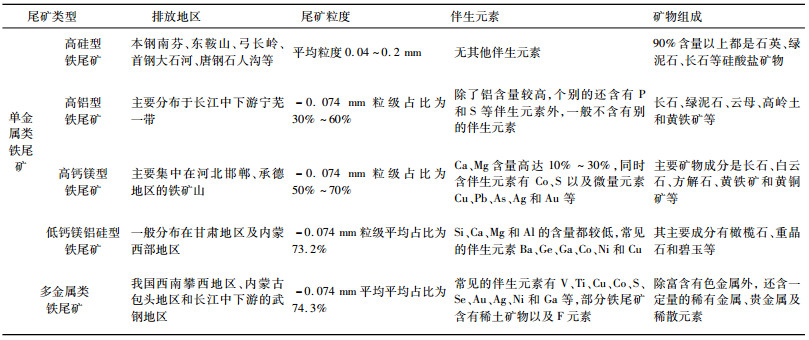
从表 1可以看出,铁尾矿中矿物相主要包括石英、绿泥石、长石、云母、方解石、白云石、橄榄石、重晶石以及少量含铁矿物等,由于资源分布较广、产地众多,不同类型铁尾矿的矿物种类有很大的差异。铁尾矿的粒度大多集中在1 mm以下,且共生关系复杂,含铁矿物与脉石矿物毗连呈紧密的连晶结构,单体解离度低。单金属类铁尾矿中,高硅和高铝型铁尾矿一般不含有伴生元素,而其他两种单金属类铁尾矿类型的伴生元素多且复杂;多金属类铁尾矿含有丰富的有色金属、稀贵金属以及稀土元素。
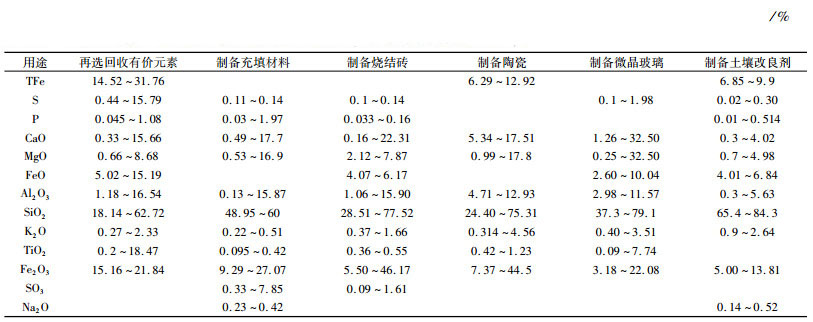
由于不同类型铁尾矿工艺矿物学特性的不同,它们可能被资源化利用的途径也会存在差异。由已有的利用途径铁尾矿的化学成分统计结果(如表 2)可以看出,不同类型铁尾矿具有多种可利用途径的特点,但高钙、高镁、高铝型铁尾矿富含Ca、Mg和Al等元素,很难制备土壤改良剂和肥料;此外与单金属类铁尾矿相比,多金属类铁尾矿更适用从其中回收有价金属。总之,只有在对不同类型铁尾矿工艺矿物学特性进行充分认识的基础上,才能分别选择出最为合适的资源化途径,开展二次资源再利用,从而实现铁尾矿的高效综合利用。
| 表 2 不同利用途径铁尾矿化学组成特点[36-49] Table 2 Chemical composition characteristics of iron tailings in different utilization ways |
|
2 我国铁尾矿的资源化技术 2.1 再选回收技术
我国铁尾矿的矿物组成复杂,伴生元素多样,除富含金属矿物外,还存在一定量的非金属矿物,部分类型的铁尾矿中还含有贵金属和稀土元素,可通过相应的再选技术对其中有价元素进行回收利用。但铁尾矿具有有用元素品位低、嵌布粒度细、共生关系复杂的特点,造成铁尾矿再选回收技术的难度大,已成为铁尾矿资源化利用的研究热点。
2.1.1 金属铁的回收在目前的技术及经济条件下,我国铁尾矿回收再选的边界全铁品位为7%,即对于铁品位7%以上的铁尾矿可根据实际情况进行开发利用[50]。针对铁尾矿再选回收铁的技术大致分为以下几种:全磁选流程、磁选—浮选联合流程、磁选—重选联合流程、重选—磁选—浮选联合流程、磁化焙烧—磁选联合流程、以及深度还原提铁技术等。相对而言,各种再选回收铁流程最终获得铁品位都要达到60%左右,但所得精矿中铁的回收率差别较大,全磁选流程一般所得精矿中铁的回收率低于20%,重选、磁选和浮选联选流程一般能获得30%~70%的铁回收率,而磁化焙烧法和深度还原法所获得铁回收率一般都可高达80%以上[51-65]。
2.1.2 其他有价金属的回收国内对铁尾矿中有色金属、贵金属和稀土元素等有价成分回收的研究起步较晚,但相关回收技术的发展较快。贺轶材等[66]开展了我国晋南地区矽卡岩型铁尾矿中金元素回收技术的研究,首先采用重选—磁选联合流程将铁矿物与脉石矿物分离,再采用淘金盘重选摇床选矿流程,最终得到金品位为18.17 g/t、回收率为75.7%的金精矿和铁品位为66.3%、回收率为20.81%的铁精粉。郑强等人[67]对白云鄂博选矿厂铁尾矿回收稀土资源进行研究,开展了钙化焙烧—弱磁选—盐酸浸出稀土工艺条件试验;在盐酸浓度为1.5 mol /L、浸出温度为45 ℃、液固比为10:1 mL/g、浸出时间为60 min、搅拌速度为300 r/min条件下,最终稀土浸出率可达93.15%。
2.1.3 非金属矿的回收目前铁尾矿中主要回收的非金属矿物有石英、磷灰石、云母、长石等,对铁尾矿中的有用矿物进行再选后可达到相应精矿标准[68-72]。例如本钢南芬选矿厂的铁尾矿,经过“给矿脱泥—弱磁—强磁—反浮选”的工艺流程,获得了产率21.51%、SiO2品位99.15%、回收率27.98%的石英精矿[73]。针对攀西白马钒钛磁铁矿尾矿,成都矿产综合利用研究所采用“再磨—硫钴浮选—弱磁除铁—强磁分离—重浮联合—强磁—反浮选”新工艺流程,实现了富集钛铁矿、分离尾矿高梯度强磁深度除铁、回收长石[74]。王玉峰等对云母含量为20%左右的某选铁尾矿,采用脱泥—碱性浮选工艺流程,最终试验获得了产率在10%左右,云母矿物含量在96%以上的云母精矿[75]。魏祥松等对磷灰石型矿石的选铁尾矿进行常温无碱浮选回收磷矿物,获得P2O5品位为37.88%、回收率为95.49%的磷精矿[76]。
综上所述,目前国内针对铁尾矿再选的相关工艺已经较为成熟,能够从铁尾矿的回收中获得品位较好的铁精矿,对其他有价元素的综合回收效果也较好。但统计发现铁尾矿整体综合利用率低于30%,而再选回收有价元素所消纳的铁尾矿数量所占比例很低,难度与成本也比处理铁矿石原矿更高,且仍然无法实现无尾排放,所以建立一个相对更为完善的铁尾矿利用机制,将尾矿中的每一种有价组分都利用起来才是综合利用的最佳方向。
2.2 铁尾矿制备材料技术从消纳铁尾矿数量角度来看,铁尾矿制备材料技术优于其再选回收技术,可以实现二次资源的最大化利用,绿色环保且能创造更大的经济效益。目前,利用铁尾矿制备的材料主要包括各种建筑用材料、采空区充填材料、肥料及土壤改良剂、介孔材料、3D打印材料等。大力发展铁尾矿制备材料技术能够充分体现我国的可持续发展战略。
2.2.1 制备建筑材料近年来国内外研究者对用铁尾矿制备建筑材料一直在不断探索中,当前研究集中于铁尾矿制备建筑用砖、微晶玻璃、墙体保温材料、陶瓷和水泥混凝土等[77-83],但是如何利用大宗量的铁尾矿成功地获得高附加值的建筑材料,实现产品的低成本工业化仍是目前研究的重点。
铁尾矿中含有大量硅的成分可以代替传统制砖用的原料黏土,尾矿中的钙、镁和铁的氧化物又具有一定助熔作用,因此是生产烧结砖、陶瓷砖、蒸压砖、透水砖和免蒸免烧砖等建筑用砖的良好材料[84-88]。陈永亮等以鄂西低硅铁尾矿为主要原料,添加少量的黏土、粉煤灰进行复配制备烧结砖,成品的抗压强度及其他耐久性能指标均能达到烧结普通砖合格品的国家标准;又以鄂西低硅铁尾矿、高岭土、石英砂为原料制备无釉瓷质砖,经烧结成瓷样品的主要性能均符合国家标准陶瓷砖要求[89]。总体来看,国内研究人员对铁尾矿制备烧结砖做了大量的研究工作,主要在烧结普通烧结砖和陶瓷砖的技术应用方面取得了一定成效。
微晶玻璃是铁尾矿制备建筑材料的一个新兴研究热点,其机械强度、化学稳定性、电性能均优于传统的普通玻璃。铁尾矿制备微晶玻璃对尾矿化学成分和矿物组成的要求较高,由于我国尾矿类型多且复杂,导致玻璃的颜色和性能都存在很大的差异,并且生产出的玻璃颜色受尾矿掺量影响无法调和,因此对铁尾矿掺量问题研究是微晶玻璃制备的关键[90-94]。有国内研究学者以铁尾矿和金尾矿作为主要原料,通过玻璃熔制—微波热处理方法进行微晶玻璃的制备,并且采用差热分析、显微形貌分析、X射线衍射分析和理化性能分析方法得出结果表明,这样制备的微晶玻璃综合性能要远超过普通的微晶玻璃[95]。
轻质隔热保温墙体材料制备也是铁尾矿资源化利用的一条新途径,能更好地满足建筑功能改善和建筑节能的要求,属于铁尾矿的高附加值产品范畴。目前生产轻质隔热墙体材料的主要方法有添加造孔剂法、有机泡沫浸渍法、发泡法等。陈永亮等[96]以铁尾矿为主要原料、稻壳为造孔剂、膨润土为黏结剂、长石为助熔剂,烧结制备了体积密度1.23 g/cm3、抗压强度7.6 MPa、导热系数0.29 W/(m·K)的轻质保温墙体材料。而尹洪峰等[97]以邯郸铁矿尾矿为原料,采用淀粉糊化固化的新方法,可以制备体积密度不超0.85 g/cm3、耐压强度大于0.5 MPa、导热系数不超过0.18 W/(m·K) 的轻质隔热墙体材料。
以铁尾矿为主原料,按照一定的配方添加其他材料制作陶瓷,使该陶瓷制品符合国家制陶的要求,许多矿山都做了很多有价值的工作,目前成功制备出的钢渣-尾矿陶瓷材料等,在性能上均能满足国家标准[98-99]。也有研究者[100]利用铁尾矿等原料,采用碳热还原法成功制备出了铁尾矿多孔陶瓷,为铁尾矿的高效利用提供了一种新思路。而在铁尾矿制备泡沫陶瓷制品过程中,如果铁尾矿中铁含量过高,虽然会适度提高陶瓷的强度,但是建立在降低发泡性能的前提下,导致陶粒的吸水性能降低,这是在接下来的研究中需要解决的问题之一。
铁尾矿中含有一定的铁元素,可以替代铁粉作为调节剂制备水泥熟料及混凝土;铁尾矿具有高硅铝质成分和低碱金属成分的特点,以石灰石、石英砂和铁尾矿作为原材料制备低碱水泥,可以提高生料易烧性和混凝土硬化早期体积稳定性;国内外研究水泥熟料生产时使用铁尾矿为原料,力学性能良好且拥有较高强度,可以有效降低金属污染物浓度,对固化金属有良好的效果[101-103]。但铁尾矿制备水泥混凝土方面仍处于理论研究阶段,主要是因为铁尾矿活性的制约导致其掺量不好掌握,控制不当可能会导致水泥的质量存在一定的问题,从而达不到国家标准。
2.2.2 制备充填材料我国大量的采空区集中在一些矿山及其周边地区,而治理采空区最有效的办法是进行充填,其中充填材料是保证充填工程质量的核心。地下采矿所遗留的采空区具有很多危险因素,容易导致地质灾害,所以采空区处理是矿山安全管理的难点。铁矿采空区采用尾砂胶结充填法、尾矿干式充填法和隔离法相结合的处理方式是最为有效的方法[104-105]。铁矿采空区充填方法虽然取得了一定的研究进展,但仍面临着充填成本较高的问题,约占到矿山开采成本的一半。目前最理想的思路是对铁尾矿与矿渣、钢渣、粉煤灰和煤矸石等固废进行相容性研究,通过化学激发和物理粉磨两种方式激发铁尾矿的潜在活性,探索大掺量铁尾矿作为充填用胶结材料的可行性,基于固废协同互补利用理论制备出充填用胶结材料[106-109]。利用铁尾矿作为充填材料,能够使数量可观的铁尾矿得以消纳,取代水泥胶结充填体,这样的替代明显节约了回填成本。对于超细铁尾矿制胶凝材料的试验研究虽已满足规范,但以现有技术的尾矿活性仍不足以实现其转化为产品加以应用,因此,如何提高铁尾矿在作胶凝材料时的活性,是实现技术突破的重点与关键。
2.2.3 制备肥料及土壤改良剂利用铁尾矿制备肥料和土壤改良剂是铁尾矿资源化利用的一个新途径,不仅可以解决铁尾矿堆存带来的环境问题,另一方面也将重新赋予了铁尾矿二次资源的应用价值。有少量磁铁矿的铁尾矿中含有植物生长所需和改善土壤营养的组分,可利用其载磁性能将其进一步磁化制成磁尾土壤改良剂,以铁尾矿为主要原料的复合改良剂对苏打盐碱地具有较好的改良效果,且改良后对土壤无毒副作用、无污染、无公害,具有较高的推广价值[110-111]。此外,可以在铁尾矿中掺入一定比例的N、P、K及部分微量元素,后经磁化制成磁尾复合肥料[112]。还有相关研究以铁尾矿、废钢渣、粉煤灰等不同固废与尿素、磷酸铵、氯化钾和氯化铵等普通肥料进行混合造粒,然后经磁化机在不同的磁化顺序、磁化时间、磁化强度以及外界磁场和放置时间条件下进行磁化得到缓释磁化肥料,对作物的氮磷钾吸收与积累均有突出的提高作用,且能明显抑制土壤中N、P和K养分流失[113]。铁尾矿采用高温烧结的方法制备硅肥也是一种新的途径,烧结过程中在煅烧温度为950 ℃时,制得的缓释硅肥可溶性SiO2可从0.70% 增加至20.77%,可以达到硅肥的国家标准[114]。
2.2.4 铁尾矿制备介孔材料介孔材料是一种孔径介于2~50 nm之间、有规律的孔道结构和高比表面积的新型材料。采用铁尾矿制备具有优良吸附、分离和催化性能的介孔材料是近年来铁尾矿资源化利用的新兴方向[115]。近年来有学者提出利用铁尾矿制备介孔微球的新工艺(见图 1),其工艺流程为:首先将质量比为1:2的铁尾矿与NaOH混合,在550 ℃条件下煅烧3 h;然后将煅烧后混合物加入去离子水中(固液体积比为1:5),在60 ℃条件下搅拌1.5 h得到悬浮液;再将悬浮液中过滤分离出来的硅源加入pH=10的溶液中,经40 ℃条件下搅拌24 h;最终将干燥后固体混合物与Na2SO4·10H2O混合均匀,放入180 ℃条件下高压反应釜12 h,成功地制备了纳米级介孔微球。该制备方法与水热法和蒸汽辅助转化法等传统方法相比,提高了高压釜的利用率,大大减少了污染物排放,简化了合成过程,并节约了能源和时间,为铁尾矿制备介孔微球的工业化应用提供了一条重要的途径[116]。
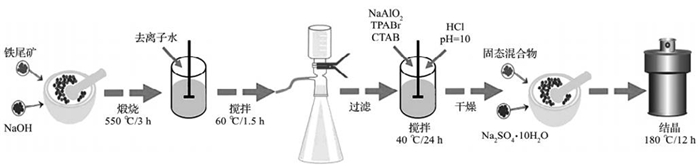 |
| 图 1 铁尾矿制备介孔微球工艺流程[116] Fig.1 Flowcheet of mesoporous microsphere preparation from iron tailings |
铁尾矿内石英和磁铁矿呈共存状态,其密度比磁铁矿低,易于流化,具有磁性可作为载体吸附生活污水中的污染物,用于城市污水处理,其吸附机理同样可用于吸附其他物质,因此铁尾矿也可用于制备介孔分子筛[117-118]。目前介孔分子筛常用的材料组分包括二氧化硅、硅酸钠、正硅酸乙酯等纯化工原材料,既存在成本问题又隐含有毒物质,将铁尾矿作为介孔分子筛的原材料,体现了铁尾矿转化为高附加值产品的可行性,使用铁尾矿制得的介孔分子筛吸附率和光降解效率均可达80%以上[119],但是对提高铁尾矿综合利用率的贡献较小,因此铁尾矿制备介孔分子筛的研究道路依然任重而道远。
2.2.5 铁尾矿制备3D打印材料3D打印又称快速成型,是一种逐层累加材料的技术,被誉为第三次工业革命的核心,因建造速度快、成本低、低碳环保等特点被广泛应用,在3D打印技术不断进步的同时,3D打印材料也得到了很大的发展。铁尾矿含铁量较高,而铁本身强度又比较高,所以在3D打印材料中掺入适量的铁尾矿会提高材料的强度[120]。铁尾矿还含有石粉,能起到晶核的作用,可以加速水泥早期的水化,并且加速钙矾石的形成进而提高材料的早期强度,铁尾矿的加入还会降低3D打印材料造价,极大地提高材料制备的性价比[121]。有研究者以铁尾矿和铜尾矿为研究对象,制备了铜/铁尾矿胶凝复合材料,经性能检测和应用分析,满足产品的国家标准要求,是3D打印建筑材料的极佳选择[122]。此外,国内也有以铁尾矿和普通硅酸盐水、硫铝酸盐水泥、普通河沙为原材料制备3D打印材料的探索研究[123],但其涉及原材料种类较多,铁尾矿与其他各种原材料之间的影响和交互作用有待于进一步深入研究。
3 结论与展望我国铁尾矿极细的颗粒粒径、多棱角的颗粒形态和复杂的矿物组分等工艺矿物学特性是造成难以大宗量高效利用的主要原因。虽然国内研究者在铁尾矿资源化利用技术方面做了大量研究工作,但铁尾矿资源化利用成效不容乐观。铁尾矿再选回收有价元素时,要求的工艺更为复杂,一般采用重选、磁选、浮选联合选别流程,且选别成本更高,仍然无法全面消除尾矿排放堆存问题;铁尾矿用于制备高附加值产品的资源化利用途径,虽在一定程度上可解决铁尾矿长期堆存带来的环境问题,但多存在制备流程复杂、规模化利用率低的问题,而且新兴资源化技术仍需大量试验数据与理论实践支撑。因此,加强相关理论研究,开展不同类型铁尾矿再选流程与高附加值产品制备流程的协同机制研究,实现铁尾矿的大宗量高效循环利用,是需要进一步深入研究和技术攻关的重要方向。
| [1] |
刘淑鹏, 张小伟. 我国金属矿山尾矿综合利用现状及对策[J]. 中国资源综合利用, 2020, 38(3): 75-78. LIU S P, ZHANG X W. Comprehensive utilization status and countermeasures of tailings in metal mines in China[J]. Comprehensive Utilization of Resources in China, 2020, 38(3): 75-78. DOI:10.3969/j.issn.1008-9500.2020.03.023 |
| [2] |
黄勇刚. 我国铁尾矿资源的利用现状及展望[J]. 资源与产业, 2013(3): 40-44. HUANG Y G. Utilization status and prospect of iron tailings resources in China[J]. Resources and Industry, 2013(3): 40-44. |
| [3] |
刘玉林, 刘长淼, 刘红召, 等. 我国矿山尾矿利用技术及开发利用建议[J]. 矿产保护与利用, 2018(6): 140-144. LIU Y L, LIU C M, LIU H Z, et al. Suggestions on utilization technology and development of mine tailings in China[J]. Conservation and Utilization of Mineral Resources, 2018(6): 140-144. |
| [4] |
杨亚东, 刘新亮, 张冰, 等. 铁尾矿资源综合利用现状研究[J]. 化工矿物与加工, 2021, 50(1): 28-32. YANG Y D, LIU X L Z B, et al. Research on the current status of the comprehensive utilization of iron tailings resources[J]. Chemical Minerals and Processing, 2021, 50(1): 28-32. |
| [5] |
陈虎, 沈卫国, 单来, 等. 国内外铁尾矿排放及综合利用状况探讨[J]. 混凝土, 2012(2): 88-92. CHEN H, SHEN W G, SHAN L, et al. Discussion on the emission and comprehensive utilization of iron tailings at home and abroad[J]. Concrete, 2012(2): 88-92. DOI:10.3969/j.issn.1002-3550.2012.02.028 |
| [6] |
GIRI S, DAS N, PRADHAN G. Magnetite powder and kaolinite derived from waste iron tailings for environmental applications[J]. Powder Technology, 2011, 214(3): 513-518. DOI:10.1016/j.powtec.2011.09.017 |
| [7] |
BARAT S, TABATABAIE S P, SAMANI N, et al. Stabilization of iron ore tailings with cement and bentonite: a case study on golgohar mine[J]. Bulletin of Engineering Geology and the Environment, 2020, 79(8): 4151-4166. DOI:10.1007/s10064-020-01843-6 |
| [8] |
RESHAMA B, RAMASAMY S, NIGAMANANDA D. Synthesis of cobalt ferrite nanoparticles from waste iron ore tailings and spent lithium iron batteries for photo/sono-catalytic degradation of Congo Red[J]. Powder Technology, 2021(386): 519-527. |
| [9] |
MENDES B C, PEDROTI L G, FONTES M P, et al. Technical and environmental assessment of the incorporation of iron ore tailings in construction clay bricks[J]. Construction and Building Materials, 2019(227): 1-13. |
| [10] |
COURA I R, CARMIGNANO O R, HEITMANN A P, et al. Use of iron mine tailing as fillers to polyethylene[J]. Scientific Reports, 2021, 11(1): 7091-7098. DOI:10.1038/s41598-021-86456-z |
| [11] |
SHETTIMA A U, HUSSIN M W, et al. Evaluation of iron ore tailings as replacement for fine aggregate in concrete[J]. Construction and Building Materials, 2016(120): 72-79. |
| [12] |
DAS S K, KUMAR S, RAMACHANDRARAO P. Exploitation of iron ore tailing for the development of ceramic tiles[J]. Waste Management, 2000, 20(8): 725-729. DOI:10.1016/S0956-053X(00)00034-9 |
| [13] |
GALVO J L B, ANDRADE H D, BRIGOLINI G J, et al. Reuse of iron ore tailings from tailings dams as pigment for sustainable paints[J]. Journal of Cleaner Production, 2018(200): 412-422. |
| [14] |
BEDI A, SINGH B R, DESHMUKH S K, et al. An aspergillus aculateus strain was capable of producing agriculturally useful nanoparticles via bioremediation of iron ore tailings[J]. Journal of Environmental Management, 2018(215): 100-107. |
| [15] |
李玉凤, 包景岭, 张锦瑞. 铁尾矿资源开发利用现状分析[J]. 中国矿业, 2015, 24(11): 12-16. LI Y F, BAO J L, ZHANG J R. Analysis of the current development and utilization of iron tailings resources[J]. China Mining Industry, 2015, 24(11): 12-16. DOI:10.3969/j.issn.1004-4051.2015.11.004 |
| [16] |
舒敏, 刘昆, 李德军, 等. 铁尾矿资源化利用标准化现状及对策研究[J]. 中国标准化, 2021(11): 154-158. SHU M, LIU K, LI D J, et al. Standardization status and countermeasures of iron tailings resource utilization[J]. Standardization in China, 2021(11): 154-158. DOI:10.3969/j.issn.1002-5944.2021.11.022 |
| [17] |
闫满志, 白丽梅, 张云鹏, 等. 我国铁尾矿综合利用现状问题及对策[J]. 矿业快报, 2008(7): 9-13. YAN M Z, BAI L M, ZHANG Y P, et al. Current situation and countermeasures of comprehensive utilization of iron tailings in China[J]. Mining Express, 2008(7): 9-13. |
| [18] |
顾晓薇, 张延年, 张伟峰, 等. 大宗工业固废高值建材化利用研究现状与展望[J]. 金属矿山, 2022(1): 1-12. GU X W, ZHANG Y N, ZHANG W F, et al. Research status and prospect of high-value building materials utilization of bulk industrial solid waste[J]. Metal Mine, 2022(1): 1-12. |
| [19] |
王艳辉, 盛龙, 王建臣, 等. 河北省铁尾矿的利用现状与发展方向分析[J]. 产业与科技论坛, 2015, 14(6): 86-87. WANG Y H, SHENG L, WANG J C, et al. Analysis of the utilization status and development direction of iron tailings in Hebei Province[J]. Industry and Technology Forum, 2015, 14(6): 86-87. |
| [20] |
唐艳东, 马北越, 邓承继. 铁尾矿的资源化利用研究现状[J]. 耐火与石灰, 2021, 46(6): 23-27. TANG Y D, MA B Y, DENG C J. Research status of resource utilization of iron tailings[J]. Fire Resistance and Lime, 2021, 46(6): 23-27. |
| [21] |
孟祥然, 周月鑫, 郭晓影. 铁尾矿综合利用研究综述[J]. 辽宁科技学院学报, 2019, 26(3): 12-14. MENG X R, ZHOU Y X, GUO X Y. Research review on the comprehensive utilization of iron tailings[J]. Journal of Liaoning University of Science and Technology, 2019, 26(3): 12-14. |
| [22] |
CUI X W, GENG Y, LI T, et al. Field application and effect evaluation of different iron tailings soil utilization technologies[J]. Resources, Conservation and Recycling, 2021(173): 105746. |
| [23] |
ZHAO J S, NI K, SU Y P, et al. An evaluation of iron ore tailings characteristics and iron ore tailings concrete properties[J]. Construction and Building Materials, 2021(286): 122968. |
| [24] |
李瑾, 倪文, 范敦城, 等. 齐大山铁尾矿工艺矿物学研究[J]. 金属矿山, 2014(1): 158-162. LI J, NI W, FAN D C, et al. Process mineralogy of Qidashaniron tailings[J]. Metal Mine, 2014(1): 158-162. |
| [25] |
侯云芬, 赵思儒, 王婧婷. 铁尾矿粉的组成及其物理性能研究[J]. 粉煤灰综合利用, 2015(2): 26-28. HOU Y F, ZHAO S L, WANG J T. Study on the composition and physical property of iron tailings powder[J]. Comprehensive Utilization of Fly Ash, 2015(2): 26-28. DOI:10.3969/j.issn.1005-8249.2015.02.007 |
| [26] |
秦玉芳, 李娜, 王其伟, 等. 白云鄂博选铁尾矿稀土的工艺矿物学研究[J]. 中国稀土学报, 2021, 39(5): 796-804. QIN Y F, LI N, WANG Q W, et al. Process mineralogyof Bayan Obo iron tailings[J]. Chinese Journal of Rare Earth, 2021, 39(5): 796-804. |
| [27] |
胡神涛, 潘爱芳, 马润勇, 等. 陕西某钒钛磁铁矿选铁尾矿工艺矿物学研究[J]. 有色金属, 2021(5): 1-5. HU S T, PAN A F, MA R Y, et al. Process mineralogy of vanadium titanomagnetite in Shanxi[J]. Non-ferrous Metals, 2021(5): 1-5. |
| [28] |
唐志东, 陈国岩, 曲孔辉, 等. 鞍钢东部尾矿工艺矿物学研究[J]. 金属矿山, 2018(6): 109-113. TANG Z D, CHEN G Y, QU K H, et al. Process mineralogy of iron tailing at Anshan steel eastern[J]. Metal Mine, 2018(6): 109-113. |
| [29] |
王亚琴. 河北某铁尾矿工艺矿物学研究[J]. 现代矿业, 2018, 34(6): 151-153. WANG Y Q. Process mineralogy of an iron tailings in Hebei province[J]. Modern Mining, 2018, 34(6): 151-153. |
| [30] |
赵红星, 文娅, 胡航嘉, 等. 柞水某地铁尾矿品位偏高机制工艺矿物学研究[J]. 有色金属设计, 2020, 47(1): 1-4. ZHAO H X, WEN Y, HU H J, et al. Process mineralogy of high grade mechanism of some subway tailings in Zhashui[J]. Nonferrous Metal Design, 2020, 47(1): 1-4. |
| [31] |
陈继佳, 李文博. 含稀土萤石铁尾矿的工艺矿物学研究[J]. 中国矿业, 2022, 31(3): 67-72. CHEN J J, LI W B. Process mineralogy of rare earth fluorite iron tailings[J]. China Mining Industry, 2022, 31(3): 67-72. |
| [32] |
牛珊, 王硕. 含云母铁尾矿的工艺矿物学研究[J]. 中国金属通报, 2019(5): 50-52. NIU S, WANG S. Process mineralogy of biotite iron tailings[J]. China Metal Bulletin, 2019(5): 50-52. DOI:10.3969/j.issn.1672-1667.2019.05.033 |
| [33] |
杨召群, 揣新, 张宏光, 等. 某铁矿超细碎尾矿工艺矿物学研究[J]. 现代矿业, 2019, 35(10): 135-138. YANG Z Q, CHUAI X, ZHANG H G, et al. Process mineralogy of ultra finetailings of one iron mine[J]. Modern Mining, 2019, 35(10): 135-138. DOI:10.3969/j.issn.1674-6082.2019.10.041 |
| [34] |
万小金, 魏霞. 云南某铁尾矿工艺矿物学特性与选矿工艺研究[J]. 矿产综合利用, 2012(4): 39-42. WAN X J, WEI X. Research on mineralogy and mineral process of an iron tailings in Yunnan[J]. Comprehensive Utilization of Minerals, 2012(4): 39-42. DOI:10.3969/j.issn.1000-6532.2012.04.011 |
| [35] |
梁冬云, 洪秋阳. 某拜尔法赤泥选铁尾矿工艺矿物学研究[J]. 金属矿山, 2011(12): 39-42. LIANG D Y, HONG Q Y. Process mineralogy of a bale law red mud iron tailings[J]. Metal Mine, 2011(12): 39-42. |
| [36] |
李晶晶, 丁益民, 陆文雄, 等. 铁尾矿的处理及其资源化利用[J]. 粉煤灰综合利用, 2012(6): 52-56. LI J J, DING Y M, LU W X, et al. Treatment and recycling and utilization of iron tailings[J]. Comprehensive Utilization of Fly Ash, 2012(6): 52-56. DOI:10.3969/j.issn.1005-8249.2012.06.015 |
| [37] |
张淑会, 薛向欣, 金在峰. 我国铁尾矿的资源现状及其综合利用[J]. 材料与冶金学报, 2004(4): 241-245. ZHANG S H, XUE X D, JIN Z F. Current situation and comprehensive utilization of iron tailings resources in China[J]. Journal of Materials and Metallurgy, 2004(4): 241-245. DOI:10.3969/j.issn.1671-6620.2004.04.001 |
| [38] |
易龙生, 李行, 齐莉娜, 等. 铁尾矿用于路面基层材料的研究进展及前景[J]. 矿业研究与开发, 2015, 35(10): 27-32. YI L S, Li XING, Q L, et al. Research progress and prospect of iron tailings for road base materials[J]. Mining Research and Development, 2015, 35(10): 27-32. |
| [39] |
杨茂春, 周亮, 魏清成, 等. 某残坡积铁尾矿再选流程考查及工艺优化研究[J]. 中国矿业, 2020, 29(S2): 308-311. YANG M C, ZHOU L, WEI Q C, et al. Research on process optimization of a residual slope iron tailings[J]. China Mining, 2020, 29(S2): 308-311. |
| [40] |
黄玥. 磁化焙烧-磁选工艺回收铁尾矿中铁的研究[D]. 广州: 广东工业大学, 2020. HUANG Y. Study on recovery of iron tails by magnetic roaking-magnetic process[D]. Guangzhou: Guangdong University of Technology, 2020. |
| [41] |
李素. 复配捕收剂对某铁尾矿浮选回收钛铁矿的研究[D]. 武汉: 武汉理工大学, 2020. LI S. Study on iron tailings with compound capture[D]. Wuhan: Wuhan University of Technology, 2020. |
| [42] |
YI Z L, SUN H H, WEI X Q, et al. Iron ore tailings used for the preparation of cementitious material by compound thermal activation[J]. International Journal of Minerals Metallurgy and Materials, 2009, 16(3): 355-358. DOI:10.1016/S1674-4799(09)60064-9 |
| [43] |
吴瑞东. 石英岩型铁尾矿微粉及废石对水泥基材料的性能影响及机理[D]. 北京: 北京科技大学, 2020. WU R D. The influence mechanism of quartzite iron tailings powder and waste rock on cement-based materials[D]. Beijing: Beijing University of Technology and Science, 2020. |
| [44] |
代文彬, 王晓明, 谭皓纬, 等. 铁尾矿仿古蒸养青砖的配料工艺研究[J]. 混凝土与水泥制品, 2018(9): 47-52. DAI W B, WANG X M, TAN H W, et al. Ingredients process of iron tailings making for antique steamed green bricks[J]. Concrete and Cement Products, 2018(9): 47-52. DOI:10.3969/j.issn.1000-4637.2018.09.012 |
| [45] |
潘德安, 逯海洋, 刘晓敏, 等. 高硅铁尾矿制备轻质闭孔泡沫陶瓷研究[J]. 中国陶瓷, 2020, 56(3): 51-58. PAN D A, LU H Y, LIU X M, et al. Research on the preparation of lightweight closed-hole foam ceramics with high-level iron silicon tailings[J]. Chinese Ceramics, 2020, 56(3): 51-58. |
| [46] |
代卫丽, 陈鹏飞, 朱程程. 铁尾矿制备莫来石复相陶瓷的工艺研究[J]. 商洛学院学报, 2021, 35(6): 6-12. DAI W L, CHEN P F, ZHU C C. Preparation of morite compound phase ceramics by iron tailings[J]. Journal of Shangluo University, 2021, 35(6): 6-12. |
| [47] |
ZHAI J H, WANG H B, CHEN P, et al. Recycling of iron and titanium resources from early tailings: from fundamental work to industrial application[J]. Chemosphere, 2020, 24(2): 175-178. |
| [48] |
王广文. 铁尾矿制备烧结砖的物相转化及重金属的固化机理[D]. 广州: 广东工业大学, 2019. WANG G W. Phase conversion of iron tailings and curing mechanism of heavy metals[D]. Guangzhou: Guangdong University of Technology, 2019. |
| [49] |
李春, 韩茜, 董菁, 等. 商洛井边沟铁尾矿渣制备微晶玻璃的试验研究[J]. 矿产综合利用, 2016(1): 83-85. LI C, HAN Q, DONG J, et al. Experimental study on preparation of microcrystalline glass in Shangluo well[J]. Comprehensive Utilization of Minerals, 2016(1): 83-85. DOI:10.3969/j.issn.1000-6532.2016.01.019 |
| [50] |
陈甲斌, 贾文龙, 范继涛. 铁尾矿利用经济分析模型与应用[J]. 资源科学, 2009, 31(1): 152-156. CHEN J B, JIA W L, FAN J T. Economic analysis model and application of iron tailings using[J]. Resource Science, 2009, 31(1): 152-156. DOI:10.3321/j.issn:1007-7588.2009.01.020 |
| [51] |
MISHRA R.K., ROUT P.C., SARANGI K., et al. Solvent extraction of Fe (Ⅲ) from the chloride leach liquor of low grade iron ore tailings using aliquat 336[J]. Hydrometallurgy, 2011(108): 93-99. |
| [52] |
PANDA L, BISWAL S K, VENUGOPAL R, et al. Investigation of the mechanism for selective flocculation process using natural iron ore tailings[J]. Metallurgical Research&Technology, 2020, 117(1): 102-107. |
| [53] |
蒋京航, 叶国华, 胡艺博, 等. 铁尾矿再选技术现状及研究进展[J]. 矿冶, 2018, 27(1): 1-4. JIANG J H, YE G H, HU Y B, et al. Current situation and research progress of iron tailings recycling technology[J]. Mining and Metallurgy, 2018, 27(1): 1-4. |
| [54] |
余建文, 欧杨, 曲孔辉, 等. 鞍钢东部铁尾矿悬浮磁化焙烧-磁选试验[J]. 钢铁, 2021, 56(7): 25-30. YU J W, OU Y, QU K H, et al. Suspended magnetization-magnetic separation test of iron tailings at Anshan steel eastern[J]. Steel, 2021, 56(7): 25-30. |
| [55] |
杨龙, 韩跃新, 袁致涛, 等. 梅山铁尾矿强磁再选粗精矿深度还原试验[J]. 金属矿山, 2012(7): 148-150. YANG L, HAN Y X, YUAN Z T, et al. Depth reduction test of strong magnetic reselected crude concentrate in Meishan iron tailings[J]. Metal Mine, 2012(7): 148-150. DOI:10.3969/j.issn.1001-1250.2012.07.040 |
| [56] |
朱运凡, 杨波, 卢琳. 云南大红山铁尾矿再选新工艺研究[J]. 矿冶, 2012, 21(1): 35-38. ZHU Y F, YANG B, LU L. Research on new process of Dahongshan iron tailings in Yunnan[J]. Mining and Metallurgy, 2012, 21(1): 35-38. |
| [57] |
袁致涛, 马玉新, 毛卫东, 等. 马耳岭选矿厂尾矿中磁铁矿再回收试验研究[J]. 矿产保护与利用, 2014(2): 44-48. YUAN Z T, MA Y X, MAO W D, et al. Experimental study on magnetite recycling in tailings of malling concentrator[J]. Conservation and Utilization of Mineral Resources, 2014(2): 44-48. |
| [58] |
邓小龙, 李茂林, 刘旭, 等. 磁选-絮凝-反浮选从山东某铁尾矿中回收铁试验[J]. 金属矿山, 2018(6): 172-178. DENG X L, LI M L, LIU X, et al. Magnetic-flocculation-reverse flotation iron recovery from an iron tailings in Shandong[J]. Metal Mine, 2018(6): 172-178. |
| [59] |
张作金, 周振华, 韩佳宏, 等. 某超贫钒钛磁铁矿中有价元素综合回收试验研究[J]. 化工矿物与加工, 2022, 51(4): 15-18. ZHANG Z J, ZHOU Z H, HAN J H, et al. Experimental study on the comprehensive recovery of an ultra-poor vanadium titanomagnetite[J]. Chemical Minerals and Processing, 2022, 51(4): 15-18. |
| [60] |
马崇振. 用重选-磁选-反浮选法回收鞍山某尾矿中的铁[J]. 矿产保护与利用, 2021, 41(5): 111-117. MA C Z. Recycling iron in a tailings in Anshan by reconcentration-magnetic concentration-reverse flotation method[J]. Conservation and Utilization of Mineral Resources, 2021, 41(5): 111-117. |
| [61] |
贺宇龙. 白云鄂博尾矿综合回收稀土、萤石、铌、钪选矿新工艺[D]. 包头: 内蒙古科技大学, 2020. HE Y L. New process of comprehensive recovery of rare earth, fluorite, niobium and scandium in Bayan Obo tailings[D]. Baotou: Inner Mongolia University of Science and Technology, 2020. |
| [62] |
王明强. 齐大山铁矿选矿厂重选尾矿回收利用研究[J]. 工程建设, 2018, 50(5): 6-10. WANG M Q. Study on the recovery and utilization of redressing tailings in Qishan mountain iron mine concentration plant[J]. Engineering Construction, 2018, 50(5): 6-10. DOI:10.3969/j.issn.1001-2206.2018.05.002 |
| [63] |
袁致涛, 马玉新, 李庚辉, 等. 某铁尾矿再回收铁矿物试验研究[J]. 矿冶工程, 2016, 36(4): 37-40. YUAN Z T, MA Y X, LI G H, et al. Experimental study on iron mineral recovery of some iron tailings[J]. Mining and Metallurgy Engineering, 2016, 36(4): 37-40. DOI:10.3969/j.issn.0253-6099.2016.04.010 |
| [64] |
余力, 钟晋, 刘丽芬. 云南某铁尾矿选矿试验研究[J]. 矿业工程, 2014, 12(2): 10-13. YU L, ZHONG J, LIU L F. Study on beneficiprocessing of an iron tailings in Yunnan[J]. Mining Engineering, 2014, 12(2): 10-13. DOI:10.3969/j.issn.1671-8550.2014.02.004 |
| [65] |
付余. 山东某铁尾矿再选试验研究[J]. 山东化工, 2020, 49(12): 90-91. FU Y. Experimental study on reselection of an iron tailings in Shandong[J]. Shandong Chemical Industry, 2020, 49(12): 90-91. DOI:10.3969/j.issn.1008-021X.2020.12.037 |
| [66] |
贺轶才. 晋南选铁尾矿的综合回收利用[J]. 黄金地质, 1998(1): 79-81. HE Y C. Comprehensive recycling of selected iron tailings in southern Shanxi Province[J]. Gold Geology, 1998(1): 79-81. |
| [67] |
郑强, 边雪, 吴文远. 盐酸浸出白云鄂博选铁尾矿中经钙化焙烧的稀土[J]. 金属矿山, 2017(5): 197-200. ZHENG Q, BIAN X, WU W Y. Rare earth calcified baked in Bayan Obo iron tailings[J]. Metal Mine, 2017(5): 197-200. DOI:10.3969/j.issn.1001-1250.2017.05.039 |
| [68] |
张以河, 胡攀, 张娜, 等. 铁矿废石及尾矿资源综合利用与绿色矿山建设[J]. 资源与产业, 2019, 21(3): 1-13. ZHANG Y H, HU P, ZHANG N, et al. Comprehensive utilization of iron ore waste stone and tailings resources and construction of green mines[J]. Resources and Industry, 2019, 21(3): 1-13. |
| [69] |
李肖, 徐彪, 胡敏捷, 等. 本溪某铁尾矿制备高纯石英砂试验[J]. 现代矿业, 2018, 34(4): 106-108. LI X, XU B, HU M J, et al. Preparation of high purity quartz sand in Benxi[J]. Modern Mining, 2018, 34(4): 106-108. DOI:10.3969/j.issn.1674-6082.2018.04.026 |
| [70] |
聂轶苗, 刘淑贤, 牛福生, 等. 回收承德某铁尾矿中低品位磷矿的试验研究[J]. 化工矿物与加工, 2015, 44(8): 4-7. NIE Y M, LIU S X, NIU F S, et al. Experimental study on the recovery of low-grade phosphate ore in some iron tailings in Chengde[J]. Chemical Mineral and Processing, 2015, 44(8): 4-7. |
| [71] |
霍松洋, 宋瑞杰, 罗世勇, 等. 承德某铁尾矿回收磷、钛的试验研究[J]. 世界有色金属, 2017(1): 35-36. HUO S Y, SONG R J, LUO S Y, et al. Experimental study on phosphorus and titanium recovery from an iron tailings in Chengde[J]. World Nonferrous Metals, 2017(1): 35-36. |
| [72] |
历平, 高野, 徐铜林, 等. 辽宁某铁尾矿云母选矿试验研究[J]. 中国非金属矿工业导刊, 2021(3): 53-55. LI P, TAKANO, XU T L, et al. Experimental study on mica beneficiation of an iron tailings mine in Liaoning province[J]. China Nonmetallic Mining Industry Guide, 2021(3): 53-55. |
| [73] |
许晗, 徐彪, 陈煊年. 南芬铁尾矿回收石英试验研究[J]. 矿业工程, 2017, 15(5): 21-24. XU H, XU B, CHEN X N. Experimental study on quartz recovery of Nanfeniron tailings[J]. Mining Engineering, 2017, 15(5): 21-24. |
| [74] |
刘烜, 袁波. 攀西钒钛磁铁矿尾矿利用新技术助力有价元素深度回收[J]. 中国矿山工程, 2020, 49(1): 75-76. LIU X, YUAN B. Panxi vanadium titanium-magnetite tailings uses new technology to help the deep recovery of valuable elements[J]. China Mining Engineering, 2020, 49(1): 75-76. |
| [75] |
王玉峰. 选铁尾矿回收云母选矿试验[J]. 现代矿业, 2013(6): 31-34. WANG Y F. Mica dressing test of iron dressing tailings recovery[J]. Modern Mining, 2013(6): 31-34. |
| [76] |
魏祥松. 选铁尾矿综合回收利用低品位磷、钛、钴技术工业化应用[J]. 化工矿产地质, 2010, 32(4): 238-240. WEI X S. Industrial application of comprehensive recovery and utilization of low-grade phosphorus, titanium and cobalt technology in iron selection tailings[J]. Chemical and Mineral Geology, 2010, 32(4): 238-240. |
| [77] |
路畅, 陈洪运, 傅梁杰, 等. 铁尾矿制备新型建筑材料的国内外进展[J]. 材料导报, 2021, 35(5): 5011-5026. LU C, CHEN H Y, FU L J, et al. Progress in the preparation of new building materials by iron tailings[J]. Material Guide, 2021, 35(5): 5011-5026. |
| [78] |
蔡霞. 铁尾矿用作建筑材料的进展[J]. 金属矿山, 2000(10): 45-48. CAI X. Progress in iron tailings used as building material[J]. Metal Mines, 2000(10): 45-48. |
| [79] |
潘德安, 逯海洋, 刘晓敏, 等. 高硅铁尾矿制备轻质闭孔泡沫陶瓷研究[J]. 中国陶瓷, 2020, 56(3): 51-58. PAN D A, LU H Y, LIU X M, et al. Research on preparation of light closed-hole foam ceramics by high-level iron silicon tailings[J]. Chinese Ceramics, 2020, 56(3): 51-58. |
| [80] |
杨航, 申士富, 刘海营, 等. 铁尾矿和废石制备建筑外墙防火保温陶瓷材料[J]. 矿冶, 2016, 25(6): 45-50. YANG H, SHEN S F, LIU H Y, et al. Iron tailings and waste stone preparation of building exterior wall fire insulation ceramic materials[J]. Mining and Metallurgy, 2016, 25(6): 45-50. |
| [81] |
陈盛建, 陈吉春, 高宏亮, 等. 铁尾矿制备微晶玻璃研究的进展[J]. 矿业快报, 2004(3): 27-30. CHEN S J, CHEN J C, GAO H L, et al. Progress in preparation of microcrystal glass[J]. Mining Express, 2004(3): 27-30. |
| [82] |
尹洪峰, 王明利, 任耘, 等. 利用邯郸铁矿尾矿制备轻质隔热墙体材料[J]. 金属矿山, 2006(8): 76-78. YIN H F, WANG M L, REN Y, et al. Preparation of light insulated wall material[J]. Metal Mine, 2006(8): 76-78. |
| [83] |
吕兴栋, 刘战鳌, 朱志刚, 等. 尾矿作为水泥和混凝土原材料综合利用研究进展[J]. 材料导报, 2018(2): 452-456. LU X D, LIU Z A, ZHU Z G, et al. Research progress in the comprehensive utilization of tailings as a raw material for cement and concrete[J]. Material Guide, 2018(2): 452-456. |
| [84] |
YANG C M, CUI C, QIN J, et al. Characteristics of the fired bricks with low-silicon iron tailings[J]. Construction and Building Materials, 2014, 70(5): 36-42. |
| [85] |
LI W S, LEI G Y, XU Y, et al. The properties and formation mechanisms of eco-friendly brick building materials fabricated from low-silicon iron ore tailings[J]. Journal of Cleaner Production, 2018(204): 685-692. |
| [86] |
贾清梅, 张锦瑞, 李凤久. 高硅铁尾矿制取蒸压尾矿砖的研究[J]. 中国矿业, 2006(4): 39-41. JIA Q M, ZHANG J R, LI F J. Research on making autoclaved tailing brick from high-level iron silicon tailings[J]. China Mining Industry, 2006(4): 39-41. |
| [87] |
王金忠, 李晖, 辛向阳. 利用铁尾矿生产烧结砖的试验研究[J]. 辽宁建材, 2000(3): 21-23. WANG J Z, LI H, XIN X Y. Experimental study on sintered brick production using iron tailings[J]. Liaoning Building Materials, 2000(3): 21-23. |
| [88] |
LUO L Q, LI K Y, FU W, et al. Preparation, characteristics and mechanisms of the composite sintered bricks produced from shale, sewage sludge, coal gangue powder and iron ore tailings[J]. Construction and Building Materials, 2020(232): 1-8. |
| [89] |
陈永亮. 鄂西低硅铁尾矿烧结制砖及机理研究[D]. 武汉: 武汉科技大学, 2012. CHEN Y L. Research on the mechanism of brick sintering from low iron silicon tailings in western Hubei[D]. Wuhan: Wuhan University of Science and Technology, 2012. |
| [90] |
杨博宇, 张雪峰. 微波加热法制备尾矿微晶玻璃的研究[J]. 中国陶瓷, 2018, 54(2): 63-67. YANG B Y, ZHANG X F. Study on preparation of microcrystalline glass by microwave heating[J]. Chinese Ceramics, 2018, 54(2): 63-67. |
| [91] |
张锦瑞, 倪文, 王亚利. 利用铁尾矿制取微晶玻璃的研究[J]. 金属矿山, 2005(11): 72-74. ZHANG J R, NI W, WANG Y L. Study of microcrystalline glass by using iron tailings[J]. Metal Mine, 2005(11): 72-74. |
| [92] |
郭明彬. 铁尾矿试制微晶玻璃的研究[J]. 矿业快报, 2006(5): 21-23. GUOM B. Research on microcrystalline glass for trial production by iron tailings[J]. Mining Express, 2006(5): 21-23. |
| [93] |
陈吉春, 陈盛建. 低硅铁尾矿微晶玻璃成分的研究[J]. 金属矿山, 2005(5): 60-63. CHEN J C, CHEN S J. Study on microcrystalline glass composition of low silicon iron tailings[J]. Metal Mine, 2005(5): 60-63. |
| [94] |
邢军, 吕荣, 宋守志, 等. 铁尾矿微晶玻璃的组成设计与晶化研究[J]. 矿产综合利用, 2001(2): 38-42. XING J, LV R, SONG S Z, et al. Composition design and crystallization study of iron tailings microcrystal glass[J]. Comprehensive Utilization of Minerals, 2001(2): 38-42. |
| [95] |
ZHANG X, AI Z, JIA F, et al. Generalized one-potsynthesis, characterization, and photocatalytic activity of hierarchical BiOX (X=Cl, Br, I) nanoplate microspheres[J]. The Journal of Physica Chemistry C, 2008, 112(3): 747-753. |
| [96] |
陈永亮, 石磊, 杜金洋, 等. 铁尾矿轻质保温墙体材料的制备及性能研究[J]. 建筑材料学报, 2019, 22(5): 721-729. CHEN Y L, SHI L, DU J Y, et al. Study on the preparation and properties of iron tailings[J]. Journal of Building Materials, 2019, 22(5): 721-729. |
| [97] |
尹洪峰, 王明利, 任耘, 等. 利用邯郸铁矿尾矿制备轻质隔热墙体材料[J]. 金属矿山, 2006(8): 76-78. YIN H F, WANG M L, REN Y, et al. Preparation of light insulated wall material[J]. Metal Mine, 2006(8): 76-78. |
| [98] |
黎邦城, 石棋, 胡海明, 等. 程潮铁尾矿制备泡沫陶瓷的研究[J]. 中国陶瓷, 2014, 50(9): 82-86. LI B C, SHI Q, HU H M, et al. Research on foam ceramics preparation by Chengchao iron tailings[J]. Chinese Ceramics, 2014, 50(9): 82-86. |
| [99] |
郭大龙, 李宇, 艾仙斌, 等. 利用铁尾矿制备低温烧结陶瓷材料[J]. 冶金能源, 2014, 33(3): 53-57. GUO D L, LI Y, AI X B, et al. Preparation of low-temperature sintering ceramic materials using iron tailings[J]. Metallurgical Energy, 2014, 33(3): 53-57. |
| [100] |
刘晓倩, 周洋, 刘旭峰, 等. 碳热还原法制备铁尾矿多孔陶瓷的结构与性能[J]. 矿产保护与利用, 2020, 40(3): 56-63. LIU X Q, ZHOU Y, LIU X F, et al. Structure and properties of iron tailings porous ceramics prepared by carbon thermal reduction method[J]. Conservation and Utilization of Mineral Resources, 2020, 40(3): 56-63. |
| [101] |
QIU J P, YANG L, SUN X G, et al. Strength characteristics and failure mechanism of cemented super-fine unclassified tailings backfill[J]. Minerals, 2017, 7(4): 58-64. |
| [102] |
TAN Y, ZHU Y, XIAO H. Evaluation of the hydraulic, physical, and mechanical properties of perviousconcrete using iron tailings as coarse aggregates[J]. Applied Sciences, 2020, 10(8): 2691-2696. |
| [103] |
XU X, SHU A. Research on application of iron tailings on road base[J]. Advanced Materials Research, 2013(743): 54-57. |
| [104] |
刘爱平, 曹苗佳, 张雄涛. 铁尾矿规模化利用研究现状及其利用途径[J]. 中国金属通报, 2019(11): 279-280. LIU A P, CAO M J, ZHANG X T. Research status and utilization of iron tailing[J]. China Metal Bulletin, 2019(11): 279-280. |
| [105] |
李恒天. 铁尾矿基充填材料研发及性能研究[D]. 济南: 山东大学, 2020. LI H T. Research and development and performance research of iron tailings-based filling material[D]. Jinan: Shandong University, 2020. |
| [106] |
张丹. 基于铅锌尾矿/铅锌冶金渣制备矿山采空区充填材料的研究[D]. 北京: 中国地质大学, 2016. ZHANG D. Research on the preparation of mine goaf filling materials based on lead-zinc tailings/lead-zinc metallurgical slag[D]. Beijing: China University of Geosciences, 2016. |
| [107] |
段圆圆. 煤基固废协同利用制备采空区充填膏体试验研究[D]. 包头: 内蒙古科技大学, 2021. DUAN Y Y. Study on cooperative utilization of coal-based solid waste[D]. Baotou: Inner Mongolia University of Science and Technology, 2021. |
| [108] |
张静文. 铁矿矿山充填采矿用胶结充填料研究[D]. 北京: 北京科技大学, 2014. ZHANG J W. Study on cemented packing materials for filling and mining in iron ore mines[D]. Beijing: University of Technology and Science, Beijing, 2014. |
| [109] |
纪宪坤, 周永祥, 杨建辉, 等. 铁尾矿全尾砂胶结充填固化剂及工程应用[J]. 新型建筑材料, 2014, 41(4): 30-33. JI X K, ZHOU Y X, YANG J H, et al. Iron tailings whole tailings sand cement filling curing agent and engineering application[J]. New Building Materials, 2014, 41(4): 30-33. |
| [110] |
张丛香, 刘润华, 刘双安, 等. 利用铁尾矿改良苏打盐碱地技术研究与应用[J]. 矿业工程, 2016, 14(1): 39-41. ZHANG C X, LIU R H, LIU S A, et al. Research and application of improving the soda-based saline-alkali land technology by iron tailings[J]. Mining Engineering, 2016, 14(1): 39-41. |
| [111] |
杨孝勇. 基于铁尾矿的新型盐碱地复合改良剂研制及应用[D]. 济南: 山东大学, 2020. YANG X Y. Development and application of new salt-alkali earth composite modifier based on iron tailings[D]. Jinan: Shandong University, 2020. |
| [112] |
牛京考, 袁怀雨, 刘保顺, 等. 矿山固体废弃物的综合利用与治理系统工程[J]. 中国矿业, 1999, 8(5): 47-49. NIU J K, YUAN H Y, LIU B S, et al. Comprehensive utilization and treatment system engineering of mine solid waste[J]. China Mining Industry, 1999, 8(5): 47-49. |
| [113] |
李丁. 缓释磁化复混肥料研制及肥效研究与应用[D]. 合肥: 安徽农业大学, 2013. LI D. Research and application of slow-release magnetized compound fertilizer and fertilizer efficiency[D]. Hefei: Anhui Agricultural University, 2013. |
| [114] |
丁文金, 李丁, 马友华, 等. 磁化复混肥料的磁化工艺及磁性稳定性研究[J]. 磷肥与复肥, 2014, 29(2): 13-15. DING W J, LI D, MA Y H, et al. Study on magnetization process and magnetic stability of magnetized compound fertilizer[J]. Phosphorus Fertilizer and Compound Fertilizer, 2014, 29(2): 13-15. |
| [115] |
许小东. 铁尾矿合成Fe-SBA-15介孔材料及性能研究[D]. 北京: 中国地质大学, 2019. XU X D. Study on the properties of Fe-SBA-15 mesoporous materials synthesized by iron tailings[D]. Beijing: China University of Geosciences, 2019. |
| [116] |
DONG G, TIAN G, GONG L, et al. Mesoporous zinc silicate composites derived from iron ore tailings for highly efficient dye removal: Structure and morphology evolution[J]. Microporous and Mesoporous Materials, 2020(305): 110352. |
| [117] |
吕扬. 铁尾矿为原料制备介孔分子筛[D]. 沈阳: 沈阳理工大学, 2009. LV Y. Iron tailings as raw material to prepare mesoporous molecular sieve[D]. Shenyang: Shenyang University of Technology, 2009. |
| [118] |
张鹏, 李素芹, 郭鹏辉, 等. 铁尾矿两步法制备多级孔ZSM-5分子筛[J]. 工程科学学报, 2022, 44(5): 894-899. ZHANG P, LI S Q, GUO P H, et al. Multi-stage porous ZSM-5 molecular sieve was prepared by a two-step iron tailings method[J]. Journal of Engineering Science, 2022, 44(5): 894-899. |
| [119] |
DENG Y X, XU X D, WANG R, et al. Characterization and photo catalytic evaluation of Fe-loaded mesoporous Mcm-41 prepared using iron and silicon sources extracted from iron ore tailing[J]. Waste and Biomass Valorization, 2020, 11(4): 1491-1498. |
| [120] |
孙仁东, 何百静, 谢慧东. 脱硫石膏对大掺量粉煤灰-矿渣粉干混砂浆性能的影响[J]. 中国粉体技术, 2012, 18(5): 72-76. SUN R D, HE B J, XIE H D. Effect of desulfurized gypsum on the performance of large mixed fly ash-slag powder dry mixed mortar[J]. China Powder Technology, 2012, 18(5): 72-76. |
| [121] |
李晓光, 景帅帅, 马玉平. 铁尾矿水泥砂浆的力学性能及孔结构特征[J]. 混凝土, 2014(6): 124-128. LI X G, JING S S, MA Y P. Mechanical properties and pore structure characteristics of iron tailings cement mortar[J]. Concrete, 2014(6): 124-128. |
| [122] |
路兴旺. 3D打印一次成型非承重墙体材料试验研究[D]. 沈阳: 沈阳工业大学, 2021. LU X W. Study on one-time non-bearing wall material for 3D printing[D]. Shenyang: Shenyang University of Technology, 2021. |
| [123] |
李新健. 铜/铁尾矿制备3D打印建筑材料及性能研究[D]. 北京: 中国地质大学, 2020. LI X J. Study on preparing 3D printed building materials and properties of copper/iron tailings[D]. Beijing: China University of Geosciences, 2020. |