


2. 西藏泽邦环境工程咨询有限公司, 西藏 日喀则 857000
2. Tibet Zebang Environmental Engineering Consulting Co., Ltd., Shigatse 857000, China
针对全球能源危机与气候变化的挑战,木质纤维素作为一种可持续的生物质资源,提供了减少化石燃料依赖并促进碳中和的重要机遇。然而,木质纤维素类生物质具有复杂紧密的结构,其在水中的溶解度有限。因此,木质纤维素的利用通常需要进行预处理,再将其各组分溶解后分离提取出来,这限制了其在生产高附加值产品方面的潜力[1-2]。
在木质纤维素预处理过程中,传统有机溶剂的工艺技术成熟、产物纯度高,但存在易燃易爆、回收过程耗能大以及残留溶剂影响后续酶解过程等问题[3-4]。离子液体(ILs)作为一类特殊的液体盐,由带电离子组成,在室温或接近室温下呈现液态,因其具有低可燃性、可忽略蒸气压以及较宽的液态温域、良好的热稳定性与溶解性等优势[5-10],已在溶解木质纤维素领域引起广泛关注。研究表明,ILs在溶解与分离木质纤维素方面具有独特的优势,特别是能够在不改变原有结构的前提下促进其高效溶解[10]。近年来的研究揭示了ILs对木质纤维素的溶解机理,它们通过与木质纤维素分子间的氢键相互作用,打破了木质纤维素中纤维素/半纤维素和木质素间的复杂网络结构[11]。然而,ILs本身的回收利用、成本效率及其在复杂体系中行为的研究仍存在诸多挑战,亟待深入探讨。
本研究以ILs为起点,首先探讨了ILs与木质纤维素间的相互作用及其溶解机理;其次论述了基于ILs的木质纤维素组分的高效分离提取方法;然后讨论了ILs的回收及再利用技术并分析其可行性;最后以对木质纤维素处理技术的现状和未来发展的展望对文章进行总结。
2 ILs溶解木质纤维素的机理研究 2.1 木质纤维素的结构木质纤维素主要由纤维素、半纤维素和木质素三组分组成,是构成植物细胞壁的主要成分,如图 1所示[12]。
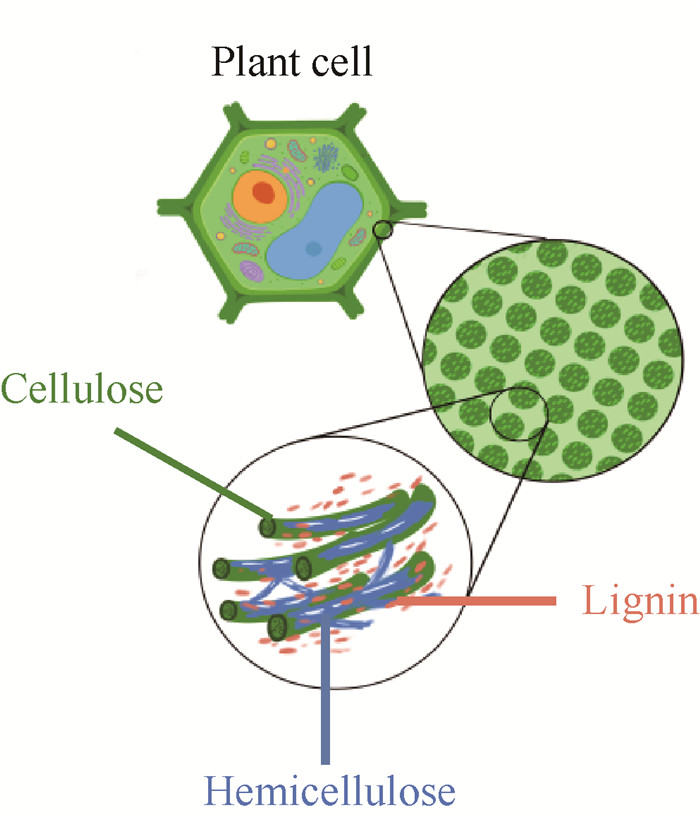
纤维素是由葡萄糖单元通过β-1, 4-糖苷键连接而成的多糖[13]。它形成长而刚性的链,为植物细胞壁提供机械强度[14]。每个葡萄糖单元的羟基足以形成链间和链内氢键,稳定本身分子结构,并与相邻分子连接形成微纤丝[15]。大量的分子间和分子内氢键,形成了纤维素复杂的三维氢键网络结构。半纤维素作为植物细胞壁中的主要成分之一与纤维素并列,主要是由两种或两种以上单糖组成的非均质聚糖,包括木糖、甘露糖、阿拉伯糖、葡萄糖、半乳糖及其衍生物[16],通过氢键和范德华力与纤维素和木质素紧密结合。木质素是目前唯一天然可再生的芳香族聚合物,主要分布于植物的次生细胞壁中[17],主要由3种羟基肉桂醇、鲸蜡硬脂醇和芥子醇组成。它赋予植物细胞壁刚性和强度,并保护其免受微生物的攻击[18]。Isik等[19]的研究便揭示了纤维素微纤丝的有序排列,以及半纤维素和木质素的填充情况。
纤维素、半纤维素和木质素通过复杂的物理缠结以及氢键、范德华力等化学作用,形成了复杂的结构。同时还具有纤维素的高度结晶、细胞壁的多级结构以及蜡状和含硅的防护层[20]。这些特点使得木质纤维素成为自然界中稳定且难以降解的物质之一,预处理工作尤为困难[21]。而ILs的介入,为破解这一稳定结构提供了全新的可能,ILs能够通过形成氢键、偶极-偶极和范德华相互作用等几种类型的相互作用,破坏木质纤维素生物质中三大组分之间的强连接,在预处理木质纤维素的过程中具有显著效果[22]。此外,改变阳离子和阴离子的结构可以调节溶解力,因此研究人员可以自由地设计特定的ILs以用于生物质预处理的不同需求,实现预处理过程的高效性和选择性[18, 23-25]。
2.2 纤维素的溶解纤维素在ILs中的溶解机理涉及纤维素中羟基的氧原子/氢原子与ILs相互作用形成电子供体-电子受体复合物[26]。在这个过程中纤维素原子作为电子供体,而氢原子作为电子受体。与之对应的是,ILs中阳离子充当电子受体中心,而阴离子则充当电子供体中心。通过纤维素的羟基与ILs之间的相互作用,羟基中的氧原子和氢原子被分离,进而破坏纤维素分子链之间的氢键结构,促使纤维素溶解[12]。
许多实验表明,ILs的阴离子在ILs溶解纤维素的能力中起着重要的作用。一般而言,阴离子作为氢键受体的能力与ILs溶解纤维素能力呈现正比关系[23]。例如具有形成氢键能力的Cl-、OAc-、HCOO-等阴离子可以与纤维素分子链中羟基上的氢原子形成氢键,这种相互作用有助于破坏纤维素分子链之间原有的氢键网络,促进纤维素溶解[27]。
阳离子与阴离子的协同作用有助于打破纤维素固有的氢键网络。Li等[28]通过对纤维素在ILs多样化体系下溶解行为的分子动力学模拟研究发现,阳离子利用范德华力与纤维素表面的六元环相结合,而阴离子则穿透纤维素层面并与其羟基建立氢键。随着越来越多阴离子的渗透,纤维素链吸引了更多阳离子,由于阴阳离子之间强烈的电荷吸引关系,纤维素分子解体并最终溶解。
李垚[29]对纤维素微丝在[Emim]OAc的溶解过程进行了长时间的分子动力学模拟,发现微丝表层的单链是以剥离的形式从内圈到外圈逐渐溶解。并且在溶解过程中ILs阴阳离子分布于微丝的不同位置。以[Emim]OAc为例,阴离子[OAc]-主要在纤维素链水平方向上与纤维素的羟基作用,而阳离子[Emim]+更多地在疏水面上与纤维素微丝接触。在溶解过程中,[OAc]-主要与纤维素链上极性的羟基形成氢键,而[Emim]+上活泼的C2-H会与纤维素中的羟基氧原子或者醚键氧原子作用,这属于极性区域之间的相互作用;由于电子离域,[Emim]+的咪唑环与纤维素的葡萄糖环存在一定的疏水相互作用,这是非极性区域之间的相互作用。总之,ILs和纤维素均有极性和非极性区域的存在,这一特点使得ILs成为一种能够高效溶解纤维素的溶剂。
2.3 半纤维素的溶解半纤维素的溶解则更加复杂,半纤维素与纤维素的结合通过氢键实现,而它与木质素之间则是通过以α-苄基醚键为主的共价键相连。对半纤维素进行溶解和预处理时,碱处理方法是最为广泛采用的技术[30]。Sun等[31]和Li等[32]通过结合使用ILs和连续的碱处理手段,提升半纤维素的分离效率,其研究表明,ILs的预处理步骤能够增加碱溶解过程中半纤维素的产率与分子量。此外,相关的分析和特性鉴定表明,这种处理方法能在保证半纤维素结构未受到显著破坏的前提下,有效提高半纤维素的热稳定性[32]。因此,经过这种处理方法分离出的半纤维素不仅收率高、相对分子质量大,并且具有成为高附加值产品原料的潜力。不同生物物种中细胞壁内半纤维素结构的多样性,为研究其溶解机制带来了额外的挑战。如今,有关ILs在溶解半纤维素机理方面的研究报道仍然较为有限。
2.4 木质素的溶解木质素相对于纤维素和半纤维素具有更复杂的结构,但其溶解机理与纤维素相似。由于木质素具有复杂的三维交联结构,在传统溶剂中其溶解度通常较低,这主要是因为木质素分子之间存在着强氢键力和π-π堆叠相互作用。然而,现有的研究成果显示,ILs(尤其是咪唑盐类ILs)对木质素显示出较好的溶解能力[33]。Zhu等[34]发现木质素溶解过程中咪唑阳离子通过π-π堆积和分子间氢键与异丙基甘油-β-愈创木酰醚(VG)相互作用,从而促进木质素溶解。Zubeltzu等[35]指出咪唑阳离子中的酸性氢原子趋向于集中在木质素羟基氧的周围,这一现象表明在木质素的溶解过程中,阳离子在稳定芳香环和羟基氧方面发挥了重要作用。但溶解过程中起主要作用的依然是阴离子,研究显示,质子型ILs对木质素有着显著的溶解作用[36-37],例如,由醋酸与胺发生反应形成的ILs,能够有效地从木质素纤维生物质中提取超过70 % 的木质素[21]。
3 基于ILs的木质纤维素组分的分离提取 3.1 分离提取方法基于ILs的木质纤维素分离策略正在逐步成为一个高效且可持续的预处理手段,可以根据木质纤维素组分的化学特性和所需的纯度要求,选择合适的ILs进行相应的溶解和分离处理。根据木质纤维素中所需提取组分的种类以及ILs的溶解特性,可以大致归结两种分离提取方法,即完全溶解法和选择性溶解法[38]。目前,常以加入反溶剂或调节pH等方法提取出所需组分,其中,较常见的反溶剂有水、甲醇、乙醇、NaOH、丙酮、乙腈、四氢呋喃等[39]。
溶解了木质纤维素的ILs如果不进行分离纯化就直接进行二次利用,其中残留的降解产物可能会影响ILs的物理化学性质,例如改变电导率、表面张力和黏度等。这些变化可能会降低ILs作为溶剂的效率,影响其在后续应用中的性能,对ILs的选择性、产物的纯度和ILs的回收再利用等产生影响[40-41]。
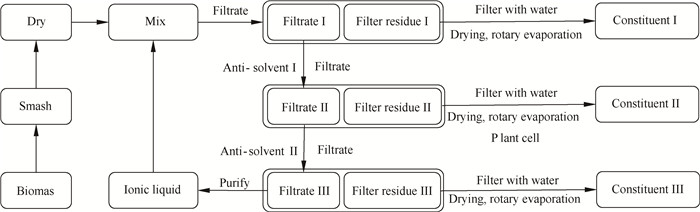
3.1.1 完全溶解法完全溶解法是使用一种对木质纤维素三组分都有一定溶解效果的ILs,将这3种组分完全溶解,而后通过加入不同的反溶剂等实现逐级沉淀分离,分别得到所需的不同组分。此方法提取的组分纯度相较偏低,但能够为随后的分离过程提供一个均质化的溶液环境,后续单种ILs的纯化以及回收利用较简便,使用较为普遍。
在使用完全溶解法分离提取木质纤维素时,[Emim]Cl和[Bmim]Cl等都是十分常见的ILs。这些ILs因为其较低的熔点和优异的化学稳定性,并且对木质纤维素三组分都有一定溶解效果而特别适合作为完全分离木质纤维素的介质[26, 42],流程图如图 2所示。
|
图 2 完全溶解法流程图 Fig.2 Flow chart of complete dissolution method |
Sun等[43]使用[C2mim]OAc将木材完全溶解,将得到的生物质溶液与丙酮水溶液混合,使纤维素沉淀,随后通过蒸发丙酮将木质素从滤液中分离,最后剩余ILs与水的混合溶液。Alan等[44]通过在木质纤维素溶液中加入NaOH溶液后,形成了两相体系。其中ILs相基本不含生物质成分,可以直接重新使用而无需经过复杂处理。而碱液相则含有溶解的木质素、半纤维素以及纤维素沉淀,通过简单的过滤或离心可以实现纤维素的沉淀分离,木质素可通过调节pH至酸性沉淀分离,而剩余的酸性溶液中的半纤维素则可以通过超滤或反渗透技术进行分离。
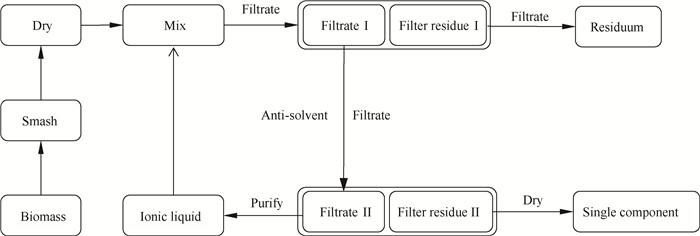
3.1.2 选择性溶解法选择性溶解法是一种利用ILs的特性进行目标木质纤维素组分选择性溶解的技术。相较于完全溶解法,选择性溶解法更侧重于对特定组分的溶解,这种方法可以通过选用仅对特定组分有强溶解性的ILs将其单独溶解分离,而不影响其他组分。通过此方法提取的组分纯度更高,但若想将三组分都提取则需使用多种ILs,而实现多种ILs的纯化以及回收利用十分困难,给后续提取其他组分增加难度以及经济负担。
在使用选择性溶解法分离提取木质纤维素时,常见的ILs包括[Emim]OAc、[Bmim]HSO4和磷onium基ILs等。这些ILs通常对特定木质纤维素组分有很强的亲和力,能有效解构目标组分间的化学键并将其转移到溶液相中,同时尽量减少对其他组分的影响[45],而选择性溶解法的ILs通常也是专门针对特定组分而设计[2]。如图 3所示是选择性溶解法的流程图。值得注意的是,选择性溶解法对溶解条件的控制相较于完全溶解法要更加严格。
|
图 3 选择性溶解法流程图 Fig.3 Flow chart of selective dissolution method |
如苗长林等[46]利用[ChCl][Gly]从尾叶桉木中提取木质素,木质素的提取率能达到93.73 %,再生木质素纯度为96.3 %,在这个过程中纤维素和半纤维素几乎没有发生溶解。Lee等[47]采用[Emim][CH3COO]作为预处理溶剂提取木粉中的木质素,在木质纤维素的预处理过程中纤维素与半纤维素不会被溶解,并能降低纤维素的结晶度,提高酶对纤维素的水解效率。Anugwom等[48]研究了由醇(正己醇或正丁醇)、CO2和脒(1, 8-二氮杂二环-[5.4.0]-十一碳-7-烯)制成的开关型离子液体(SILs)作为木材材料的溶解/分馏溶剂,可以从木材材料中选择性提取半纤维素。
3.2 影响因素(1) 粒度。粒度会直接影响ILs与木质纤维素样品的接触与扩散。Chambon等[49]通过研究得出结论,较小的颗粒应该更适合用于ILs处理过程。因为较小的颗粒拥有更大的表面积,并且生物质在研磨过程中原本的结构会被破坏,以促进生物质在ILs中的溶解[50-51]。
(2) 温度。一般随着温度升高,ILs的黏度会降低,木质纤维素在ILs中的溶胀和溶解速率会加快,当温度降低,生物质的有效溶胀和溶解则会需要更长的时间[40, 52]。温度也会影响ILs对木质纤维素的选择性,Wei等[53]发现在高温条件下,原本几乎不溶解纤维素的[Bmim]Cl经过长时间处理,可以有效溶解纤维素。更高的温度有助于提高溶解效率,但同时也会导致碳水化合物和ILs本身的降解,以及木质素性质的改变[52]。此外,保持更高的温度会消耗更多的能源,不利于反应的可持续性与经济性。因此,必须根据所使用的生物质和ILs优化溶解过程中的温度选择[54]。
(3) 时间。据报道,较长的预处理时间有利于木质素提取,这个过程中ILs向生物质中的扩散得到改善,从而促进了从生物质中分离提取木质素[50]。然而,预处理的时间过长(尤其是在高温条件下)会导致再生颗粒收集困难,回收率反而下降[52]。
(4) 含水量。生物质的溶解过程对生物质的含水量很敏感,水对木质纤维素的溶解具有抑制作用,并可能会降低纤维素在ILs中的溶解度[50, 55]。此外,残留的水分也会显著影响ILs的黏度和熔点[39, 56]。
除了上述影响因素外,生物质的种类[57-58]、液固比[54]、搅拌方式[50]、加热方式[59]等均会对木质纤维素组分分离提取过程产生影响。
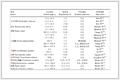
4 离子液体的回收利用 4.1 回收技术的研究现状ILs的独特物理化学性质,使得传统的溶剂回收技术不一定适用,因此,为实现经济性与环境可持续性,开发专门的回收技术变得尤为重要。目前,针对ILs的回收主要采用蒸馏、萃取、膜分离、吸附分离及相分离等多种技术,表 1中列举出了用于ILs回收的不同技术[60-76],可以看到,每一种都有其独特的应用场景和优点。
|
表 1 离子液体回收技术 Table 1 Ionic liquids recovery techniques |
为了提高回收率、回收纯度以及经济性,现阶段的研究正致力于优化4.1节提到的回收工艺。例如,传统蒸馏过程中需要的高温不仅增加能源消耗,还有可能导致ILs的热解。通过应用低温真空蒸馏,可以在更低的温度下进行蒸馏,从而降低能耗并减少ILs的破坏[77-78]。
在萃取过程中,选择或合成新型萃取剂(尤其是那些对ILs具有高选择性和亲和力的萃取剂)是研究的热点。高效的萃取剂可以显著提高ILs的回收纯度并减少所需萃取次数,为提高萃取效率,现代萃取法研究也在注重萃取剂的回收和再利用,以降低长期运行成本并减少萃取剂的消耗[79]。
此外,将工艺集成,如将萃取与吸附结合使用,同样是当前研究的重点,单独的萃取或吸附过程可能存在效率不高或成本不经济的问题。在萃取步骤将ILs从原混合物中分离出来之后,再利用吸附剂从萃取相中精细回收ILs,这种集成方法可以有效提高ILs的回收率及经济效益[67]。
5 结论本研究围绕ILs溶解、分离提取木质纤维素及ILs回收的过程展开分析讨论,所得关键结论如下:
(1) ILs通过形成氢键、偶极-偶极和范德华力等几种类型的相互作用破坏木质纤维素生物质中三大组分之间的强连接,以溶解木质纤维素。ILs中阴离子主要作为强氢键受体,竞争性结合木质纤维素的羟基等,瓦解分子内/间氢键。阳离子则通过疏水作用、范德华力等与六元环相互作用,协同促进木质纤维素溶解。
(2) 木质纤维素分离提取的方法可分为完全溶解法与选择性溶解法,完全溶解法操作简便,但产物纯度相较偏低;选择性溶解法可实现高纯度分离,但操作繁琐与并且需要多种ILs,后续回收困难,且经济性低。
(3) 对分离提取效率产生影响的关键因素包括:粒度、温度、时间和含水量,此外生物质种类与液固比也会影响分离效率。
(4) 针对ILs的回收主要采用蒸馏、萃取、膜分离、吸附分离及相分离等多种技术,每种技术都有其独特的应用场景与优点。目前研究的重点聚焦于通过合成新型高效的萃取剂、工艺集成等方法提升经济性,以达到为工业化应用提供支持的目的。
| [1] |
LIU Y R, NIE Y, LU X M, et al. Cascade utilization of lignocellulosic biomass to high-value products[J]. Green Chemistry, 2019, 21(13): 3499-3535. DOI:10.1039/C9GC00473D |
| [2] |
MOHTAR S S, BUSU T N Z T M, NOOR A M M, et al. Extraction and characterization of lignin from oil palm biomass via ionic liquid dissolution and non-toxic aluminium potassium sulfate dodecahydrate precipitation processes[J]. Bioresource Technology, 2015, 192: 212-218. DOI:10.1016/j.biortech.2015.05.029 |
| [3] |
VAIDYA A A, MURTON K D, SMITH D A, et al. A review on organosolv pretreatment of softwood with a focus on enzymatic hydrolysis of cellulose[J]. Biomass Conversion and Biorefinery, 2022, 12(11): 5427-5442. DOI:10.1007/s13399-022-02373-9 |
| [4] |
WEI KIT CHIN D, LIM S, PANG Y L, et al. Fundamental review of organosolv pretreatment and its challenges in emerging consolidated bioprocessing[J]. Biofuels, Bioproducts and Biorefining, 2020, 14(4): 808-829. DOI:10.1002/bbb.2096 |
| [5] |
刘宝友, 张佩文. 离子液体的进展——绿色制备及在环境修复中的应用研究[J]. 有机化学, 2018, 38(12): 3176-3188. LIU B Y, ZHANG P W. Progress of ionic liquids-green preparation and application research in environmental remediation[J]. Ch inese Journal of Organic Chemistry, 2018, 38(12): 3176-3188. |
| [6] |
GOGOI G, HAZARIKA S. Coupling of ionic liquid treatment and membrane filtration for recovery of lignin from lignocellulosic biomass[J]. Separation and Purification Technology, 2017, 173: 113-120. DOI:10.1016/j.seppur.2016.09.019 |
| [7] |
ZHANG J K, ZHOU G H, FANG T M, et al. Insight into the factors for separation of lignin and cellulose by ionic liquids based on molecular simulation[J]. Industrial & Engineering Chemistry Research, 2023, 62(36): 14700-14711. |
| [8] |
DONG S J, ZHANG B X, ZHANG P, et al. Functional acidic ionic liquids as effective solvents for the fractionation of lignocelluloses[J]. BioResources, 2019, 14(2): 4721-4732. DOI:10.15376/biores.14.2.4721-4732 |
| [9] |
李苏佳, 李宁杰, 何闽祖, 等. 离子液体在木质纤维素预处理中的应用[J]. 轻工科技, 2023, 39(2): 88-91. LI S J, LI N J, HE M Z, et al. The application of ionic liquids in wood cellulose pretreatment[J]. Light Industry Science and Technology, 2023, 39(2): 88-91. |
| [10] |
BHAT A H, KHAN I, USMANI M A, et al. Cellulose an ageless renewable green nanomaterial for medical applications: An overview of ionic liquids in extraction, separation and dissolution of cellulose[J]. International Journal of Biological Macromolecules, 2019, 129: 750-777. DOI:10.1016/j.ijbiomac.2018.12.190 |
| [11] |
ISHIDA T. Theoretical investigation of dissolution and decomposition mechanisms of a cellulose fiber in ionic liquids[J]. The Journal of Physical Chemistry B, 2020, 124(15): 3090-3102. DOI:10.1021/acs.jpcb.9b11527 |
| [12] |
HASANOV I, RAUD M, KIKAS T. The role of ionic liquids in the lignin separation from lignocellulosic biomass[J]. Energies, 2020, 13(18): 4864. DOI:10.3390/en13184864 |
| [13] |
ZHU J Y, PAN X J. Efficient sugar production from plant biomass: Current status, challenges, and future directions[J]. Renewable and Sustainable Energy Reviews, 2022, 164: 112583. DOI:10.1016/j.rser.2022.112583 |
| [14] |
SEDDIQI H, OLIAEI E, HONARKAR H, et al. Cellulose and its derivatives: Towards biomedical applications[J]. Cellulose, 2021, 28(4): 1893-1931. DOI:10.1007/s10570-020-03674-w |
| [15] |
LIU H Y, XU T, LIU K, et al. Lignin-based electrodes for energy storage application[J]. Industrial Crops and Products, 2021, 165: 113425. DOI:10.1016/j.indcrop.2021.113425 |
| [16] |
YU H, WANG J, YU J X, et al. Adsorption performance and stability of the modified straws and their extracts of cellulose, lignin, and hemicellulose for Pb2+: pH effect[J]. Arabian Journal of Chemistry, 2020, 13(12): 9019-9033. DOI:10.1016/j.arabjc.2020.10.024 |
| [17] |
AGARWAL A, RANA M, PARK J H. Advancement in technologies for the depolymerization of lignin[J]. Fuel Processing Technology, 2018, 181: 115-132. DOI:10.1016/j.fuproc.2018.09.017 |
| [18] |
WU W J, LI P H, HUANG L J, et al. The role of lignin structure on cellulase adsorption and enzymatic hydrolysis[J]. Bioma ss, 2023, 3(1): 96-107. |
| [19] |
ISIK M, SARDON H, MECERREYES D. Ionic liquids and cellulose: Dissolution, chemical modification and preparation of new cellulosic materials[J]. International Journal of Molecular Sciences, 2014, 15(7): 11922-11940. DOI:10.3390/ijms150711922 |
| [20] |
候其东, 鞠美庭, 李维尊, 等. 基于离子液体的生物质组分分离研究进展[J]. 化工进展, 2016, 35(10): 3022-3031. HOU Q D, JU M T, LI W Z, et al. Research progress on biomass fractionation using ionic liquids[J]. Chemical Industry and Engineering Progress, 2016, 35(10): 3022-3031. |
| [21] |
赵金政, 周国辉, 刘晓敏. 离子液体在生物质溶解分离中的应用与机理研究[J]. 化工学报, 2021, 72(1): 247-258. ZHAO J Z, ZHOU G H, LIU X M. Study on application and mechanism of ionic liquids in biomass dissolution and separation[J]. CIESC Journal, 2021, 72(1): 247-258. |
| [22] |
ZHOU L, LIU Y X, ZHANG J T, et al. Ionic liquid screening for lignocellulosic biomass fractionation: COSMO-RS prediction and experimental verification[J]. Journal of Molecular Liquids, 2024, 407: 125214. DOI:10.1016/j.molliq.2024.125214 |
| [23] |
XU A R, CHEN L, WANG J J. Functionalized imidazalium carboxylates for enhancing practical applicability in cellulose processing[J]. Macromolecules, 2018, 51(11): 4158-4166. DOI:10.1021/acs.macromol.8b00724 |
| [24] |
GEORGE A, BRANDT A, TRAN K, et al. Design of low-cost ionic liquids for lignocellulosic biomass pretreatment[J]. Green Chemistry, 2015, 17(3): 1728-1734. DOI:10.1039/C4GC01208A |
| [25] |
LIN X Q, JIANG K S, LIU X B, et al. Review on development of ionic liquids in lignocellulosic biomass refining[J]. Journal of Molecular Liquids, 2022, 359: 119326. DOI:10.1016/j.molliq.2022.119326 |
| [26] |
USMANI Z, SHARMA M, GUPTA P, et al. Ionic liquid based pretreatment of lignocellulosic biomass for enhanced bioconversion[J]. Bioresource Technology, 2020, 304: 123003. DOI:10.1016/j.biortech.2020.123003 |
| [27] |
车睿敏, 郑文秋, 王小宇, 等. 基于离子液体的纤维素均相加工研究进展[J]. 化工学报, 2023, 74(9): 3615-3627. CHE R M, ZHENG W Q, WANG X Y, et al. Research progress on homogeneous processing of cellulose in ionic liquids[J]. CIESC Journal, 2023, 74(9): 3615-3627. |
| [28] |
LI Y, LIU X M, ZHANG Y Q, et al. Why only ionic liquids with unsaturated heterocyclic cations can dissolve cellulose: A simulation study[J]. ACS Sustainable Chemistry & Engineering, 2017, 5(4): 3417-3428. |
| [29] |
李垚. 离子液体溶解生物质的分子模拟研究[D]. 北京: 中国科学院大学(中国科学院过程工程研究所), 2017. LI Y. Molecular simulation study on dissolution of lignocellulosic biomass in ionic liquids[D]. Beijing: Institute of Process Engineering, University of Chinese Academy of Sciences, 2017. |
| [30] |
LAN W, LIU C F, SUN R C. Fractionation of bagasse into cellulose, hemicelluloses, and lignin with ionic liquid treatment followed by alkaline extraction[J]. Journal of Agricultural and Food Chemistry, 2011, 59(16): 8691-8701. DOI:10.1021/jf201508g |
| [31] |
SUN S N, LI M F, YUAN T Q, et al. Effect of ionic liquid pretreatment on the structure of hemicelluloses from corncob[J]. Journal of Agricultural and Food Chemistry, 2012, 60(44): 11120-11127. DOI:10.1021/jf3021464 |
| [32] |
LI H Y, CHEN X, LI Y J, et al. The effect of ionic liquids pretreatment on the distribution and structure of alkali-soluble hemicelluloses from Eucalyptus[J]. Separation and Purification Technology, 2018, 191: 364-369. DOI:10.1016/j.seppur.2017.08.058 |
| [33] |
张长波, 刘仲齐, 杨双, 等. 离子液体预处理纤维素及木质纤维素的研究进展[J]. 农业资源与环境学报, 2013, 30(6): 20-24. ZHANG C B, LIU Z Q, YANG S, et al. Effect of ionic liquid pretreatment on the degradation efficiency of lignocellulosic biomass: A review[J]. Journal of Agricultural Resources and Environment, 2013, 30(6): 20-24. |
| [34] |
ZHU Y T, YAN J, LIU C B, et al. Modeling interactions between a β-O-4 type lignin model compound and 1-allyl-3-methylimidazolium chloride ionic liquid[J]. Biopolymers, 2017, 107(8): e23022. DOI:10.1002/bip.23022 |
| [35] |
ZUBELTZU J, FORMOSO E, REZABAL E. Lignin solvation by ionic liquids: The role of cation[J]. Journal of Molecular Liquids, 2020, 303: 112588. DOI:10.1016/j.molliq.2020.112588 |
| [36] |
ANUGWOM I, ETA V, MÄKI-ARVELA P, et al. The effect of switchable ionic liquid (SIL) treatment on the composition and crystallinity of birch chips (Betula pendula) using a novel alkanol amine-organic superbase-derived SIL[J]. Green Processing and Synthesis, 2014, 3(2): 147-154. DOI:10.1515/gps-2013-0108 |
| [37] |
GAO D, ZHU Q Q, LIU P, et al. Efficient pretreatment of corn straw with ionic liquid composite system[J]. Journal of Inorganic and Organometallic Polymers and Materials, 2023, 33(7): 2000-2012. DOI:10.1007/s10904-023-02623-x |
| [38] |
张文超, 闫涛涛, 赵梦婷, 等. 离子液体的发展及其在生物质利用中的应用[J]. 现代化工, 2017, 37(12): 64-68, 70. ZHANG W C, YAN T T, ZHAO M T, et al. Development of ionic liquids and their applications in biomass utilization[J]. Modern Chemical Industry, 2017, 37(12): 64-68, 70. |
| [39] |
ABUSHAMMALA H, MAO J. A review on the partial and complete dissolution and fractionation of wood and lignocelluloses using imidazolium ionic liquids[J]. Polymers, 2020, 12(1): 195. DOI:10.3390/polym12010195 |
| [40] |
REDDY P. A critical review of ionic liquids for the pretreatment of lignocellulosic biomass[J]. South African Journal of Science, 2015, 111(11/12): 9. |
| [41] |
WEERACHANCHAI P, LEE J M. Recyclability of an ionic liquid for biomass pretreatment[J]. Bioresource Technology, 2014, 169: 336-343. DOI:10.1016/j.biortech.2014.06.072 |
| [42] |
LI W Y, SUN N, STONER B, et al. Rapid dissolution of lignocellulosic biomass in ionic liquids using temperatures above the glass transition of lignin[J]. Green Chemistry, 2011, 13(8): 2038-2047. DOI:10.1039/c1gc15522a |
| [43] |
SUN N, RODRÍGUEZ H, RAHMAN M, et al. Where are ionic liquid strategies most suited in the pursuit of chemicals and energy from lignocellulosic biomass?[J]. Chemical Communications, 2011, 47(5): 1405-1421. DOI:10.1039/C0CC03990J |
| [44] |
ALAN E L, SINCLA D W O. Fractionation of a lignocellulosic material: AU, 2008095252A1[P]. 2008-08-14.
|
| [45] |
DA COSTA LOPES A M, JOÃO K G, MORAIS A R C, et al. Ionic liquids as a tool for lignocellulosic biomass fractionation[J]. Sustainable Chemical Processes, 2013, 1(1): 3. DOI:10.1186/2043-7129-1-3 |
| [46] |
苗长林, 李惠文, 吕鹏梅, 等. 离子液体提取木质素及环氧树脂的合成[J]. 太阳能学报, 2021, 42(1): 371-378. MIAO C L, LI H W, LYU P M, et al. Ionic liquid extracted of lignin and synthesis of epoxy resin[J]. Acta Energiae Solaris Sinica, 2021, 42(1): 371-378. |
| [47] |
LEE S H, DOHERTY T V, LINHARDT R J, et al. Ionic liquid‐mediated selective extraction of lignin from wood leading to enhanced enzymatic cellulose hydrolysis[J]. Biotechnology and Bioengineering, 2009, 102(5): 1368-1376. DOI:10.1002/bit.22179 |
| [48] |
ANUGWOM I, MÄKI-ARVELA P, VIRTANEN P, et al. Selective extraction of hemicelluloses from spruce using switchable ionic liquids[J]. Carbohydrate Polymers, 2012, 87(3): 2005-2011. DOI:10.1016/j.carbpol.2011.10.006 |
| [49] |
CHAMBON C L, VERDÍA P, FENNELL P S, et al. Process intensification of the ionoSolv pretreatment: Effects of biomass loading, particle size and scale-up from 10 mL to 1 L[J]. Scientific Reports, 2021, 11(1): 15383. DOI:10.1038/s41598-021-94629-z |
| [50] |
RAHIM A H A, MAN Z, SARWONO A, et al. Probe sonication assisted ionic liquid treatment for rapid dissolution of lignocellulosic biomass[J]. Cellulose, 2020, 27(4): 2135-2148. DOI:10.1007/s10570-019-02914-y |
| [51] |
GOGOI G, HAZARIKA S. Dissolution of lignocellulosic biomass in ionic liquid-water media: Interpretation from solubility parameter concept[J]. Korean Journal of Chemical Engineering, 2019, 36(10): 1626-1636. DOI:10.1007/s11814-019-0363-2 |
| [52] |
DISSANAYAKE N, THALANGAMAARACHCHIGE V D, TROXELL S, et al. Substituent effects on cellulose dissolution in imidazolium-based ionic liquids[J]. Cellulose, 2018, 25(12): 6887-6900. DOI:10.1007/s10570-018-2055-1 |
| [53] |
WEI X Y, WANG Y H, LI J H, et al. Effects of temperature on cellulose hydrogen bonds during dissolution in ionic liquid[J]. Carbohydrate Polymers, 2018, 201: 387-391. DOI:10.1016/j.carbpol.2018.08.031 |
| [54] |
AMINI E, VALLS C, RONCERO M B. Ionic liquid-assisted bioconversion of lignocellulosic biomass for the development of value-added products[J]. Journal o f Cleaner Production, 2021, 326: 129275. DOI:10.1016/j.jclepro.2021.129275 |
| [55] |
KOIDE M, URAKAWA H, KAJIWARA K, et al. Influence of water on the intrinsic characteristics of cellulose dissolved in an ionic liquid[J]. Cellulose, 2020, 27(13): 7389-7398. DOI:10.1007/s10570-020-03323-2 |
| [56] |
HOU Q D, JU M T, LI W Z, et al. Pretreatment of lignocellulosic biomass with ionic liquids and ionic liquid-based solvent systems[J]. Molecules, 2017, 22(3): 490. |
| [57] |
RASHID T, SHER F, KHAN A S, et al. Effect of protic ionic liquid treatment on the pyrolysis products of lignin extracted from oil palm biomass[J]. Fuel, 2021, 291: 120133. |
| [58] |
SMUGA-KOGUT M, KOGUT T, MARKIEWICZ R, et al. Use of machine learning methods for predicting amount of bioethanol obtained from lignocellulosic biomass with the use of ionic liquids for pretreatment[J]. Energies, 2021, 14(1): 243. |
| [59] |
张沛然, 吴琼, 李钊, 等. 加热方式对离子液体溶解纤维素过程的影响分析[J]. 山东化工, 2019, 48(13): 42-46. ZHANG P R, WU Q, LI Z, et al. The impact analysis of the prime process of heating method for ionic liquid dissolving bamboo cellulose pulp[J]. Shandong Chemical Industry, 2019, 48(13): 42-46. |
| [60] |
ZHOU J J, SUI H, JIA Z D, et al. Recovery and purification of ionic liquids from solutions: A review[J]. RSC Advances, 2018, 8(57): 32832-32864. |
| [61] |
HUANG X, YAMASAKI K, KUDO S, et al. Influence of ionic liquid type on porous carbon formation during the ionothermal pyrolysis of cellulose[J]. Journal of Analytical and Applied Pyrolysis, 2020, 145: 104728. |
| [62] |
ZHANG J X, ZOU D Z, ZHAI S Y, et al. Enhancing the interaction between cellulose and dilute aqueous ionic liquid solutions and its implication to ionic liquid recycling and reuse[J]. Carbohydrate Polymers, 2022, 277: 118848. |
| [63] |
HOSSAIN M, RAWAL A, ALDOUS L. Aprotic vs protic ionic liquids for lignocellulosic biomass pretreatment: Anion effects, enzymatic hydrolysis, solid-state NMR, distillation, and recycle[J]. ACS Sustainable Chemistry & Engineering, 2019, 7(14): 11928-11936. |
| [64] |
OLEA F, MERLET G, ARAYA-LÓPEZ C, et al. Separation of vanillin by perstraction using hydrophobic ionic liquids as extractant phase: Analysis of mass transfer and screening of ILs via COSMO-RS[J]. Separation and Purification Technology, 2021, 274: 119008. |
| [65] |
MIGOWSKI P, LOZANO P, DUPONT J. Imidazolium based ionic liquid-phase green catalytic reactions[J]. Green Chemistry, 2023, 25(4): 1237-1260. |
| [66] |
LIU X X, WANG Y Y, LIU R H, et al. Selective and efficient gold extraction from E-waste by pyrrolidinium-based ionic liquids with various N-substituents[J]. ACS Sustainable Chemistry & Engineerin g, 2023, 11(2): 638-648. |
| [67] |
PENG L J, WANG S X, WANG X X, et al. Liquid-liquid extraction and mechanism exploration for separation of mixture 2, 2, 3, 3-Tetrafluoro-1-propanol and water using pyridine-based ionic liquids[J]. Journal of Molecular Liquid s, 2022, 360: 119468. |
| [68] |
DAHI A, FATYEYEVA K, LANGEVIN D, et al. Supported ionic liquid membranes for water and volatile organic compounds separation: Sorption and permeation properties[J]. Journal of Membrane Science, 2014, 458: 164-178. |
| [69] |
SOSA F H B, CARVALHO P J, COUTINHO J A P. Preconcentration of superbase ionic liquid from aqueous solution by membrane filtration[J]. Industrial & Engineering Chemistry Research, 2022, 61(39): 14626-14636. |
| [70] |
YANG J, LI H N, ZHANG X, et al. Janus membranes for fast-mass-transfer separation of viscous ionic liquids from emulsions[J]. Journal of Membrane Science, 2021, 637: 119643. |
| [71] |
SINGH M P, DHUMAL N R, KIM H J, et al. Removal of confined ionic liquid from a metal organic framework by extraction with molecular solvents[J]. The Journal of Physical Chemistry C, 2017, 121(19): 10577-10586. |
| [72] |
LV S W, LIU J M, WANG Z H, et al. Recent advances on porous organic frameworks for the adsorptive removal of hazardous materials[J]. Journal of Environmental Sciences, 2019, 80: 169-185. |
| [73] |
SUI H, ZHOU J J, MA G Q, et al. Removal of ionic liquids from oil sands processing solution by ion-exchange resin[J]. Applied Sciences, 2018, 8(9): 1611. |
| [74] |
GUAN L Z, GUTIÉRREZ M C, ROLDÁN-RUIZ M J, et al. Highly efficient and recyclable carbon-nanofiber-based aerogels for ionic liquid-water separation and ionic liquid dehydration in flow-through conditions[J]. Advanced Materials, 2019, 31(39): 1903418. |
| [75] |
LI Z, ONGHENA B, LI X H, et al. Enhancing metal separations using hydrophilic ionic liquids and analogues as complexing agents in the more polar phase of liquid-liquid extraction systems[J]. Industrial & Engineering Chemistry Research, 2019, 58(34): 15628-15636. |
| [76] |
SHI C Y, XIN J Y, LIU X M, et al. Using sub/supercritical CO2 as "phase separation switch" for the efficient production of 5-hydroxymethylfurfural from fructose in an ionic liquid/organic biphasic system[J]. ACS Sustainable Chemistry & Engineering, 2016, 4(2): 557-563. |
| [77] |
TAYLOR A W, LOVELOCK K R J, DEYKO A, et al. High vacuum distillation of ionic liquids and separation of ionic liquid mixtures[J]. Physical Chemistry Chemical Physics, 2010, 12(8): 1772-1783. |
| [78] |
MATSUMOTO Y. Recent progress in vacuum engineering of ionic liquids[J]. Molecules, 2023, 28(4): 1991. |
| [79] |
LI G X, LIU S L, YU G Q, et al. Extractive distillation using ionic liquids-based mixed solvents combined with dividing wall column[J]. Separation and Purification Technology, 2021, 269: 118713. |