


2. 中国石油兰州化工研究中心, 甘肃 兰州 730060
2. Lanzhou Petrochemical Research Center, PetroChina, Lanzhou 730060, China
环己酮作为一种重要的有机化工产品,主要用于生产己二酸和ε-己内酰胺,而后者主要用于合成尼龙-6和尼龙-66[1-4]。环己酮的制备方式主要有环己烷氧化法[5]、苯酚加氢法[6]和环己醇氧化法[7]等。目前,工业环己烷氧化制备环己酮存在转化率低、副产物多和反应条件苛刻等问题[8]。而苯酚加氢法则受到氢易燃易爆和贵金属催化剂成本较高的制约[9]。通常,环己醇气相氧化法制备环己酮需要200~300 ℃高温,且需使用贵金属催化剂,成本较高。而传统液相氧化法需要消耗大量无机氧化剂和有机溶剂,环境不友好[10-11]。因此,亟需开发一种在温和条件下通过选择性氧化环己醇生产环己酮的绿色工艺[12]。
近年来,过氧化氢(H2O2)作为一种绿色氧化剂被广泛用于环己醇氧化[13-14]。但H2O2在储存和运输过程中存在安全问题。相较而言,过硫酸盐氧化剂具有性质稳定、反应条件温和等优点,且与H2O2相比,硫酸根具有更高的氧化还原电位(2.5~3.1 V)和较长的寿命(t1/2 = 30~40 μs)。最近,基于过硫酸盐的绿色氧化体系已从环境治理领域扩展到高值化学品生产领域[15]。例如,将苯甲醇氧化成苯甲醛、将乙苯氧化成苯乙酮,以及将甲基烯烃转化成相应的酸等[16-18]。通常,过硫酸盐需通过加热、光照、过渡金属均相或多相催化剂活化产生活性物种[19-20]。其中,多相催化剂活化过硫酸盐体系因工艺简单、能耗低、催化剂可重复利用等优点而被广泛研究[21-22]。已报道的过硫酸盐氧化剂主要为过一硫酸盐(PMS)和过二硫酸盐(PDS),而PDS比PMS价格更为低廉[23-24]。因此,研究基于绿色溶剂和PDS催化活化的选择性氧化环己醇制环己酮体系,具有重要的意义。
本研究通过高温热解双金属Co1/In1沸石咪唑酯骨架(ZIFs)制备了Co/In双金属多孔炭催化剂,并用于水溶液中活化PDS氧化环己醇制备环己酮。对催化剂的理化性质进行了表征,并研究了催化剂在不同反应温度、过硫酸盐用量和水质条件下的反应性能。分析了不同活性氧化物种(ROS)对氧化过程的贡献,并提出了可能的反应途径,为PDS/水氧化体系在环己醇转化中的潜在应用提供了新思路。
2 实验材料和方法 2.1 实验试剂试剂所用包括六水合硝酸钴[Co(NO3)2·6H2O]、硝酸铟[In(NO3)3]、过硫酸钾[K2S2O8]、苯并咪唑(C7H6N2)、叔丁醇(TBA)、异丙醇(C3H8O)、L-组氨酸(C6H10N3O2)、糠醇(FFA)、对苯醌(p-BQ)、环己醇(C6H12O)、环己酮(C6H10O)、N,N-二甲基甲酰胺(DMF)、乙醇(C2H6O)、去离子水(DI),药品纯度均>99%。
2.2 Co/In掺杂多孔炭的制备(a) Co/In-ZIF一步水热合成:首先,称取0.453 g In(NO3)3和0.437 g Co(NO3)2·6 H2O溶于60 mL DMF中,充分搅拌直至溶液透明,记为溶液A;然后,将11.80 g苯并咪唑溶于120 mL DMF中,搅拌直至溶液透明,记为溶液B。将A迅速倒入B中,所得混合物置于水热反应釜,在120 ℃下加热24 h。然后,将溶液高速离心5 min,以获得固体沉淀。洗涤、干燥,得到Co1/In1-ZIF。
(b) 为探究Co/In投料比对ZIFs基催化剂性能的影响,分别以纯Co、1∶1的摩尔比、纯In投加(Co2+与In3+物质的量之和为3 mmol),与苯并咪唑反应,得到的产物以Cox/Iny-ZIF命名,其中,x和y分别表示Co、In摩尔比,其中,不含In合成的ZIFs为ZIF-9。
(c) 将干燥的ZIFs前驱体在N2气氛下于900 ℃加热2 h,升温速率为5 ℃·min-1。待冷却至室温,得到的黑色粉末分别标记为In-NC、Co1/In1-NC和Co-NC。
2.3 分析测试仪器通过X射线衍射仪(XRD,Bruker-D8)和X射线光电子能谱分析(XPS,ESCALAB 250 XI)分析催化剂的结构与元素价态组成;通过扫描电子显微镜(SEM,FEI Quanta 400 FEG)和透射电子显微镜(TEM,FEI Tecnai G2 F20)观察材料的形貌;使用傅里叶变换红外光谱仪(FT-IR,Nicolet iS5)测定催化剂表面官能团;利用物理吸附仪(Autosorb-IQ2)分析催化剂的孔隙结构;通过电子顺磁共振波谱仪(EPR,JEOL JES-FA200)检测活化过硫酸盐所产生的自由基;通过电感耦合等离子体质谱分析仪(ICP-MS,Agilent 7900)检测催化剂中金属元素的含量。
2.4 催化活化过硫酸盐氧化环己醇性能测试环己醇选择性氧化制环己酮:首先,将环己醇加入一定量的水中,依据实验方案加入一定量的PDS和催化剂,然后将反应液置于设定好加热温度和搅拌速率的反应釜内进行反应。每隔1 h取1 mL溶液,过滤后,通过气相色谱(福立GC-9790Plus)检测环己醇和环己酮的浓度。环己醇的转化率α、环己酮的选择性S和收率Y计算如式(1)~(3)。
| $\alpha=\frac{C_0-C_1}{C_0} \times 100 \%$ | (1) |
| $S=\frac{C_2}{C_0-C_1} \times 100 \%$ | (2) |
| $Y=\frac{C_2}{C_0} \times 100 \%$ | (3) |
式中:C0为环己醇的初始质量浓度,mg·L-1;C1为反应后环己醇的质量浓度,mg·L-1;C2为反应后环己酮的质量浓度,mg·L-1。
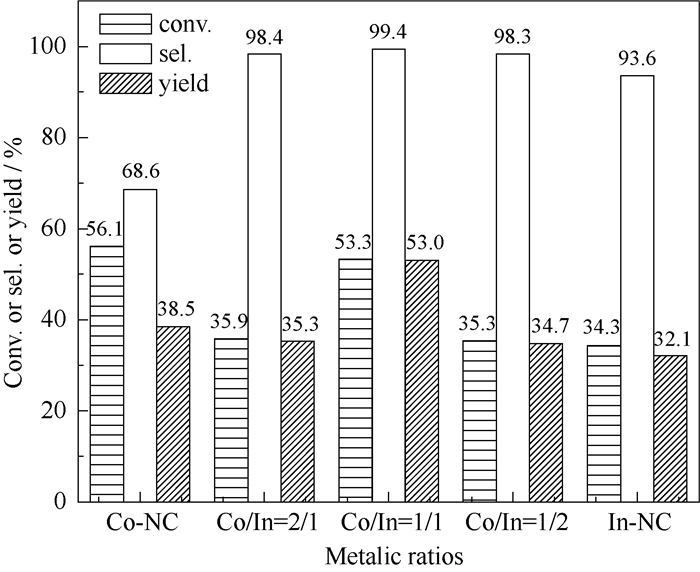
3 实验结果与讨论 3.1 最佳Co/In摩尔比的确定如图 1所示,不掺杂In3+时,Co-NC催化活化PDS氧化环己醇的转化率和选择性分别为56.1%和68.6%,而在掺入In3+后,虽然环己醇转化率有不同程度的下降,但不同比例Co/In-ZIFs基催化剂都维持了90%以上的高环己酮选择性。其中,Co1/In1-NC结合了Co-NC的高转化率和In-NC的高选择性,成为环己酮收率最高的催化剂(>53.0%)。说明Co的存在促进了催化氧化反应的转化率,而In则促进了催化剂的环己酮选择性。因此,以Co/In摩尔比为1∶1的催化剂为主进行后续实验研究。
|
图 1 不同Co/In摩尔比ZIFs基催化剂反应性能 Fig.1 Catalytic performances of ZIFs-based catalysts with different Co/In mol ratios |
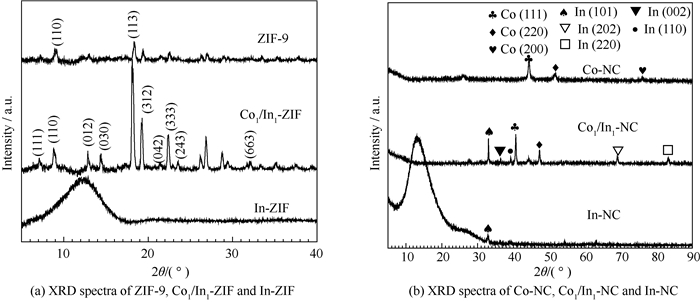
ZIF-9(Co-ZIF)、Co1/In1-ZIF和In-ZIF的XRD谱图如图 2(a)所示,Co1/In1-ZIF在2θ=7.1°、8.9°、12.8°、14.4°、18.1°、19.2°、21.4°、22.3°、23.6°和32.2°处均有峰,分别对应(111)、(110)、(012)、(030)、(113)、(312)、(042)、(333)、(243)和(663)晶面,与具有方钠石(SOD)拓扑结构的ZIF-9相吻合[25-26],说明Co1/In1-ZIF继承了ZIF-9的SOD拓扑结构[27-28]。此外,In-ZIFs的XRD没有明显的特征衍射峰,说明In3+未与苯并咪唑配位形成晶体结构。上述材料在高温碳化后(图 2(b)),Co-NC在2θ=44.26°、51.52°和75.78°处有衍射峰,分别对应金属Co的(111)、(200)和(220)晶面(PDF#44-0962)。没有检测到氧化钴的存在,可能是由于含量较低[29]。Co1/In1-NC检测出了金属Co的(111)晶面,此外,还在2θ=33.0°、36.4°、39.3°、40.5°、47.2°、69.1°、83.4°等处出现了峰,表明有混合金属碳化物Co3InC0.75以及立方相In2O3的形成[30]。相较而言,In-NC只显示出立方相In2O3的生成。
|
图 2 ZIF-9, Co1/In1-ZIF and In-ZIF以及Co-NC、Co1/In1-NC和In-NC的XRD谱图 Fig.2 XRD spectra of ZIF-9, Co1/In1-ZIF and In-ZIF and XRD spectra of Co-NC, Co1/In1-NC and In-NC |
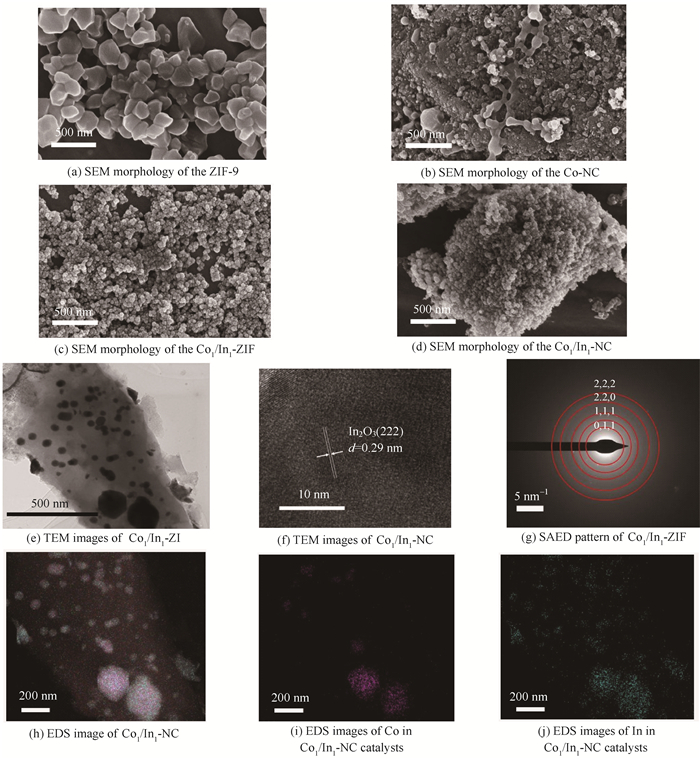
利用SEM和TEM表征了ZIF-9、Co1/In1-ZIFs及其热解产物的形貌。如图 3(a)所示,ZIF-9呈现出不规则的纳米颗粒,粒径约为190.8 nm,而掺入In之后,Co1/In1-ZIF纳米颗粒(图 3(c))的尺寸大幅减小,约为38.9 nm。这说明掺入In3+抑制了ZIF-9颗粒的生长。图 3(b)、(d)显示,ZIF-9和Co1/In1-ZIF材料在N2气氛下热解之后,其颗粒都出现了不同程度的收缩。高温热解后的Co-NC中少量保留了ZIF-9的形貌。相反,Co1/In1-ZIF的形貌结构在Co1/In1-NC(图 3(c)、(d))中得到较大程度的保留。Co1/In1-ZIF热解后的粒径从38.9 nm(图 3(c))减小到36.4 nm(图 3(d))。利用透射电镜(TEM)进一步观察Co1/In1-NC的形貌结构,如图 3(e)所示,Co1/In1-NC中的金属纳米颗粒较为均匀地分散在炭表面。高分辨图像(图 3(f))中可以看出,金属晶格间距d=0.29 nm,与之对应的是In2O3的(222)晶面[31-32]。此外,如图 3(g)所示,Co1/In1-NC的选区电子衍射显示(011)、(111)、(020)、(220)和(222)晶面,其中,(111)和(220)晶面分别对应Co和In金属,这与XRD结果相一致。Co1/In1-NC的元素分布显示Co1/In1-NC表面N、Co、In元素均匀地分布在炭表面。
|
图 3 ZIF-9 (a)、Co-NC (b)、Co1/In1-ZIF (c)和Co1/In1-NC (d)的SEM图、Co1/In1-NC的TEM图(e-f)、SAED图(g)以及EDS元素分布图(h-j) Fig.3 SEM images of ZIF-9 (a), Co-NC (b), Co1/In1-ZIF (c) and Co1/In1-NC (d), TEM images of Co1/In1-NC (e-f), SAED pattern(g) and EDS elemental mappings(h-j) of Co1/In1-NC |
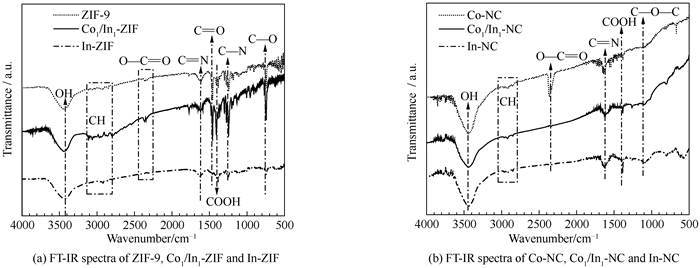
利用傅里叶变换红外光谱(FT-IR)检测不同ZIFs及其热解产物的表面官能团。如图 4(a)所示,所有样品在1 621.8 cm-1处均出现特征峰,为咪唑结构的C=N振动峰[33]。位于1 457.9、1 382.7、1 245.8、744.4 cm-1的特征峰,分别对应C=O、COOH、C—N、C—O[34]。样品热解之后的红外吸收光谱(图 4(b))在1 646.9、1 382.7、1 115.2 cm-1处出峰,表明材料表面存在C=N、COOH、C—O—C官能团[35]。
|
图 4 不同ZIFs及其热解产物的红外光谱图 Fig.4 FT-IR spectra of ZIFs precursors and carbonized products |
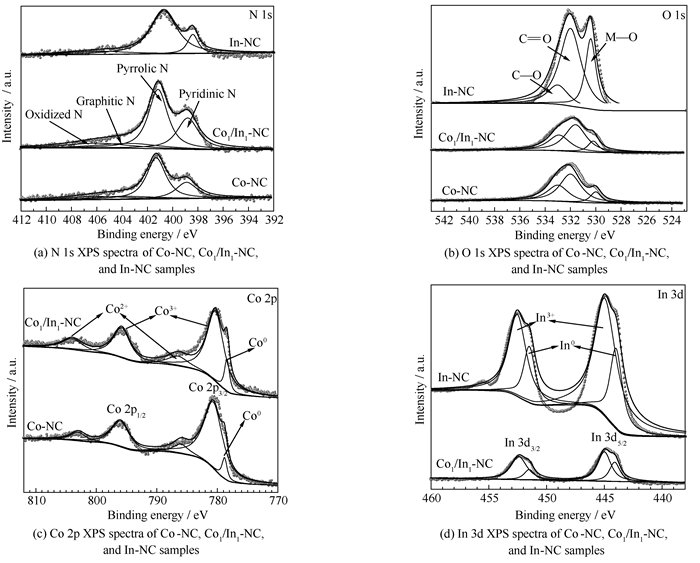
用XPS测定了Co-NC、Co1/In1-NC和In-NC的化学组成和表面元素价态。如图 5(a)所示,N 1s谱图在401.1 eV和308.8 eV处的强峰分别对应吡咯N和吡啶N,但催化剂样品表面没有出现金属(Me)—N键,这说明Co1/In1-NC表面的Co/In金属不是以Me—N键锚定在炭材料表面。O 1s谱图(图 5(b))在530.1、531.6、533.1 eV左右出现3个峰,分别对应金属(Me)—O、C=O、C—O。Co 2p谱图(图 5(c))在780.7 eV (Co 2p3/2)和796.3 eV(Co 2p1/2)的峰归属于Co3+,而在786.1 eV (Co 2p3/2)和802.9 eV (Co 2p1/2) 的峰归属于Co2+。此外,还出现了Co0的峰,位于778.8 eV (Co 2p3/2)[36]。而在In 3 d谱图(图 5(d))中,分别位于444.8 eV (In 3d5/2)和452.5 eV(In 3d3/2)的峰归属于In3+,而分别位于443.9 eV (In 3d5/2)和451.5 eV (In 3d3/2) 的峰归属于In0[37],说明在热解过程中,部分金属离子被还原。
|
图 5 Co-NC、Co1/In1-NC和In-NC的N 1s(a)、O 1s(b)、Co 2p(c)和In 3d(d) 高分辨XPS谱图 Fig.5 N 1s(a), O 1s (b), Co 2p (c), and In 3d (d) XPS spectra of Co-NC, Co1/In1-NC, and In-NC samples |
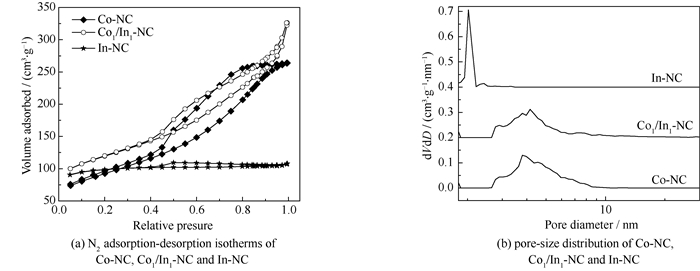
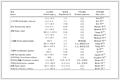
如图 6所示,In-NC的N2吸附/解吸等温线为经典的Ⅰ型等温线,说明In-NC的孔道以微孔为主。Co-NC和Co1/In1-NC的吸附/解吸等温线均为典型的Ⅰ型和Ⅳ型等温线组合,具有明显的滞后回环,说明样品以微孔和介孔为主。Co-NC、Co1/In1-NC和In-NC的BET比表面积分别是327.0、428.6、303.0 m2·g-1(表 1),可以看出,随着In3+掺入ZIF-9,热解得到催化剂的比表面积和总孔容均有增加。
|
图 6 Co-NC、Co1/In1-NC和In-NC的N2吸附解吸等温线和孔径分布 Fig.6 N2 adsorption-desorption isotherms and pore-size distribution of Co-NC、Co1/In1-NC and In-NC |
|
表 1 样品的比表面积和孔容 Table 1 BET surface area and pore volumes of the samples |
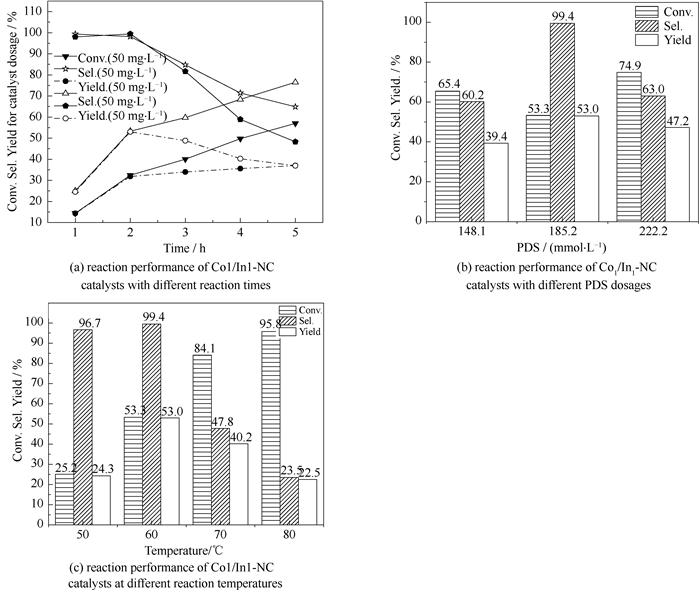
首先研究了Co1/In1-NC/PDS/水体系中反应时间、催化剂投加量、PDS浓度和反应温度对选择性氧化环己醇的影响。如图 7(a)所示,催化剂质量浓度分别为50 mg·L-1和100 mg·L-1时,反应开始2 h内,保持了98%以上的高环己酮选择性,反应进行到2 h时,转化率分别为32.4%和53.3%,收率分别为31.8%和53.0%,说明反应转化率与催化剂活性位点数目正相关。当反应时间进行到5 h时,100 mg·L-1催化剂反应体系的选择性锐减至48.3%,转化率则增加到76.6%,而收率下降至36.9%。50 mg·L-1催化剂反应体系在2~5 h内的选择性从98.2%降至64.9%,转化率则从32.4%升至57.0%,收率下降至37.0%。这可能由于体系中的酸性环境逐渐破坏了金属活性位点,溶出的Co2+和In3+参与活化PDS,释放大量ROS。这不仅破坏了溶液中自由基和1O2等活性物种原有的比例,同时也加强了体系矿化环己醇/环己酮的速率,使反应选择性随时间推移大幅下降,转化率随时间逐步上升。此外,通过改变Co1/In1-NC/PDS/水体系中的PDS浓度观察了反应效果(图 7(b)),发现催化剂的环己酮选择性和收率在PDS浓度为185.2 mmol·L-1时达到最佳,分别为99.4%和53.0%。进一步增大PDS的加入量,虽然环己醇转化率上升,环己酮的选择性和收率均有下降,可能是由于PDS量过高时,产生的ROS过大,环己酮被进一步氧化。同样,调变反应温度(图 7(c)),可发现Co1/In1-NC/PDS/水体系在50~60 ℃时可以保持96%以上的高选择性,但温度达到80 ℃时,反应选择性大幅降低至23.5%。这是因为高温不仅会加强催化剂对PDS的活化速率,也会增加溶液中活性物质对环己醇/环己酮的氧化深度。
|
图 7 不同反应时间、PDS投加量和反应温度下Co1/In1-NC催化活化过硫酸盐氧化环己醇性能 Fig.7 Effect of time, PDS dosages and temperatures on the oxidation of cyclohexanol Reaction conditions: [cyclohexanol]=103.2 mmol·L-1, [PDS]=185.2 mmol·L-1, T= 60 ℃, t= 2 h, [catalyst]=100 mg·L-1 |
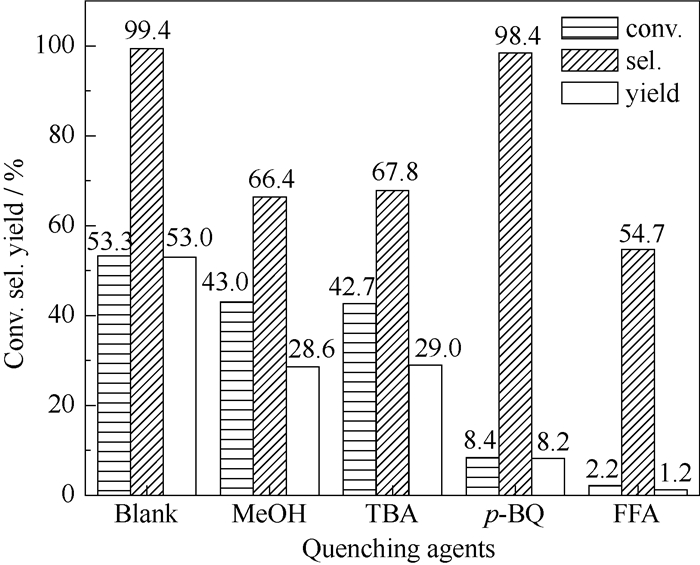
在Co1/In1-NC/PDS体系中,·SO4-、·OH等自由基和非自由基1O2可能同时存在。为确定Co1/In1-NC活化PDS产生的活性物种,进行了淬灭实验。如图 8所示,选择甲醇(MeOH)猝灭·OH和·SO4-,用TBA、p-BQ和FFA分别猝灭·OH、·O2-和1O2[38-39]。可以看出,当MeOH/PDS的摩尔比为10/1时,Co/In-NC/PDS体系中环己醇转化率降低了10.3%,环己酮选择性降低了33.0%。当加入相同摩尔比的TBA和FFA时,环己醇转化率分别下降了10.6%和51.1%,而环己酮的选择性分别降低了31.6%和44.7%。p-BQ则不同,其加入几乎没有改变环己酮的选择性,但环己醇转化率降低了44.9%。这表明Co1/In1-NC/PDS/水反应体系对环己醇的氧化是多种ROS共同作用的结果。
|
图 8 自由基猝灭剂对环己醇氧化的影响 Fig.8 Effect of free radical quenching agents on the oxidation of cyclohexanol Reaction conditions: [cyclohexanol] = 103.2 mmol·L-1, [PDS] = 185.2 mmol·L-1, T= 60 ℃, t= 2 h, [catalyst] = 100 mg·L-1, molar ratio of bursting agent/PDS = 10/1 |
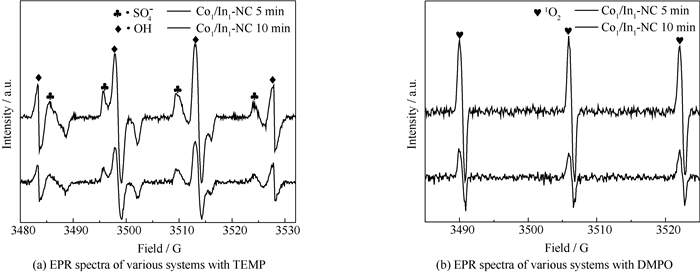
采用EPR检测了Co1/In1-NC/PDS系统中的ROS,如图 9所示。分别使用5, 5-二甲基-1-氧化吡咯啉(DMPO)作为捕获剂检测·OH和·SO4-自由基,用2, 2, 6, 6-四甲基-4-哌啶醇(TEMP)作为捕获剂检测1O2物种。由图 9(a)可以看出,所得信号为峰高1∶2∶2∶1的四重峰,每重峰的高、低两部分分别代表DMPO-·OH和DMPO-·SO4-,表明反应体系中存在·OH和·SO4-自由基。而图 9(b)呈现出强度为1∶1∶1的特征三重峰,对应TEMP-1O2的存在。此外,·OH、·SO4-和1O2的信号随反应时间由5 min增加到10 min,其强度明显增强,说明·OH、·SO4-和1O2均参与了氧化环己醇的反应。
|
图 9 以TEMP(a)和DMPO(b)为自由基捕获剂的不同体系EPR谱图 Fig.9 EPR spectra of various systems with TEMP (a) and DMPO (b) as spin trapping agents Reaction conditions: [cyclohexanol] = 103.2 mmol·L-1, [PDS] = 185.2 mmol·L-1, T= 60 ℃, t = 10 min, [catalyst] = 100 mg·L-1, molar ratio of bursting agent/PDS = 10/1 |
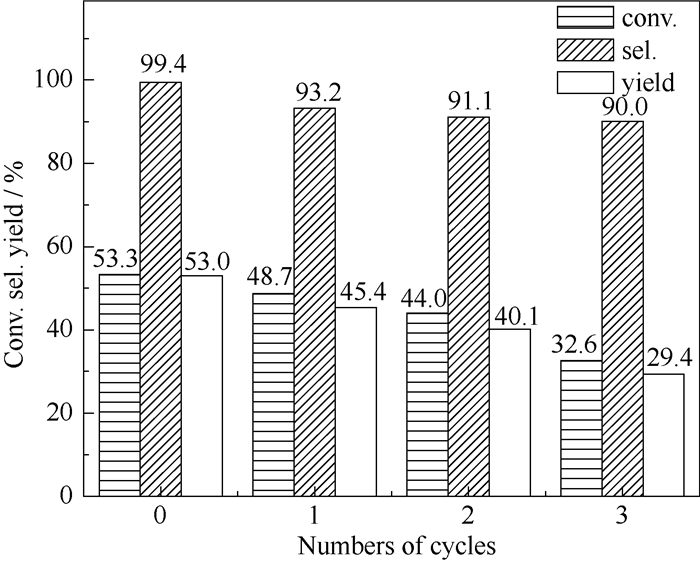
利用Co1/In1-NC的磁性回收反应后的催化剂,用乙醇洗涤3次,干燥后重新投入使用。如图 10所示,循环反应3次后Co1/In1-NC/PDS体系对环己醇的转化率从53.3%缓慢下降至32.6%,而环己酮选择性依旧保持在90.0%。对比催化剂反应前后的金属含量(表 2),可以发现Co1/In1-NC中的Co含量在3次循环反应后从11.73 mg·g-1大幅降低到6.91 mg·g-1,而In含量仅从32.03 mg·g-1降低至26.64 mg·g-1。同等反应条件下Co1/In1-NC中Co溶出的量是In的1.74倍。这说明催化剂中的Co元素主导环己醇转化率,而In元素主导环己酮选择性。而由于Co元素流失速率远快于In,所以Co1/In1-NC/PDS体系对环己酮选择性的循环稳定性优于环己醇的转化率。
|
图 10 Co1/In1-NC的循环稳定性 Fig.10 Cycle experiment results of Co1/In1-NC Reaction conditions: [cyclohexanol] = 103.2 mmol·L-1, [PDS] = 185.2 mmol·L-1, T= 60 ℃, t = 2 h, [catalyst] = 100 mg·L-1 |
|
|
表 2 Co1/In1-NC反应前后金属含量 Table 2 Metal content of Co1/In1-NC before and after reaction |
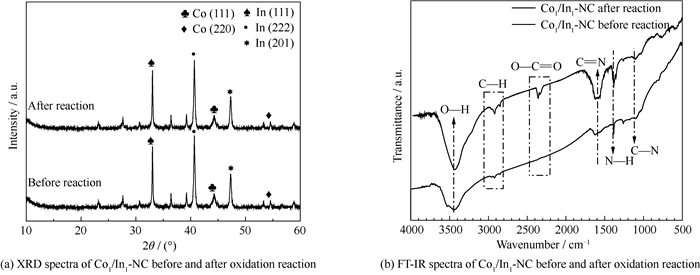
在反应多次循环后,对Co1/In1-NC进行了XRD和FT-IR分析。从图 11(a)的结果来看,Co1/In1-NC的XRD峰位置几乎没有变化,而强度略有下降,表明催化剂的结构较为稳定。反应后Co1/In1-NC的FT-IR结果如图 11(b)所示,可以看出,反应后Co1/In1-NC在2 362.4 cm-1处出现明显的O—C=O峰,是氧化反应所致。
|
图 11 Co1/In1-NC反应前后的XRD谱图和FT-IR谱图 Fig.11 XRD spectra and FT-IR spectra before and after the Co1/In1-NC reaction |
催化剂中Co0/Co2+、In0作为电子供体,促使电子转移到PDS中,激活其过氧化键(—O—O—)断裂(式(4)~(8)),生成的·SO4-被水解为·OH和SO42- (式(9)~(14))。根据上述分析,掺杂的Co2+、In3+相互协同参加了催化氧化环己醇的反应,氧化途径既有自由基,也有非自由基,可能的机理如下[40-41]。
| $\mathrm{Co}^0+\mathrm{S}_2 \mathrm{O}_8{ }^{2-} \rightarrow \mathrm{Co}^{2+}+\cdot \mathrm{SO}_4{ }^{-}+\mathrm{SO}_4{ }^{2-} $ | (4) |
| $\mathrm{Co}^{2+}+\mathrm{S}_2 \mathrm{O}_8{ }^{2-} \rightarrow \mathrm{Co}^{3+}+\cdot \mathrm{SO}_4{ }^{-}+\mathrm{SO}_4{ }^{2-}$ | (5) |
| $\mathrm{S}_2 \mathrm{O}_8{ }^{2-}+e^{-} \rightarrow \cdot \mathrm{SO}_4{ }^{-}+\mathrm{SO}_4{ }^{2-} $ | (6) |
| $\mathrm{Co}^{3+}+\mathrm{S}_2 \mathrm{O}_8{ }^{2-}+2 \mathrm{H}_2 \mathrm{O} \rightarrow \mathrm{Co}^{2+}+2 \mathrm{SO}_4{ }^{2-}+\cdot \mathrm{O}_2{ }^{-}+4 \mathrm{H}^{+}$ | (7) |
| $\mathrm{Co}^0+2 \mathrm{Co}^{3+} \rightarrow 3 \mathrm{Co}^{2+} $ | (8) |
| $\cdot \mathrm{SO}_4^{-}+\mathrm{H}_2 \mathrm{O} \rightarrow \mathrm{SO}_4^{2-}+\cdot \mathrm{OH}+\mathrm{H}^{+}$ | (9) |
| $\mathrm{In}^0+3 \cdot \mathrm{SO}_4^{-} \rightarrow \mathrm{In}^{3+}+3 \mathrm{SO}_4^{2-} $ | (10) |
| $\cdot \mathrm{SO}_5^{-}+\mathrm{H}_2 \mathrm{O} \rightarrow \cdot \mathrm{O}_2^{-}+\mathrm{SO}_4^{2-}+\mathrm{H}^{+} $ | (11) |
| $\cdot \mathrm{O}_2^{-}+2 \mathrm{H}_2 \mathrm{O} \rightarrow{ }^1 \mathrm{O}_2+\mathrm{H}_2 \mathrm{O}_2$ | (12) |
| $\cdot \mathrm{O}_2^{-}+2 \cdot \mathrm{OH} \rightarrow{ }^1 \mathrm{O}_2+2 \mathrm{H}_2 \mathrm{O}$ | (13) |
| $\mathrm{Co}^{2+}+\mathrm{H}_2 \mathrm{O}_2+\mathrm{H}^{+} \rightarrow \mathrm{Co}^{3+}+\cdot \mathrm{OH}+\mathrm{H}_2 \mathrm{O}$ | (14) |
(1) 以ZIF-9为模板,引入In元素掺杂,在惰性气氛下高温碳化制备了Co、In纳米颗粒均匀分布的Co1/In1-NC催化剂。表征分析发现,Co1/In1-NC表面含有C=N、COOH和C—O—C官能团,以及Co3+/Co2+/Co0和In3+/In0,其N2吸脱附等温线为典型的Ⅳ型曲线,比表面积为428.6 m2·g-1。研究了不同Co/In比催化剂的环己醇氧化性能,结果表明,在Co/In=1/1时得到的催化剂性能最优。在最佳反应条件下,100 mg·L-1催化剂和185.2 mmol·L-1的PDS在2 h内可将103.2 mmol·L-1的环己醇高效转化成环己酮,转化率和选择性分别达到55.3%和99.4%。同时,Co1/In1-NC催化剂循环3次后对环己酮的选择性仍保持在90%以上。
(2) 猝灭实验及EPR测试发现,Co1/In1-NC/PDS/水体系中活性物种主要为·OH、·SO4-、·O2-和1O2。其中·O2-自由基和1O2主导了环己醇的转化率,而·OH和1O2则主导了环己酮的选择性。通过XRD、FT-IR等表征了反应前后Co1/In1-NC催化剂的晶体结构和表面性质变化。此外,结合氧化反应性能推测了Co1/In1-NC催化活化PDS生成ROS的机理。
| [1] |
WU Y M, ZHAO J H, WANG C H, et al. Electrosynthesis of a nylon-6 precursor from cyclohexanone and nitrite under ambient conditions[J]. Nature Communications, 2023, 14(1): 3057. DOI:10.1038/s41467-023-38888-6 |
| [2] |
SHARP J, CIOTTI A, ANDREWS H, et al. Sustainable electrosynthesis of cyclohexanone oxime through nitrate reduction on a Zn-Cu alloy catalyst[J]. ACS Catalysis, 2024, 14(5): 3287-3297. DOI:10.1021/acscatal.3c05388 |
| [3] |
WU Y D, CHEN W, JIANG Y M, et al. Electrocatalytic synthesis of Nylon-6 precursor at almost 100%yield[J]. Angewandte Chemie, 2023, 135(30): e202305491. DOI:10.1002/ange.202305491 |
| [4] |
ZHANG Z H, XUE J Y, SUN Z W, et al. Development and comparison of substrate-supplied and product-convergent redox-neutral cascade reactions for the sustainable synthesis of lactones[J]. ACS Sustainable Chemistry & Engineering, 2023, 11(28): 10380-10390. |
| [5] |
YUAN E X, YU Y L, SHI G J, et al. Fabrication of single Co sites in graphitic carbon nitride via the ion exchange to boost aerobic cyclohexane oxidation[J]. Carbon, 2024, 217: 118612. DOI:10.1016/j.carbon.2023.118612 |
| [6] |
WU R Z, MENG Q L, YAN J, et al. Electrochemical strategy for the simultaneous production of cyclohexanone and benzoquinone by the reaction of phenol and water[J]. Journal of the American Chemical Society, 2022, 144(4): 1556-1571. DOI:10.1021/jacs.1c09021 |
| [7] |
GAO Y N, HENSEN E J M. Gas-phase selective oxidation of cyclohexanol to cyclohexanone over Au/Mg1-xCuxCr2O4 catalysts: On the role of Cu doping[J]. Journal of Catalysis, 2020, 384: 218-230. DOI:10.1016/j.jcat.2020.02.025 |
| [8] |
VOMERI A, STUCCHI M, VILLA A, et al. New insights for the catalytic oxidation of cyclohexane to K-A oil[J]. Journal of Energy Chemistry, 2022, 70: 45-51. DOI:10.1016/j.jechem.2022.02.008 |
| [9] |
PORWAL G, GUPTA S, SREEDHALA S, et al. Mechanistic insights into the pathways of phenol hydrogenation on Pd nanostructures[J]. ACS Sustainable Chemistry & Engineering, 2019, 7(20): 17126-17136. |
| [10] |
GAO Y N, ZHANG L, VAN HOOF A J F, et al. A robust Au/ZnCr2O4 catalyst with highly dispersed gold nanoparticles for gas-phase selective oxidation of cyclohexanol to cyclohexanone[J]. ACS Catalysis, 2019, 9(12): 11104-11115. DOI:10.1021/acscatal.9b02821 |
| [11] |
XU S R, ZHONG G Y, QU L X, et al. Unprecedented selective aerobic oxidation of alcohols to carbonyl compounds over drilled carbon nanotubes assisted with Fe(NO3)3[J]. ACS Sustainable Chemistry & Engineering, 2022, 10(23): 7564-7575. |
| [12] |
LAN X F, WANG S Y, ZHANG H T, et al. Pd-Cu/SiO2 catalyzed efficient hydrogen transfer of cyclohexanol and furfural platforms into cyclohexanone and furfuryl alcohol[J]. Fuel, 2024, 366: 131278. DOI:10.1016/j.fuel.2024.131278 |
| [13] |
CARABINEIRO S A C, MARTINS L M D R S, AVALOS-BORJA M, et al. Gold nanoparticles supported on carbon materials for cyclohexane oxidation with hydrogen peroxide[J]. Applied Catalysis A (General), 2013, 467: 279-290. DOI:10.1016/j.apcata.2013.07.035 |
| [14] |
WEI J F, SHI X Y, HE D P, et al. Organic solvent- and phase transfer catalyst-free oxidation of cyclohexanol to cyclohexanone with dilute H2O2[J]. Chinese Science Bulletin, 2002, 47(24): 2060-2062. DOI:10.1360/02tb9446 |
| [15] |
ZHANG T, ZHU H B, CROUÉ J P. Production of sulfate radical from peroxymonosulfate induced by a magnetically separable CuFe2O4 spinel in water: Efficiency, stability, and mechanism[J]. Environmental Science & Technology, 2013, 47(6): 2784-2791. |
| [16] |
LI J Q, ZHAO S Y, YANG S Z, et al. Atomically dispersed cobalt on graphitic carbon nitride as a robust catalyst for selective oxidation of ethylbenzene by peroxymonosulfate[J]. Journal of Materials Chemistry A, 2021, 9(5): 3029-3035. DOI:10.1039/D0TA11503G |
| [17] |
LI J Q, LI F P, YANG Q, et al. Tailoring collaborative N-O functionalities of graphene oxide for enhanced selective oxidation of benzyl alcohol[J]. Carbon, 2021, 182: 715-724. DOI:10.1016/j.carbon.2021.06.062 |
| [18] |
OLIVEIRA R L, NICINSKI K, PISAREK M, et al. Porous heteroatom-doped carbons: Efficient catalysts for selective oxidation of alcohols by activated persulfate[J]. ChemCatChem, 2022, 14(20): e202200787. DOI:10.1002/cctc.202200787 |
| [19] |
GHANBARI F, MORADI M. Application of peroxymonosulfate and its activation methods for degradation of environmental organic pollutants: Review[J]. Chemical Engineering Journal, 2017, 310: 41-62. DOI:10.1016/j.cej.2016.10.064 |
| [20] |
CHOONG Z Y, LIN K Y A, LISAK G, et al. Multi-heteroatom-doped carbocatalyst as peroxymonosulfate and peroxydisulfate activator for water purification: A critical review[J]. Journal of Hazardous Materials, 2022, 426: 128077. DOI:10.1016/j.jhazmat.2021.128077 |
| [21] |
ZHANG X, YAN X L, HU X Y, et al. Efficient removal of organic pollutants by a Co/N/S-doped yolk-shell carbon catalyst via peroxymonosulfate activation[J]. Journal of Hazardous Materials, 2022, 421: 126726. DOI:10.1016/j.jhazmat.2021.126726 |
| [22] |
LI X M, YAN X L, HU X Y, et al. Hollow Cu-Co/N-doped carbon spheres derived from ZIFs as an efficient catalyst for peroxymonosulfate activation[J]. Chemical Engineering Journal, 2020, 397: 125533. DOI:10.1016/j.cej.2020.125533 |
| [23] |
ZHANG T, CHEN Y, WANG Y R, et al. Efficient peroxydisulfate activation process not relying on sulfate radical generation for water pollutant degradation[J]. Environmental Science & Technology, 2014, 48(10): 5868-5875. |
| [24] |
LI D H, ZHANG S X, LI S N, et al. Mechanism of the application of single-atom catalyst-activated PMS/PDS to the degradation of organic pollutants in water environment: A review[J]. Journal of Cleaner Production, 2023, 397: 136468. DOI:10.1016/j.jclepro.2023.136468 |
| [25] |
LEE D Y, YOON S J, SHRESTHA N K, et al. Unusual energy storage and charge retention in Co-based metal-organic-frameworks[J]. Microporous and Mesoporous Materials, 2012, 153: 163-165. DOI:10.1016/j.micromeso.2011.12.040 |
| [26] |
RAKAP M, ÖZKAR S. Hydrogen generation from the hydrolysis of ammonia-borane using intrazeolite cobalt(0) nanoclusters catalyst[J]. International Journal of Hydrogen Energy, 2010, 35(8): 3341-3346. DOI:10.1016/j.ijhydene.2010.01.138 |
| [27] |
CAO S, LU Y B, TANG Y J, et al. Constructing ion-transport blockchain by polypyrrole to link CoTi-ZIF-9 derived carbon materials for high-performance seawater desalination[J]. Journal of Colloid and Interface Science, 2024, 654: 466-475. DOI:10.1016/j.jcis.2023.10.065 |
| [28] |
WU Q, ZHAO X L, ZHOU T Q, et al. A metal-organic framework-based electrocatalytic membrane boosts redox kinetics of lithium-sulfur batteries[J]. Journal of Energy Storage, 2023, 72: 108596. |
| [29] |
XU Y, SHAN W X, LIANG X, et al. Cobalt nanoparticles encapsulated in nitrogen-doped carbon shells: Efficient and stable catalyst for nitrobenzene reduction[J]. Industrial & Engineering Chemistry Research, 2020, 59(10): 4367-4376. |
| [30] |
PUSTOVARENKO A, DIKHTIARENKO A, BAVYKINA A, et al. Metal-organic framework-derived synthesis of cobalt indium catalysts for the hydrogenation of CO2 to methanol[J]. ACS Catalysis, 2020, 10(9): 5064-5076. DOI:10.1021/acscatal.0c00449 |
| [31] |
SUZUKI R, NISHI Y, MATSUBARA M, et al. Single-crystalline protrusion-rich indium tin oxide nanoparticles with colloidal stability in water for use in sustainable coatings[J]. ACS Applied Nano Materials, 2020, 3(5): 4870-4879. |
| [32] |
FRANZMAN M A, PÉREZ V, BRUTCHEY R L. Peroxide-mediated synthesis of indium oxide nanocrystals at low temperatures[J]. The Journal of Physical Chemistry C, 2009, 113(2): 630-636. |
| [33] |
LI Q M, KIM H. Hydrogen production from NaBH4 hydrolysis via Co-ZIF-9 catalyst[J]. Fuel Processing Technology, 2012, 100: 43-48. |
| [34] |
EBRAHIMI Z, RAD M, SAFARIFARD V, et al. Solvent-assisted ligand exchange as a post-synthetic surface modification approach of Zn-based (ZIF-7, ZIF-8) and Co-based (ZIF-9, ZIF-67) zeolitic frameworks for energy storage application[J]. Journal of Molecular Liquids, 2022, 364: 120018. |
| [35] |
DENG Y Q, LIU Y, CHEN Y J, et al. Carbon neutral via catalytic transformation of CO2 into cyclic carbonates by an imidazolium-based ionic zeolitic imidazolate frameworks[J]. Applied Surface Science, 2023, 614: 156250. |
| [36] |
JAYARAMULU K, MASA J, MORALES D M, et al. Ultrathin 2D cobalt zeolite-imidazole framework nanosheets for electrocatalytic oxygen evolution[J]. Advanced Science, 2018, 5(11): 1801029. |
| [37] |
XU H J, WANG L, ZHONG J, et al. Ultra-stable and high-rate lithium ion batteries based on metal-organic framework-derived In2O3 nanocrystals/hierarchically porous nitrogen-doped carbon anode[J]. Energy & Environmental Materials, 2020, 3(2): 177-185. |
| [38] |
ZHANG Y F, WEI J, XING L Y, et al. Superoxide radical mediated persulfate activation by nitrogen doped bimetallic MOF (FeCo/N-MOF) for efficient tetracycline degradation[J]. Separation and Purification Technology, 2022, 282: 120124. |
| [39] |
HAN M S, ZHU W K, HOSSAIN M S A, et al. Recent progress of functional metal-organic framework materials for water treatment using sulfate radicals[J]. Environmental Research, 2022, 211: 112956. |
| [40] |
PENG H H, XIONG W P, YANG Z H, et al. Insights into the mechanism of persulfate activation by hollow MOF-derived carbon: Electron transfer-triggered non-radical oxidization for antibiotic removal[J]. Environmental Science: Nano, 2024, 11(1): 216-228. |
| [41] |
HE R N, LUO X, LI L L, et al. Grain boundary and interface interaction of metal (copper/indium) oxides to boost efficient electrocatalytic carbon dioxide reduction into syngas[J]. Journal of Colloid and Interface Science, 2024, 658: 1016-1024. |